


By now advisors have heard of the growing interest in international equities, and for good reason — lots of investors are looking for return that isn’t significantly exposed to U.S. equities teetering from rising rates and bank crisis volatility. For those looking to get deeper into the subject, recent research from Richard Bernstein Advisors (RBA) offers advisors an opportunity to compare U.S. and international equities and understand RBA’s view on approaching the market overall this year.
RBA’s investment approach prioritizes the profits cycle, investing on a fundamentals-driven, top-down basis and looking at three key factors in profits, liquidity, and sentiment. Those factors help frame RBA’s overall thinking, with its recent research emphasizing two key drivers behind the difference in international and U.S. equities, which typically differ by more than 10 percentage points in a “typical year.”
See more: Stock Picking Is Risky – Look to Profit Cycles Instead
One of those factors to watch is tech stocks. International markets are much less exposed to tech stocks. While the U.S. equities market is led by megacap tech names like Apple (AAPL) or Microsoft (MSFT), foreign economies are overweight in cyclical areas like financials, materials and industrials.
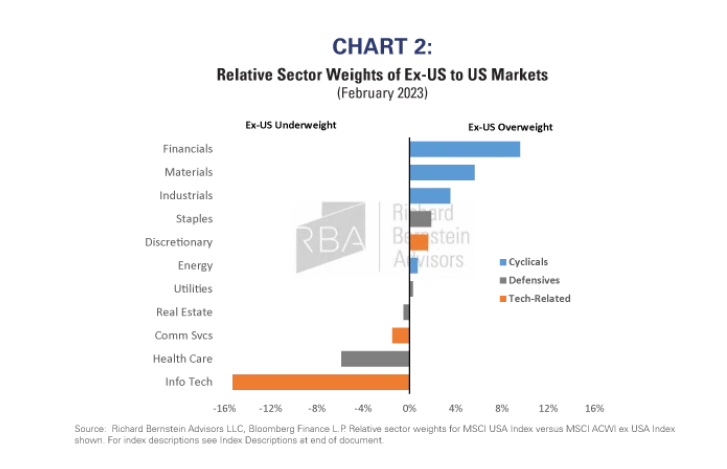
Given that the monetary policy and liquidity background has changed, tech stocks have become much less attractive, especially when comparing their valuations to firm valuations in international settings.
Sectors aren’t the only factor here, though. While regional and country equity markets have moved in parallel for several years, they may be diverging despite globalization — the same sector can perform very differently in different regions. Consumer discretionary stocks were down last year in the U.S. by about 38%, but only down by 21% in Europe. What’s more, “deglobalization” driven by the pandemic and geopolitical strife like Russia’s war in Ukraine may driven this trend further.
Furthermore, as mentioned above, concerns about the Federal Reserve and how its campaign against inflation is draining liquidity are certainly top of mind for investors and advisors. While the bank’s fight dominates market news in the U.S., international economics have done a lot of the hard monetary work already after the pandemic; add in tightening credit lines amid the bank crisis in the U.S., and the comparison leans even more towards foreign credit environments.
All of those reasons, and the ongoing trend of cheaper valuations abroad, invite investors to compare U.S. and international equities as they look at their ETF options — with RBA’s iMGP RBA Responsible Global Allocation ETF (IRBA ) one option. IRBA has a go-anywhere approach not only for assets, mixing fixed income and equities, but also geography.
IRBA has outperformed some of its multi-asset rivals YTD, like the SPDR SSGA Multi-Asset Real Return ETF (RLY) by 349 basis points in that time frame. Charging 69 basis point and actively adding a sustainability screen, it could be a tool to consider for those looking to compare U.S. and international equities right now and diversify from there.
For more news, information, and analysis from Richard Bernstein and the whole team at RBA, visit the Richard Bernstein Advisors Channel.

