

ETFdb Logo
  • ETF Database
  • Content Hubs
    • Themes
      • Active ETF
      • Alternatives
      • Artificial Intelligence
      • China Insights
      • Core Strategies
      • Crypto
      • Disruptive Technology
      • Energy Infrastructure
      • ETF Building Blocks
      • ETF Investing
      • ETF Strategist
      • Financial Literacy
      • Fixed Income
      • Free Cash Flow
      • Future ETFs
      • Innovative ETFs
      • Institutional Income Strategies
      • Leveraged & Inverse
      • Market Insights
      • Market Outlooks
      • Modern Alpha
      • Nuclear Energy
      • Portfolio Strategies
      • Sector Investing
      • Tax Efficient Income
      • Thematic Investing
    • Asset Class
      • Equity
        • U.S. Equity
        • Int'l Developed
        • Emerging Market Equities
      • Alternatives
        • Gold/Silver/Critical Materials
        • Cryptocurrency
        • Currency
        • Volatility
      • Fixed Income
        • Investment Grade Corporates
        • US Treasuries & TIPS
        • High Yield Corporates
        • Int'l Fixed Income
    • ETF Ecosystem
    • ETFs in Canada
    • Crypto ETF Hub
  • Tools
    • ETF Screener
    • ETF Country Exposure Tool
    • ETF Database Categories
    • Indexes
    • Scenario Analysis
    • Watchlists
    • Head-To-Head ETF Comparison Tool
    • Mutual Fund To ETF Converter
    • ETF Stock Exposure Tool
    • ETF Issuer Fund Flows
  • Research
    • ETF Education
    • Equity Investing
    • Dividend ETFs
    • Leveraged ETFs
    • Inverse ETFs
    • Index Education
    • Index Insights
    • Top ETF Sectors
    • Top ETF Issuers
    • Top ETF Industries
  • Webcasts
  • Sectors
    • Sector Investing Content Hub
    • XLK
    • XLI
    • XLU
    • XLY
    • XLP
    • XLRE
    • Sector Power Rankings
    • XLE
    • XLC
    • XLF
    • XLV
    • XLB
  • Multimedia
    • ETF 360 Video Series
    • ETF of the Week Podcast
    • Gaining Perspective Podcast
    • ETF Prime Podcast
    • Video
  • Company
    • About VettaFi
  • PRO
    • Pro Content
    • Pro Tools
    • Advanced
    • FAQ
    • Free sign up
    • Login
  1. Beyond Basic Beta Content Hub
  2. How Geographic Changes Affect This Emerging Markets ETF
Beyond Basic Beta Content Hub
Share

How Geographic Changes Affect This Emerging Markets ETF

Tom LydonApr 22, 2019
2019-04-22

Recently, there has been plenty of chatter about upcoming changes to the MSCI Emerging Markets Index and how those alterations will affect emerging markets exchange traded funds (ETFs). As has been widely noted, MSCI said earlier this year it is working toward significantly increasing the allocations of China A-shares, the stocks trading on mainland China, in its international benchmarks.

Additionally, Argentina and Saudi Arabia will join the MSCI Emerging Markets Index later this year. Some emerging markets ETFs that do not track MSCI indexes are also making geographic alterations. That includes the Schwab Fundamental Emerging Markets Large Company ETF (FNDE A).

FNDE tracks the Russell RAFI Emerging Markets Large Company Index. That index “measures the performance of the large company size segment by fundamental overall company scores, which are created using as the universe the emerging markets companies in the FTSE Global Total Cap Index (the parent index),” according to Schwab.

Previously, FNDE followed the the Russell Fundamental Emerging Markets large Company Index, which selected, ranked and weighed components based on fundamental factors like adjusted sales, retained operating cash flow and dividends plus buybacks. However, that benchmark’s parent index was decommissioned, meaning changes for FNDE.
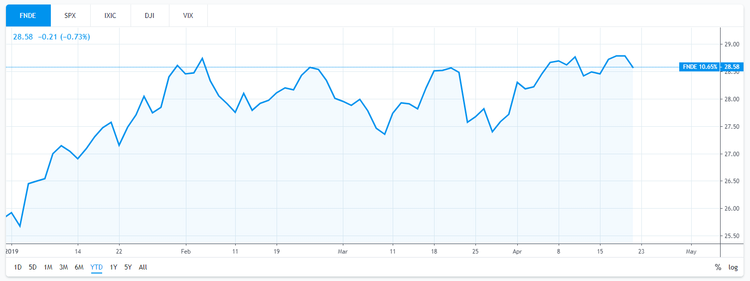
FNDE ETF YTD Performance
FNDE ETF YTD Performance Through April 22, 2019

What’s Next for Category Ratings

“This change resulted in a shakeup of the fund’s country composition that was centered around South Korean stocks,” said Morningstar in a recent note. “The outgoing Russell benchmark classified South Korea as an emerging market, while the incoming FTSE index assigns it developed-markets status. At the rebalance, FNDE’s 19% stake in South Korea went to nil, while stocks from other major markets in the emerging-markets sphere, namely China, Russia, and Taiwan, picked up the slack.”

FTSE Russell has long classified South Korea, Asia’s fourth-largest economy, as a developed market while rival MSCI has kept South Korea in the emerging markets category.

“The transition to a new starting universe and the exclusion of Korean stocks doesn’t change the fund’s ratings,” said Morningstar. “Ultimately, the fund’s fundamental weighting approach is the driver behind our Neutral Process Pillar rating and Analyst Rating of Neutral. This is because fundamental weighting causes the portfolio to overweight risky parts of the emerging-markets universe. Specifically, stocks from the volatile energy and materials sectors make up one third of its holdings. For comparison, stocks from these sectors collectively represent 17% of the cap-weighted FTSE Emerging Index.”

For more on tactical ETFs, visit our Tactical Allocation Channel.


Content continues below advertisement

Loading Articles...

Advertisement

Is Your Portfolio Positioned With Enough Global Exposure?

ETF Education Channel

How to Allocate Commodities in Portfolios

Tom LydonApr 26, 2022
2022-04-26

A long-running debate in asset allocation circles is how much of a portfolio an investor should...

Core Strategies Channel

Why ETFs Experience Limit Up/Down Protections

Karrie GordonMay 13, 2022
2022-05-13

In a digital age where information moves in milliseconds and millions of participants can transact...

}
X
