

ETFdb Logo
  • ETF Database
  • Content Hubs
    • Themes
      • Active ETF
      • Alternatives
      • Artificial Intelligence
      • China Insights
      • Core Strategies
      • Crypto
      • Disruptive Technology
      • Energy Infrastructure
      • ETF Building Blocks
      • ETF Investing
      • ETF Strategist
      • Financial Literacy
      • Fixed Income
      • Free Cash Flow
      • Future ETFs
      • Innovative ETFs
      • Institutional Income Strategies
      • Leveraged & Inverse
      • Market Insights
      • Market Outlooks
      • Modern Alpha
      • Nuclear Energy
      • Portfolio Strategies
      • Sector Investing
      • Tax Efficient Income
      • Thematic Investing
    • Asset Class
      • Equity
        • U.S. Equity
        • Int'l Developed
        • Emerging Market Equities
      • Alternatives
        • Gold/Silver/Critical Materials
        • Cryptocurrency
        • Currency
        • Volatility
      • Fixed Income
        • Investment Grade Corporates
        • US Treasuries & TIPS
        • High Yield Corporates
        • Int'l Fixed Income
    • ETF Ecosystem
    • ETFs in Canada
    • Market Outlook
    • Crypto ETF Hub
  • Tools
    • ETF Screener
    • ETF Country Exposure Tool
    • ETF Database Categories
    • Indexes
    • Scenario Analysis
    • Watchlists
    • Head-To-Head ETF Comparison Tool
    • Mutual Fund To ETF Converter
    • ETF Stock Exposure Tool
    • ETF Issuer Fund Flows
  • Research
    • ETF Education
    • Equity Investing
    • Dividend ETFs
    • Leveraged ETFs
    • Inverse ETFs
    • Index Education
    • Index Insights
    • Top ETF Sectors
    • Top ETF Issuers
    • Top ETF Industries
  • Webcasts
  • Sectors
    • Sector Investing Content Hub
    • XLK
    • XLI
    • XLU
    • XLY
    • XLP
    • XLRE
    • Sector Power Rankings
    • XLE
    • XLC
    • XLF
    • XLV
    • XLB
  • Multimedia
    • ETF 360 Video Series
    • ETF of the Week Podcast
    • Gaining Perspective Podcast
    • ETF Prime Podcast
    • Video
  • Company
    • About VettaFi
  • PRO
    • Pro Content
    • Pro Tools
    • Advanced
    • FAQ
    • Free sign up
    • Login
  1. Beyond Basic Beta Content Hub
  2. Retail Sales Tumble 0.9% in January, Worse Than Expected
Beyond Basic Beta Content Hub
Share

Retail Sales Tumble 0.9% in January, Worse Than Expected

Jennifer NashFeb 14, 2025
2025-02-14

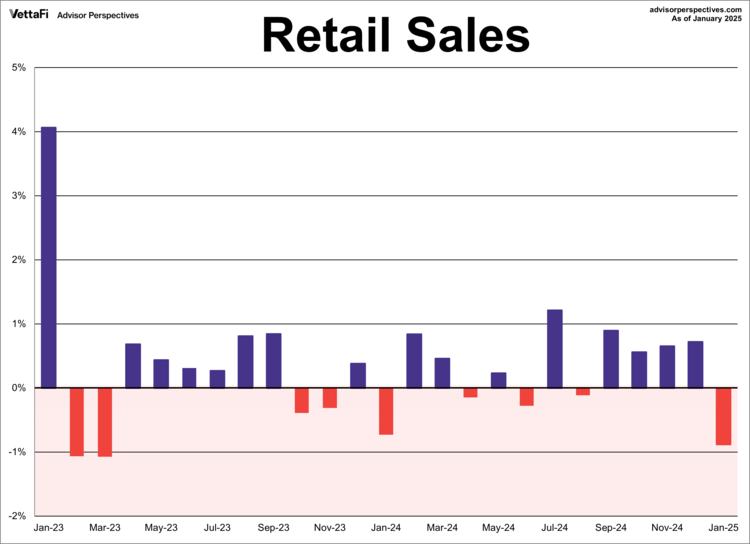
The Census Bureau’s Advance Retail Sales Report for January showed a sharper-than-expected decline, with headline sales falling 0.9%—the largest monthly drop since March 2023 and the first decline in five months. Meanwhile, December’s figures were revised upward to a 0.7% gain. The latest data came in weaker than the anticipated 0.2% drop in consumer spending.

For an inflation-adjusted perspective on retail sales, take a look at our Real Retail Sales commentary.
Here is the introduction

Here is the introduction from today’s report:


Content continues below advertisement

Advance estimates of U.S. retail and food services sales for January 2025, adjusted for seasonal variation and holiday and trading-day differences, but not for price changes, were $723.9 billion, down 0.9 percent (±0.5 percent) from the previous month, and up 4.2 percent (±0.5 percent) from January 2024. Total sales for the November 2024 through January 2025 period were up 4.2 percent (±0.5 percent) from the same period a year ago. The November 2024 to December 2024 percent change was revised from up 0.4 percent (±0.5 percent)* to up 0.7 percent (±0.3 percent). Retail trade sales were down 1.2 percent (±0.5 percent) from December 2024, and up 4.0 percent (±0.5 percent) from last year. Motor vehicle and parts dealers were up 6.4 percent (±1.8 percent) from last year, while food service and drinking places were up 5.4 percent (±1.9 percent) from January 2024.

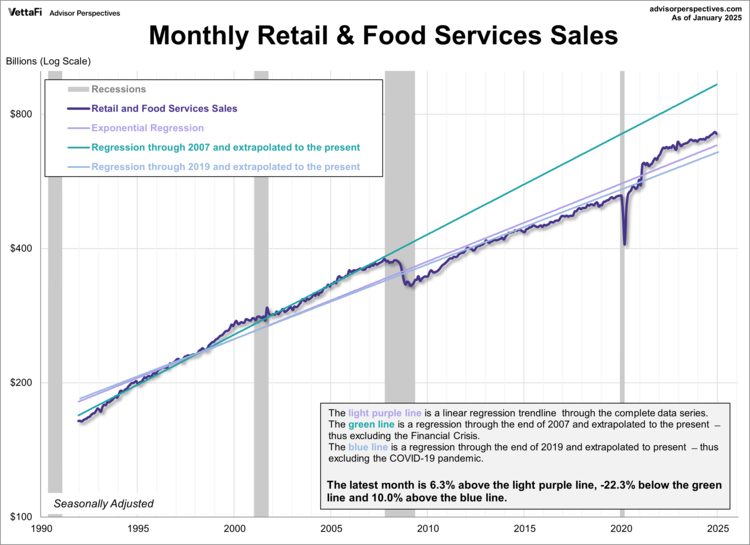
The chart below is a log-scale snapshot of retail sales since the early 1990s. The three exponential regressions through the data help us to evaluate the long-term trend of this key economic indicator.

  1. The light purple line is a linear regression through the complete data series.
  2. The green line is a regression from the start of the series through the end of 2007 and then extrapolated to the present – thus excluding the Financial Crisis.
  3. The blue line is a regression from the start of the series through the end of 2019 and then extrapolated to the present – thus excluding the COVID-19 pandemic.

Monthly retail sales have been above the light purple and blue line since March 2021, signaling increased consumer spending that was most likely pent up as a result of the pandemic.
The year-over-year percent

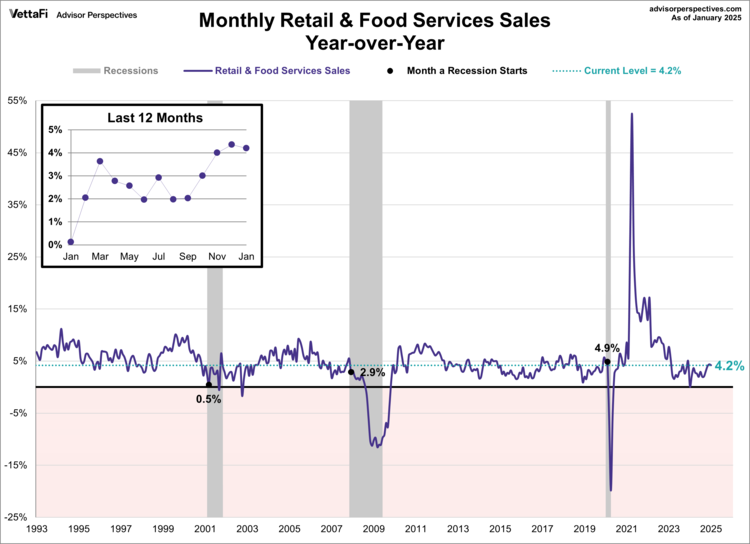
The year-over-year percent change provides another perspective on the historical trend. Current retail sales are up 4.2% compared to January 2024. Here is the headline series with a callout to the most recent 12 months.
Year over Year Monthly Retail

Core Retail Sales

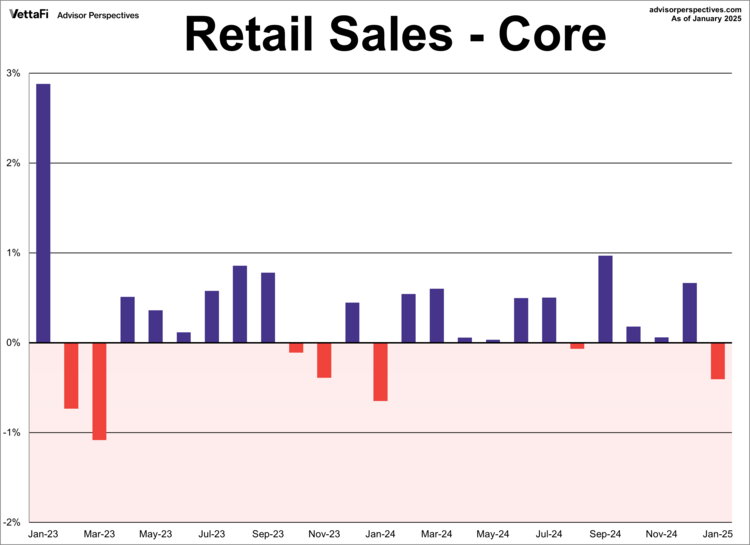
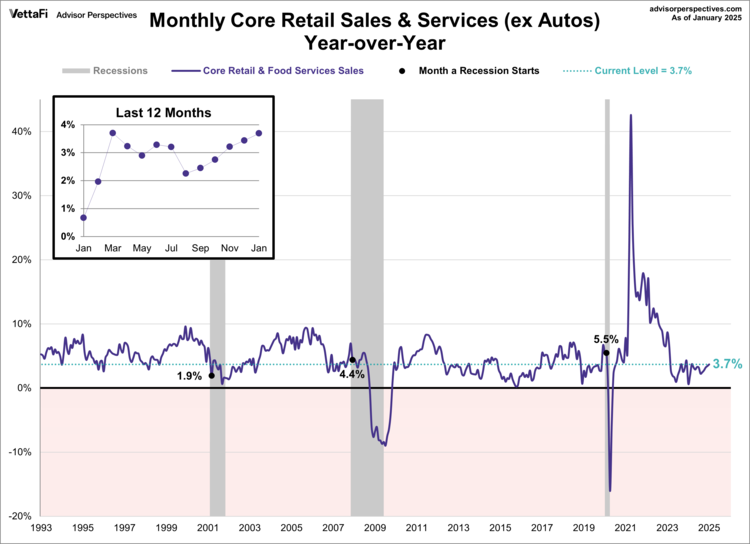
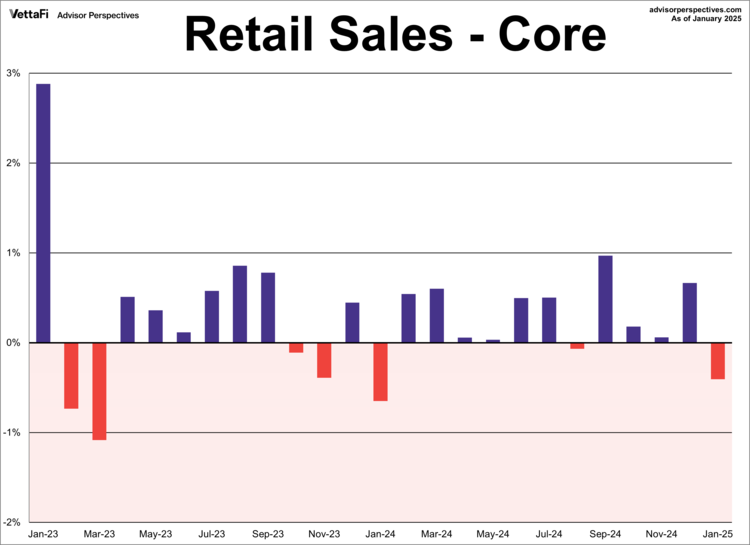
Core sales (ex Autos) fell 0.4% in January, coming in lower than the expected 0.3% growth. This is the largest monthly drop since January 2024 and the first decline in the past five months.
Core retail sales

Core retail sales are up 3.7% compared to January 2024. Here is the year-over-year chart of core retail sales with a callout to the most recent 12 months.
Retail Sales: “Control” Purchases

Retail Sales: “Control” Purchases

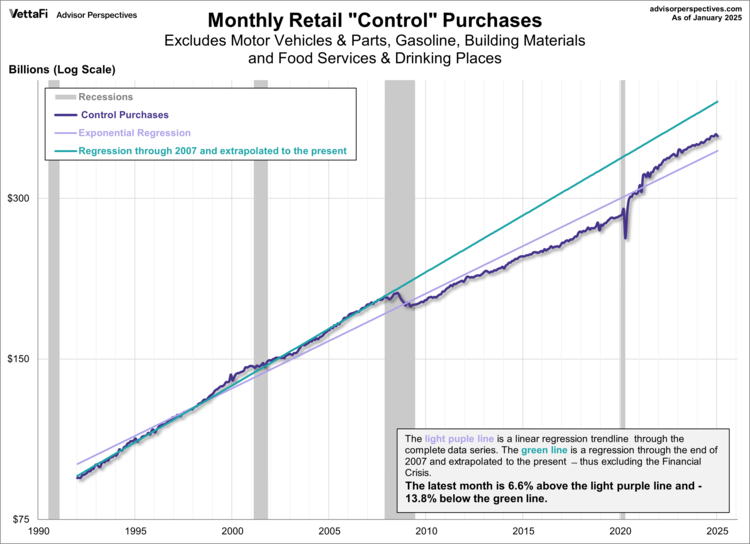
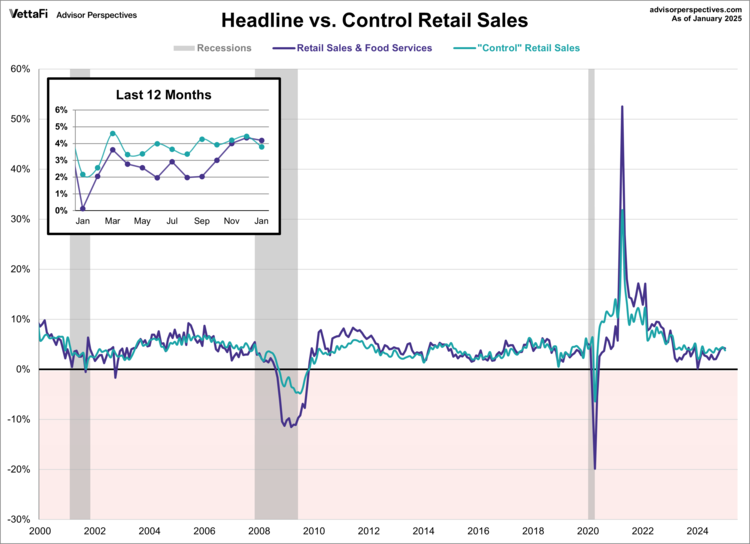
The next two charts illustrate retail sales “control” purchases, which is an even more “core” view of retail sales. This series excludes motor vehicles & parts, gasoline, building materials as well as food services & drinking places. The popular financial press typically ignores this series, but it’s a more consistent and reliable reading of the economy. Retail sales control purchases were down 0.8% in January, lower than the expected 0.3% growth. This is the largest monthly drop since March 2023 and the first decline in five months.
Similar to the retail sales

Similar to the retail sales snapshot chart earlier, the chart below is a log-scale snapshot of control purchases since the early 1990s and includes two of the exponential regressions previously mentioned.
Here is the same series

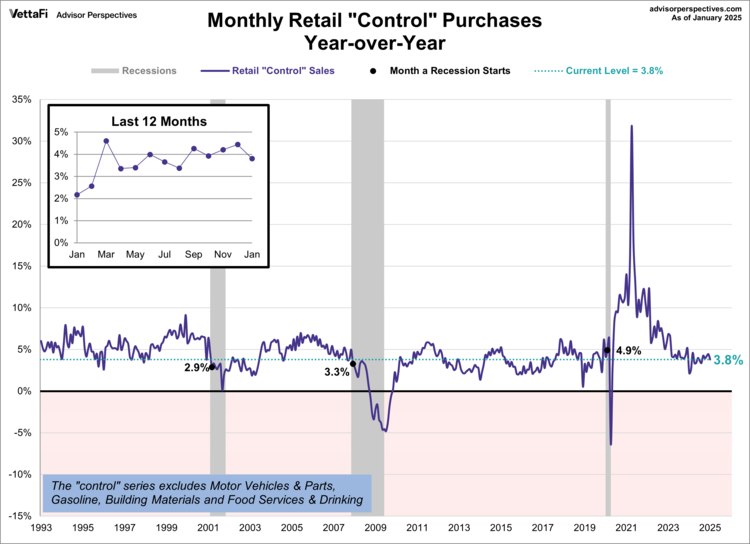
Here is the same series year-over-year. Current control purchases are up 3.8% compared to January 2024.
For a better sense of the reduced

For a better sense of the reduced volatility of the “control” series, here is a YoY overlay with the headline retail sales. Note that the two series follow each other closely, but headline sales have more extreme highs and lows than the control series.
Retail sales will impact interest

Retail sales will impact interest in the SPDR S&P Retail ETF (XRT B+), VanEck Retail ETF (RTH A-), Amplify Online Retail ETF (IBUY C+), and ProShares Online Retail ETF (ONLN B).

vettafi.com is owned by VettaFi LLC (“VettaFi”). VettaFi is the index provider for IBUY for which it receives an index licensing fee. However, IBUY is not issued, sponsored, endorsed, or sold by VettaFi. VettaFi has no obligation or liability in connection with the issuance, administration, marketing, or trading of IBUY.

Originally published on Advisor Perspectives.

For more news, information, and analysis, visit the Beyond Basic Beta Channel.

Loading Articles...

Advertisement

Is Your Portfolio Positioned With Enough Global Exposure?

ETF Education Channel

How to Allocate Commodities in Portfolios

Tom LydonApr 26, 2022
2022-04-26

A long-running debate in asset allocation circles is how much of a portfolio an investor should...

Core Strategies Channel

Why ETFs Experience Limit Up/Down Protections

Karrie GordonMay 13, 2022
2022-05-13

In a digital age where information moves in milliseconds and millions of participants can transact...

}
X
