


Crypto tends to get framed as volatile prices and speculation. However, two growth drivers are quietly creating long-term support: stablecoins (crypto designed to stay relatively stable in value) and tokenization (putting traditional assets into more widely accessible tokens).
Stablecoins can make digital payments and settlement easier, while tokenization is about modernizing how assets are issued, owned, traded, and settled. As stablecoins and tokenization enter the ETF world, investors are getting their first taste of exposure to these concepts, primarily through the companies and infrastructure enabling adoption. Here’s what investors and advisors need to know about stablecoins, tokenization, and this new emerging area of ETFs.
Stablecoins vs. Tokenization
A stablecoin is a cryptocurrency designed to keep a steady value — usually pegged to $1 or another currency. It holds that peg by being backed with reserves (like cash and Treasuries) or using mechanisms that adjust supply and demand. In simple terms, stablecoins aim to be the spendable, transferable cash-like token of the crypto ecosystem. Popular examples include Tether (USDT) and USD Coin (USDC). According to CoinLedger, there are now almost 300 stablecoins. With the passage of the GENIUS Act in July 2025, banks and other financial institutions gained a regulatory framework for stablecoins. That may contribute to higher growth in the segment.
While stablecoins are a form of tokenization, tokenization is a broader concept than stablecoins. Tokenization is the process of creating and recording a digital representation of traditional assets (e.g., securities, deposits, real estate, commodities, etc.) so ownership and transfer can happen in more automated, accessible ways. That idea also extends to ETFs and other funds. Several issuers already offer tokenized funds, including Franklin Templeton (the Franklin OnChain U.S. Government Money Fund (FOBXX)), BlackRock (the BlackRock USD Institutional Digital Liquidity Fund (BUIDL)), and WisdomTree (tokenized 1940 Act funds). Unconfirmed news spread that BlackRock may explore tokenization through its iShares retail brand. Afterwards, BlackRock reaffirmed its interest in exploring tokenization in its October 14 earnings call.
(I touch on both concepts in more detail in this note and my VettaFi colleague, Jane Edmondson, also discussed the stablecoin theme in this note.)
Stablecoin and Tokenization ETFs
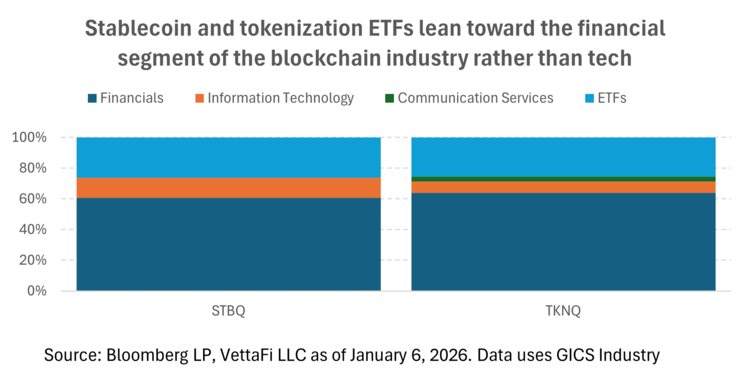
On December 23, 2025, Amplify launched two targeted ETFs that try to map these themes into public markets. Instead of investing directly in stablecoins or tokenized assets, they are built around the inputs and infrastructure who will benefit from long-term adoption of this theme. This can include equities of financial institutions that issue stablecoins or companies active in tokenization efforts. But it can also include certain crypto assets. Ethereum and Solana, for instance, serve as leading blockchain platforms for stablecoins and the tokenization market. XRP Ledger is also emerging as a fast, low-cost option. And Chainlink provides some of the infrastructure, tools, and data needed for tokenization.
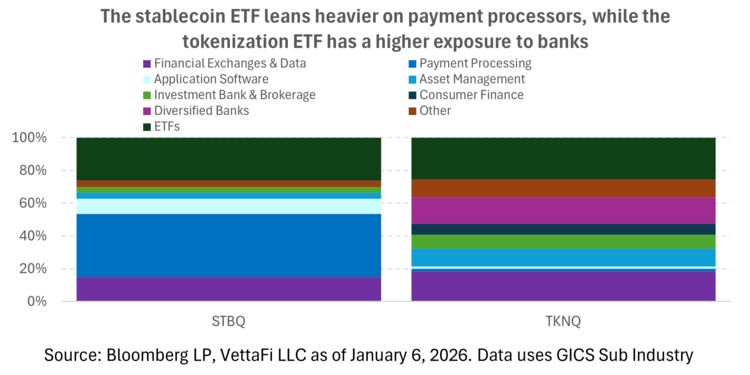
- The Amplify Stablecoin Technology ETF (STBQ) holds XRP, Solana, Ethereum, and Chainlink ETFs. Asset-weighted, together these total around 25% of the ETF’s weight (fund documents state that this can range from 25-50%). The remaining 75% of the ETF’s weight are currently equities of companies that have issued a stablecoin or enable payments, wallets, and technology for stablecoin transactions. Some well-known names include: Visa (V), Block (XYZ), and Mastercard (MA). Equity names are equally-weighted within their own bucket, and can range from 50-75% of total weight.
- Similarly, the Amplify Tokenization Technology ETF (TKNQ) holds around 25% in the same XRP, Solana, Ethereum, and Chainlink ETFs and follows the same weighting scheme as STBQ. Its equity holdings, however, differ. It holds companies exposed to tokenization, including names like Baidu (BIDU), Blackrock (BLK), and Citigroup ©. While still heavily financial, this ETF is more focused on banks rather than payment processors. Besides the four ETFs, TKNQ and STBQ have very little crossover. Only a handful of names like Block, Coinbase Global (COIN), and Circle Internet Group (CRCL) are shared between the two.
- More products are expected to emerge in the near future. In recent months, both Bitwise and Grayscale have shown interest in launching a similar product and have filed for a potential Bitwise Stablecoin & Tokenization ETF and Grayscale Stablecoin Ecosystem ETF, respectively.
Stablecoin and Tokenization ETFs vs. Broader Blockchain ETFs
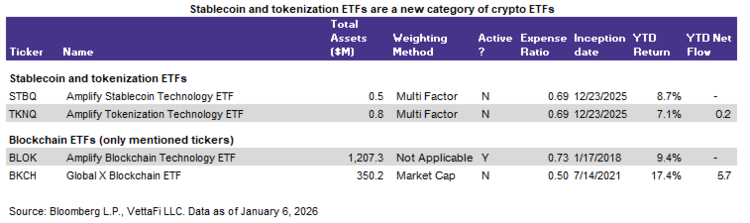
Stablecoin and tokenization ETFs align closely with previous thematic equity ETFs in blockchain and digitalization. However, there are some key differences. As mentioned above, STBQ and TKNQ are theme-specific satellites with a focus on a specific segment of the blockchain universe. This parallels the narrower silo of crypto mining ETFs. Funds like the Amplify Blockchain Technology ETF (BLOK ) or the Global X Blockchain ETF (BKCH) are broader “crypto economy” equity baskets that may be driven more by the overall cycle in miners, exchanges, infrastructure providers, and other crypto-related trends. These capture the overall blockchain adoption trade across industries with a broader focus on blockchain tech rather than on just financial companies. This widens holdings to include Robinhood Markets (HOOD), HUT 8 CORP (HUT), and Cipher Mining Inc (CIFR).
Bottom Line
Stablecoins and tokenization may not be the loudest parts of crypto, but they are increasingly becoming the foundation underneath it. For investors who want exposure beyond spot ETFs, STBQ and TKNQ are the first of an emergent space. These should be understood as infrastructure and adoption plays, not direct stablecoin or tokenized-asset ownership.
VettaFi LLC (“VettaFi”) is the index provider for BLOK, for which it receives an index licensing fee. However, BLOK is not issued, sponsored, endorsed, or sold by VettaFi, and VettaFi has no obligation or liability in connection with the issuance, administration, marketing, or trading of BLOK.
For more news, information, and analysis, visit The Thematic Investing Content Hub.

