


The defense industry is transforming into one of the most interesting areas of the market, particularly for investors seeking a stable growth alternative to higher-beta sectors like technology. Beyond its traditional industrial roots, the industry has expanded into a broader global opportunity that includes international defense spending, themes tied to space, and the rapid rise of drones and autonomous systems. That evolution has made defense a much more multifaceted investment story, with growth drivers that extend well beyond legacy defense and military companies.
Global Catch-Up Broadens Growth Opportunities in Defense
Defense has become more popular on the international side as geopolitical tensions, rising military budgets, and a renewed focus on national security have pushed many countries (particularly in Europe and Asia) to ramp up spending. That has broadened the opportunity beyond U.S. contractors and turned global defense into a compelling investment theme, especially as investors look for areas tied to government-backed demand and longer-term spending.
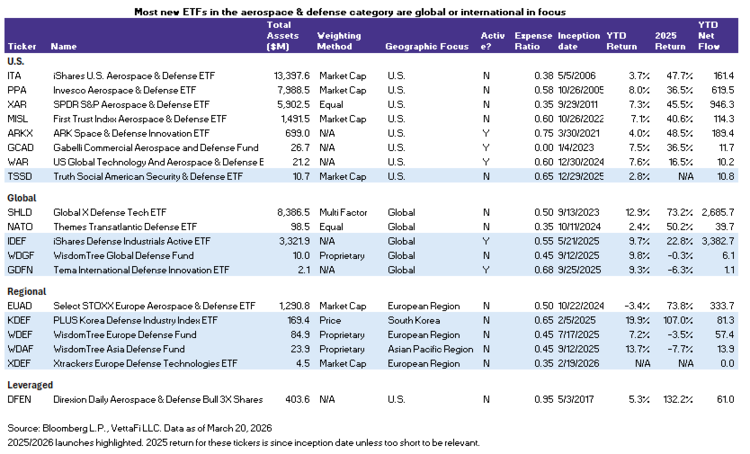
That momentum has also helped drive a new wave of ETF launches. Funds like the iShares Defense Industrials Active ETF (IDEF ) and the PLUS Korea Defense Industry Index ETF (KDEF ) have recently launched on the tailwinds of earlier products like the Global X Defense Tech ETF (SHLD ) and the Select STOXX Europe Aerospace & Defense ETF (EUAD ), which helped show that investor appetite for defense exposure extends beyond traditional U.S. aerospace names. The newer funds add a more thematic appeal to the category through broader international exposure, more targeted country access, or a greater emphasis on the modernization themes reshaping global defense. Interestingly, there were eight new defense ETFs launched in 2025 and 2026. Seven out of the eight ETFs are either global or internationally focused.
I dive deeper into the international defense theme here.
Space Technology Becomes a Natural Extension of Defense
Space technology (primarily activities beyond Earth’s atmosphere) has become an adjacent theme to defense because many of the same growth drivers overlap. Satellites, missile warning systems, communications networks, and surveillance capabilities combine defense technology and commercial innovation, making space less of a niche concept and instead a layer of modern defense. As governments and private companies invest more heavily in space-based capabilities, the theme has gained traction as another way to access growth tied to security and connectivity.
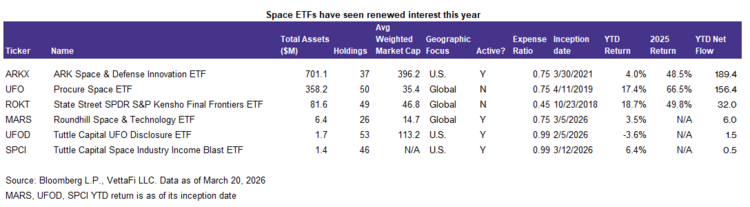
That growing interest has also been reflected in the ETF market. Earlier entrants like the ARK Space & Defense Innovation ETF (ARKX ) and the Procure Space ETF (UFO ) helped introduce investors to the space theme, with ARKX taking a broader, innovation-driven approach and UFO positioning itself as a more pure-play space industry fund. More recently, newer products such as the Roundhill Space & Technology ETF (MARS), the Tuttle Capital UFO Disclosure ETF (UFOD), and the Tuttle Capital Space Industry Income Blast ETF (SPCI) have expanded the group even further, showing how quickly the category is branching into different interpretations of the theme. I expand deeper into the theme here, and expand on some of the largest or newest ETFs below.
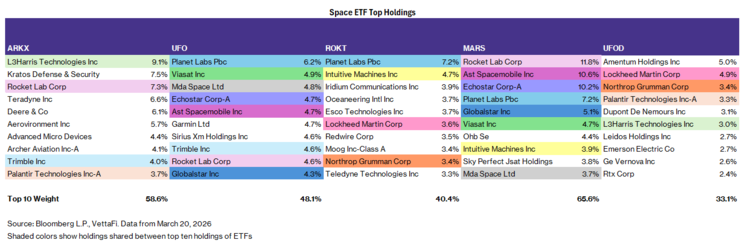
- ARK’s ARKX is an active ETF that targets companies driving innovation in space and defense. These include autonomous mobility, intelligent devices, 3D printing, reusable rockets, and more. Top holdings include 9% in L3Harris Technologies (LHX), 8% in Kratos Defense & Security (KTOS), and 7% in Rocket Lab (RKLB). But it also includes some more diversified holdings like Amazon (AMZN) and Alphabet Inc (GOOG). Interestingly, the ETF’s name and investment policy were changed to include defense in November 2025.
- Procure’s UFO invests in a range of companies involved in space technology, space-based imagery, satellite communications, and rocket manufacturing. With just over $360 million in assets, this ETF has caught up to almost half of ARKX’s assets. Unlike many of its peers, UFO contains a large allocation to the communication sector—companies that focus on the broader theme of connectivity in a global world. For example, one of its top holdings, Echostar Corp (SATS), is a satellite communication company with recognizable subsidiaries like Boost Mobile, Dish Network, and Sling TV. UFO provides investors with pure-play solution to space that doesn’t overlap with Magnificent Seven names.
- Roundhill’s MARS is an active ETF from a manager well-known in the thematic space which allocates across the space value chain. It looks most similar to UFO, but has significantly fewer holdings (around 25 vs. 50).
- Tuttle Capital’s UFOD is an active ETF focused on alien alpha: companies in aerospace, defense, advanced materials, sensing, and energy that may benefit in the event of a UFO disclosure. While the ETF sounds niche and unusual (its website is https://www.thetruthisoutthereufod.com/), under the hood reveals a familiar group of names including Lockheed Martin (LMT), Northrop Grumman (NOC), and Palantir Technologies (PLTR).
- Tuttle Capital’s SPCI is part of Tuttle Capital’s five ETF income blast suite. It provides exposure to the Syntax Space Industry Index while generating weekly income using a systematic put spread strategy.
Drones Add a New Dimension to Defense
Drones have become another closely related defense theme as warfare, surveillance, and defense procurement shift toward lower-cost, more flexible, and more autonomous systems. Drones sit at the intersection of several fast-growing areas including defense modernization, artificial intelligence, robotics, communications, and real-time intelligence gathering. That gives drones a broader investment case than traditional military hardware alone, while also tying the theme to both commercial and defense applications.
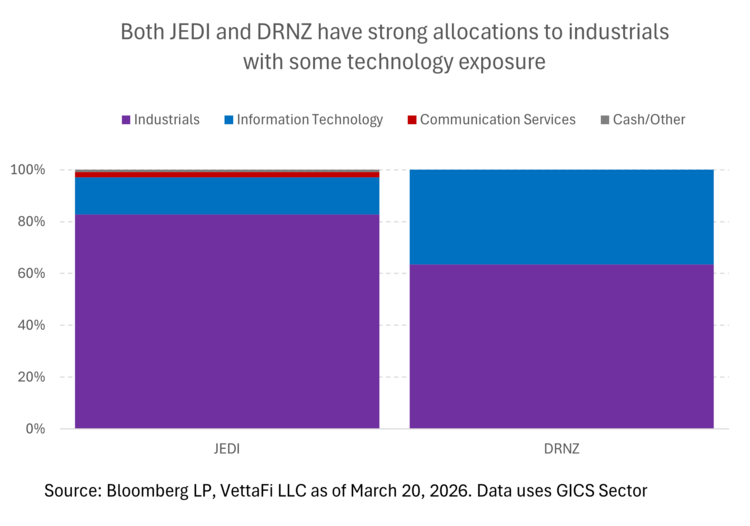
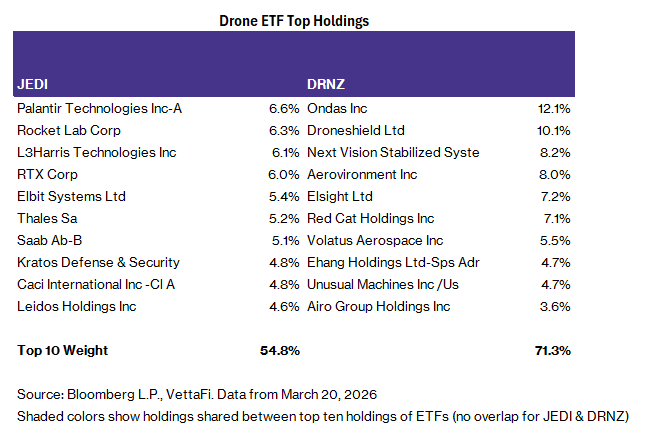
The growing interest in drones has started to show up in the ETF market as well. Newer funds like the Defiance Drone and Modern Warfare ETF (JEDI) and the REX Drone ETF (DRNZ), approach it a bit differently. Together, they show how the ETF market is beginning to carve drones out as a more distinct theme rather than treating it as just another small sleeve within broader aerospace and defense exposure.
- REX’s DRNZ is more directly centered on companies involved in drones and UAV (unmanned aerial vehicle) technologies across both defense and commercial use cases. Beyond defense, the exposure also touches logistics, agriculture, infrastructure, and AI-driven applications. 80% of its weight is in pure-play drone companies which are capped at a max weight of 15% per constituent (vs. 5% for diversified constituents). As a result, top holdings include pure-play names like Ondas Holdings (ONDS) and Droneshield (DRO AU). Further down the list are some more familiar defense names like Palantir, Lockheed Martin, and Northrup Grumman. But outperformance in its top holdings have contributed to its 17% YTD return (vs. 7% for peers)
- Defiance’s JEDI is positioned more broadly around drone and modern warfare technologies, including areas like military drones, AI-driven warfare, unmanned systems, ISR, military cybersecurity, and space defense. The ETF is heavily weighted toward larger names like Palantir, Rocket Lab, and L3Harris. This ETF may appeal to investors looking for a more diversified defense ETF that includes drones rather than a more concentrated drone exposure.

Bottom Line:
The defense industry is a perfect example of thematic evolution grounded on real trends. Defense has expanded into a broader global theme that now touches international security, space technology, and drones. This expansion gives investors more ways to access the industry’s evolving growth drivers. As more defense ETFs emerge, advisors and investors have more options to create additional layers to their defense exposure.
For more news, information, and analysis, visit The Thematic Investing Content Hub.
VettaFi LLC (“VettaFi”) is the index administrator and calculation agent for UFO and DRNZ, for which it receives a fee. However, UFO and DRNZ are not issued, sponsored, endorsed, or sold by VettaFi, and VettaFi has no obligation or liability in connection with the issuance, administration, marketing, or trading of UFO and DRNZ.

