ETFdb Logo
  • ETF Database
  • Content Hubs
    • Themes
      • Active ETF
      • Alternatives
      • Artificial Intelligence
      • China Insights
      • Core Strategies
      • Crypto
      • Disruptive Technology
      • Energy Infrastructure
      • ETF Building Blocks
      • ETF Investing
      • ETF Strategist
      • Financial Literacy
      • Fixed Income
      • Free Cash Flow
      • Future ETFs
      • Innovative ETFs
      • Institutional Income Strategies
      • Leveraged & Inverse
      • Market Insights
      • Market Outlooks
      • Modern Alpha
      • Nuclear Energy
      • Portfolio Strategies
      • Sector Investing
      • Tax Efficient Income
      • Thematic Investing
    • Asset Class
      • Equity
        • U.S. Equity
        • Int'l Developed
        • Emerging Market Equities
      • Alternatives
        • Gold/Silver/Critical Materials
        • Cryptocurrency
        • Currency
        • Volatility
      • Fixed Income
        • Investment Grade Corporates
        • US Treasuries & TIPS
        • High Yield Corporates
        • Int'l Fixed Income
    • ETF Ecosystem
    • ETFs in Canada
    • Market Outlook
    • Crypto ETF Hub
  • Tools
    • ETF Screener
    • ETF Country Exposure Tool
    • ETF Database Categories
    • Indexes
    • Scenario Analysis
    • Watchlists
    • Head-To-Head ETF Comparison Tool
    • Mutual Fund To ETF Converter
    • ETF Stock Exposure Tool
    • ETF Issuer Fund Flows
  • Research
    • ETF Education
    • Equity Investing
    • Dividend ETFs
    • Leveraged ETFs
    • Inverse ETFs
    • Index Education
    • Index Insights
    • Top ETF Sectors
    • Top ETF Issuers
    • Top ETF Industries
  • Webcasts
  • Sectors
    • Sector Investing Content Hub
    • XLK
    • XLI
    • XLU
    • XLY
    • XLP
    • XLRE
    • Sector Power Rankings
    • XLE
    • XLC
    • XLF
    • XLV
    • XLB
  • Multimedia
    • ETF 360 Video Series
    • ETF of the Week Podcast
    • Gaining Perspective Podcast
    • ETF Prime Podcast
    • Video
  • Company
    • About VettaFi
  • PRO
    • Pro Content
    • Pro Tools
    • Advanced
    • FAQ
    • Free sign up
    • Login
  1. Thematic Investing Content Hub
  2. Holiday Travel Recovers From Going South(west)
Thematic Investing Content Hub
Share

Holiday Travel Recovers From Going South(west)

Roxanna Islam, CFA, CAIAJan 05, 2023
2023-01-05

At first, the 2022 holiday travel season seemed to be a flashback to 2021—last minute flight cancellations occurred Christmas week leaving delayed flights and stranded passengers during one of the busiest travel weeks of the year. But unlike the 2021 holiday season (discussed here), these were fortunately not attributed to broader issues like aircraft supply or COVID-19 pandemic staffing issues and had little effect on travel stocks. These cancellations were mostly limited to Southwest Airlines (LUV, 3.0% index weight)—which experienced issues from its out-of-date scheduling system called SkySolver—while other U.S. airlines were still operating at normal levels. According to Flightaware, Southwest canceled over 60% of its flights at its peak during the week following Christmas, while other airlines were canceling an average amount of flights (varies by airline but ranging from 0-10%). While cancellations for Southwest recovered to only 3% of its total flights as of January 3, the stock price was still down almost 11% as investors realize that these disruptions will affect 4Q earnings results (from rebooking fees, refunds, and expense reimbursements). Other airlines, however, experienced relatively more stable price performance during this time and we do not anticipate many negative readthroughs for the airline or travel industry.
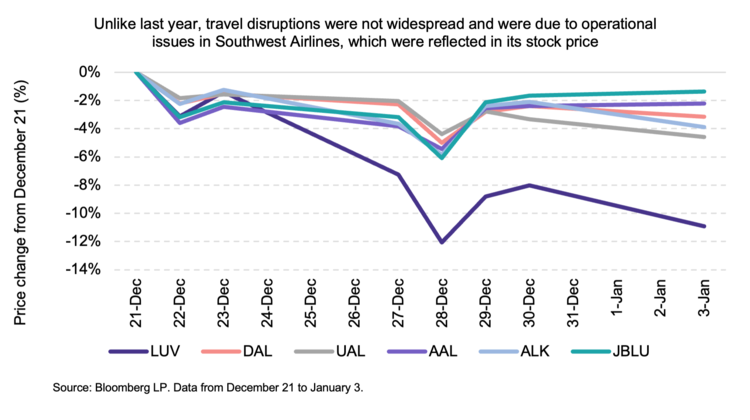
Despite the operational issues at Southwest

Despite the operational issues at Southwest, overall demand for travel this holiday season was actually much higher than the 2021 and 2020 holiday season. TSA checkpoint numbers show that over 2,000,000 passengers passed through TSA checkpoints from December 15 to December 30 (except for Christmas Eve and Christmas which are traditionally slower travel days). After two years of pandemic related lockdowns and cancellations, consumers were eager to celebrate the holiday season for the first time without any restrictions (see this note for more details on consumer spending this holiday season).

We often discuss airlines

Content continues below advertisement

We often discuss airlines within our travel research because they serve as a leading indicator for the rest of the travel industry; however, the airlines and airport services segment makes up only around 16.9% of the index so any disruption in the airline sector may not be reflected in overall index performance. Out of the top ten constituents, (which equal 43.3% of the total index weight) none of the top ten constituents are airlines. Most are consumer-oriented sectors which will benefit from consumers continuing to spend on higher end goods, travel, and services despite inflationary pressures on more price sensitive consumers (see this note for more details on luxury spending).

Holiday Travel Recovers From Going South(west)

Bottom Line:

While operational issues at Southwest Airlines made headlines this past week, these issues were limited to the company and not the broader airline sector. In addition, travel indexes like the S-Network Global Travel Index (TRAVEL) do not have concentrated exposure to the airline sector and are diversified with travel and leisure stocks. 

For more news, information, and strategy, visit the Thematic Investing Channel.

Loading Articles...

Advertisement

Is Your Portfolio Positioned With Enough Global Exposure?

ETF Education Channel

How to Allocate Commodities in Portfolios

Tom LydonApr 26, 2022
2022-04-26

A long-running debate in asset allocation circles is how much of a portfolio an investor should...

Core Strategies Channel

Why ETFs Experience Limit Up/Down Protections

Karrie GordonMay 13, 2022
2022-05-13

In a digital age where information moves in milliseconds and millions of participants can transact...

}
X
