


Emerging market ETFs are back in focus. Two of the ten largest U.S.-listed ETF inflow winners year-to-date are broad EM funds. As expected, low-cost passive strategies continue to dominate flows, although they don’t always lead on returns. At the same time, several less-followed EM ETFs have outperformed, and each leans into a distinct human or democracy focus. In this note, I unpack this theme and highlight a few funds worth a closer look.
Emerging trends in emerging markets
Most investors are familiar with the flagship broad emerging markets ETFs—especially iShares Core MSCI Emerging Markets ETF (IEMG ) and iShares MSCI Emerging Markets ETF (EEM ). But emerging market ETFs include well over 100 products with broad EM exposure, including active and ex-China variants.
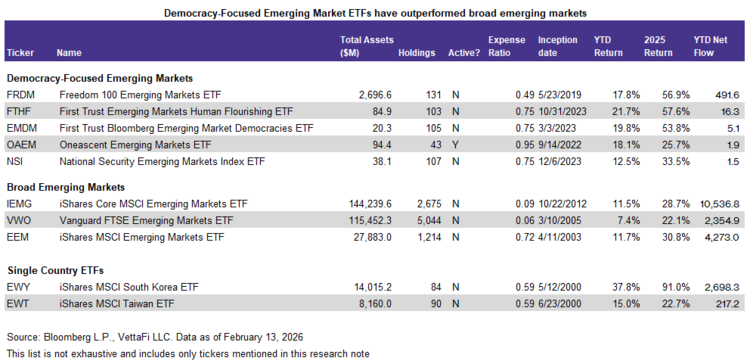
While a large share of ETFs removes or reduces China exposure, a smaller and increasingly visible subset goes further by embedding explicit human rights criteria into their methodologies. These all have varying methodologies and names for their strategies, but I refer to them as democracy-focused ETFs in this note. But despite their differences, this group has generally delivered stronger results than core emerging market benchmarks on both a year-to-date basis and over 2025, illustrating that values-based design and competitive returns are not mutually exclusive. In 2025, three out of the five ETFs returned over 50% in 2025, while IEMG and EEM returned around 30%. YTD in 2026, four out of five of the democracy-focused ETFs are returning high teens to low double digits, while broader emerging market ETFs are in the low teens (see ETF table at the end of this note for more specific performance details).
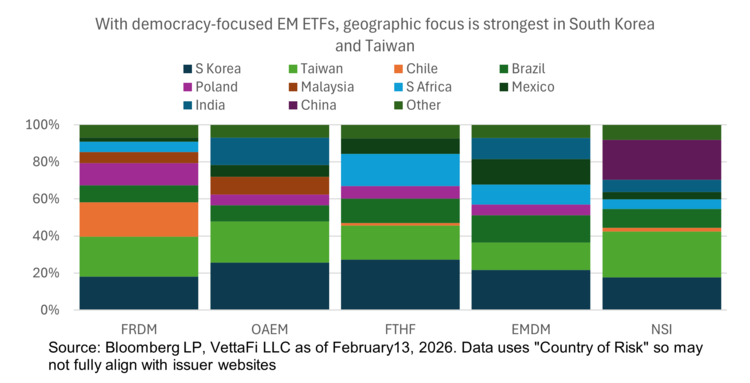
Much of the return can be attributed to higher allocations of countries like South Korea and Taiwan relative to broad emerging market ETFs. I recently wrote about performance strength in South Korea ETFs. The largest ETF, the iShares MSCI South Korea ETF (EWY ) has over $14 billion in assets and is up 38% YTD (in 2025, it was up 91%). But it is also very concentrated in its top two holdings—Samsung (28%) and Sk Hynix (19%)—which make up almost 50% of the portfolio. Similarly, the iShares MSCI Taiwan ETF (EWT ) has been up 15% so far this year, but is also concentrated with 25% in its top holding Taiwan Semiconductor Manufacturing (25%).
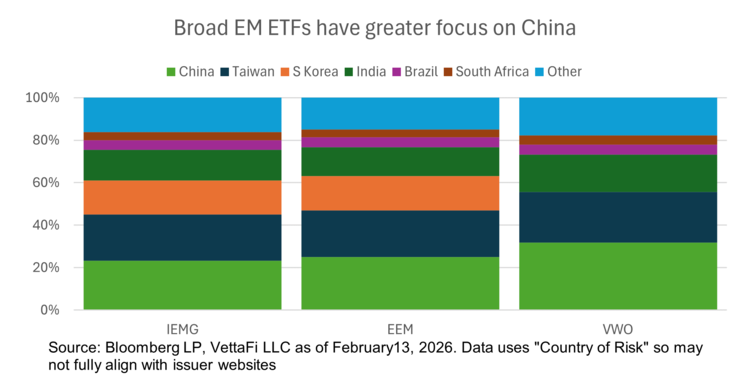
To compare, broad emerging market ETFs like the iShares IEMG and EEM have large exposures to South Korea and Taiwan, but have an even larger exposure to China—around 25% of the ETF. The Vanguard FTSE Emerging Markets ETF (VWO ) has its top geographic exposures in China (32%) and Taiwan (24%), but does not have exposure to South Korea since FTSE classifies it as a developed market.
Opportunities in democracy-focused emerging market ETFs
These are a few of the ETFs which follow this theme:
- The Freedom 100 Emerging Markets ETF (FRDM ) is the most well-known of the group with $2.7 billion in assets. This ETF uses a freedom-weighting process that incorporates third-party quantitative personal and economic freedom metrics. That means FRDM tilts toward countries with stronger civil and economic institutions while reducing exposure to more authoritarian regimes. FRDM does not have exposure to China, but has its top geographic exposure in Taiwan (22%), Chile (18%), South Korea (18%), Poland (12%), and Brazil (9%). In contrast, broad emerging market ETFs like IEMG and EEM have significant China exposure (around 25%) but less than 1% exposure in Chile.
- The OneAscent Emerging Markets ETF (OAEM ) uses proprietary value-based screening to identify investments that will make an impact on the world and exclude companies that harm their stakeholders. The ETF also has a formal China investment policy including strict guardrails. Unsurprisingly, it’s largest geographic exposures are to South Korea (26%) and Taiwan (22%). Its third largest exposure is in India (15%).
- First Trust has a couple of ETFs that follow scoring by Freedom House, a nonprofit that conducts research and advocacy on democracy, political freedom, and human rights. The First Trust Emerging Markets Human Flourishing ETF (FTHF ) tracks an index of companies that belong to emerging market countries with a high Human Dignity Score. Freedom House creates the Human Dignity Score based on freedom of expression and belief (80%) and freedom from religious persecution (20%). After the country screen, the index applies an additional company-level screen that excludes firms associated with seven defined controversial practices.
- The First Trust Emerging Market Democracies ETF (EMDM ) tracks an index of companies that belong to emerging market countries that meet minimum political rights and civil liberties standards to qualify as Electoral Democracies. Freedom House classifies an Electoral Democracy as a country with high scores in their electoral process, political rights, and civil liberties scoring methodology.
- The National Security Emerging Markets Index ETF (NSI ) tracks an index which excludes national security threats and human rights violators. To be excluded, companies must meet one of nine investments screens including: subject to U.S. government sanctions, strategic threat, cybersecurity threat, espionage threat, or human rights violator. Unlike other ETFs in the group, it’s not currently an ex-China fund. China exposure can remain if a company clears the governance screens, while firms that trip the national-security or human-rights flags are removed. The stated aim is to keep broad emerging markets exposure without compromising U.S. national security and human rights interests, while also attempting to reduce geopolitical headline risk in the portfolio
Bottom Line:
International equities, specifically emerging markets, are regaining attention. Investors and advisors have access to an expanded menu of ETFs that can potentially improve their international allocations beyond their core international holdings.
__For more news, information, and analysis, visit VettaFi | ETFDB._
VettaFi LLC (“VettaFi”) is the index administrator and calculation agent for NSI, for which it receives a fee. However, NSI is not issued, sponsored, endorsed, or sold by VettaFi, and VettaFi has no obligation or liability in connection with the issuance, administration, marketing, or trading of NSI._

