


The ETF universe continued to expand in 2025, with a growing number of high-income products incorporating options strategies to enhance payouts. However, for many investors and advisors, traditional ETFs that own dividend-paying stocks remain a core component of a well-rounded portfolio.
According to S&P Dow Jones Indices, dividend growth slowed during the fourth quarter of 2025. Corporate boards appeared more cautious about forward cash commitments, likely influenced by uncertainty surrounding tariff policies, rising costs, and fluctuating consumer and enterprise spending. While the majority of companies continued to increase their dividends, the size of those raises was generally smaller. For the S&P 500, dividend payments grew by 2.2% compared to the previous year.
Identifying the Dividend Drivers
While over 80% of S&P 500 companies pay a dividend, the commitment to higher payouts in 2025 was concentrated in specific areas. The Financials and Industrials sectors led the way, with each sector recording 68 positive dividend actions. This represented a significant majority of their constituents—89% and 85%, respectively. Among sectors with smaller overall market weights, Real Estate and Utilities also performed well, contributing 32 and 28 positive dividend actions.
A Tale of Three Strategies
There are many dividend ETFs available to investors, and even those using the same parent index can provide vastly different exposures.
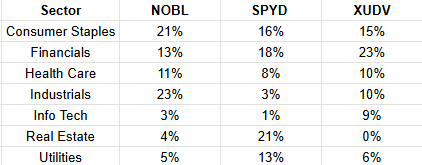
The ProShares S&P 500 Dividend Aristocrats ETF (NOBL ) focuses on quality and longevity, requiring holdings to have raised dividends for at least 25 consecutive years. This leads to a heavy concentration in “old economy” sectors like Industrials and Consumer Staples.
In contrast, the SPDR Portfolio S&P 500 High Dividend ETF (SPYD ) prioritizes current yield. It targets approximately 80 of the highest-yielding names in the index, which results in a significant tilt toward Real Estate and a minimal footprint in Technology.
Finally, the Franklin U.S. Dividend Booster Index ETF (XUDV ), which will cross its one-year anniversary later this month, offers a unique optimization process. It seeks to maximize yield while specifically managing for volatility and concentration risks. Its portfolio is led by Financials (23%), Consumer Staples (15%), and Health Care (10%), featuring names like Kraft Heinz, Pfizer, and United Parcel Service.
The table below illustrates how these different objectives result in distinct sector profiles:
Performance and Yield Nuances
The structural differences between these funds led to diverging results in 2025. SPYD’s 4.4% dividend yield was double that of NOBL, and its 0.07% expense ratio is significantly lower. However, NOBL’s 6.8% total return was more than 200 basis points stronger than SPYD’s, proving that dividend growth and sector tailwinds can often outperform raw yield. XUDV does not have a full year 2025 record.
However, XUDV’s 5.2% yield and 0.09% expense ratio offer a compelling middle ground for those seeking a modernized approach to income. As always, looking under the hood is essential to ensure a fund’s sector bets align with your market outlook.
For more news, information, and analysis, visit the Tax Efficient Income Content Hub.
VettaFi LLC (“VettaFi”) is the index provider for XUDV, for which it receives an index licensing fee. However, XUDV is not issued, sponsored, endorsed, or sold by VettaFi, and VettaFi has no obligation or liability in connection with the issuance, administration, marketing, or trading of XUDV.`

