


Key Takeaways:
- SpaceX’s IPO has created strong ETF demand across leveraged, active, and index-based strategies.
- The Procure Space ETF (UFO) remains central as the original pure-play space ETF, with its index methodology adapting for SpaceX.
- Space ETFs offer diversified space exposure, but they may not move in line with SpaceX stock.
Space Exploration Technology’s (SPCX) IPO lived up to the hype. After pricing at $135 per share and raising a record-breaking $75 billion, the stock surged roughly 50% within its first three days of public trading. That demand has also spilled into the ETF ecosystem. Leveraged ETFs, broad equity ETFs, and thematic space ETFs are all responding in different ways, showing how one mega-cap IPO can reshape access to an entire investment theme.
Leveraged ETFs Point to Strong Single-Stock Interest
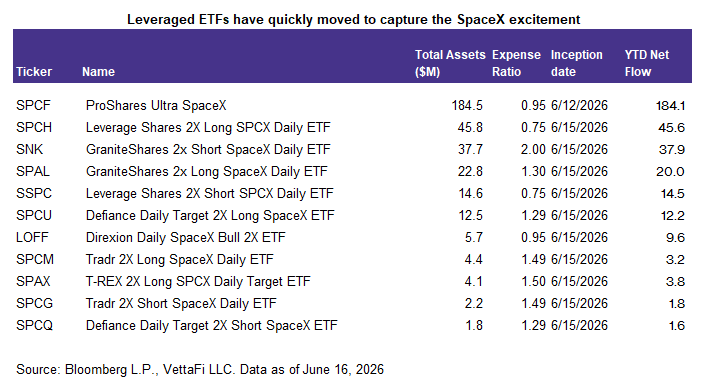
The emergence of leveraged ETFs tied to Space Exploration Technologies (more familiarly known as SpaceX) points to strong investor demand for concentrated exposure. At least 11 leveraged SpaceX ETFs launched alongside SpaceX’s debut. These products give traders a way to express short-term views on the stock without owning it directly. While these products are designed for tactical use, their early arrival shows how fast ETF issuers are moving to capture investor interest around one of the market’s most anticipated public companies.
SpaceX Could Enter Portfolios Through Several ETFs
Beyond leveraged products, SpaceX is expected to enter several large, broad equity indexes within only a few days, including Nasdaq and FTSE Russell benchmarks. That could eventually push SpaceX into many core portfolios, but several smaller ETFs have already moved ahead. (For a broader list of ETFs outside of the space industry with SpaceX holdings, see this article.)
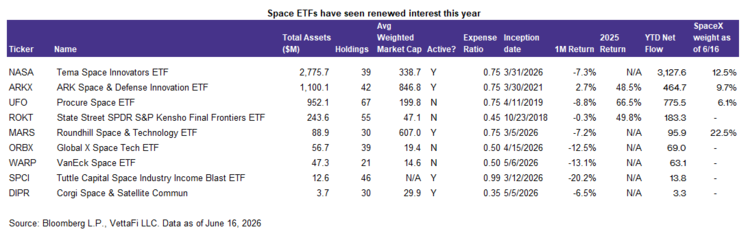
Active pure-play space ETFs, in particular, have been able to add exposure immediately rather than waiting for formal index inclusion. The Roundhill Space & Technology ETF (MARS) currently has the largest weight at 22.5%. The Tema Space Innovators ETF (NASA) and the ARK Space & Defense Innovation ETF (ARKX ) have weights of 12.5% and 9.7%, respectively. All three of these ETFs currently have SpaceX as their largest position (data as of June 16, 2026).
On the index side, index providers have been proactive in adjusting methodologies for mega-cap IPOs. The first indexed ETF to make a SpaceX addition has been the Procure Space ETF (UFO ), the original pure-play space ETF.
In May 2026, the VettaFi Space Index (UFO’s underlying index) expanded its methodology, allowing newly listed non-diversified companies with market caps above $500 billion to be eligible for immediate inclusion. This would also allow pure-play space companies with more than $100 billion in float-adjusted market capitalization to have up to 15% exposure in the index. Previously, pure-play companies were capped at 4.8%. On June 17, SpaceX entered UFO as its top holding with around 6.2% weight, which could potentially increase as more shares hit the market.
SpaceX Connects Space ETFs With the Space Economy
The addition of SpaceX has been particularly important for thematic ETFs like UFO, where waiting several months to add mega-cap companies could make the portfolio feel disconnected from the theme that it’s designed to represent. Launched in April 2019, UFO helped define the space ETF category before SpaceX became investable. It was the first U.S.-listed pure-play space ETF and remains one of the most established ways to track the industry and access the theme through an index-based approach. The fund holds a global basket of companies tied to the space economy, including satellite communications, launch services, space-based imagery and intelligence, GPS and navigation, and ground-based equipment and infrastructure.
UFO currently has around $1 billion in assets, reflecting renewed investor interest in space as an investment theme. Its largest positions include SpaceX, EchoStar (SATS), Rocket Lab (RKLB), Trimble (TRMB), and AST SpaceMobile ASTS, showing that the fund’s exposure is not just about launch providers but the broader space infrastructure ecosystem. This makes UFO particularly relevant in a post-SpaceX market: it represents the original index-based space ETF with diversified exposure to the commercial space economy.
Bottom Line:
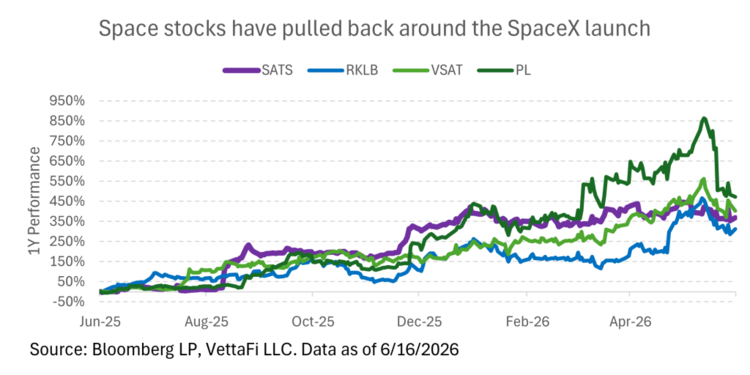
Diversified ETFs are designed to provide exposure to a broader basket of holdings rather than a single stock, which can create some relative underperformance when one market leader is driving returns. While SpaceX has already become the largest holding in many space ETFs, these funds have still underperformed the SpaceX stock.
Other large holdings, including several shown above, had previously rallied on broader enthusiasm for the space theme, but pulled back around SpaceX’s IPO as investor attention shifted toward SpaceX directly. This illustrates an important trade-off for investors: space ETFs can offer broader access to the commercial space economy while still providing diversified exposure to SpaceX, but they will not always move in line with the stock.
For more news, information, and analysis, visit the Thematic Investing Content Hub.
VettaFi LLC (“VettaFi”) is the index provider for UFO, for which it receives an index licensing fee. However, UFO is not issued, sponsored, endorsed, or sold by VettaFi, and VettaFi has no obligation or liability in connection with the issuance, administration, marketing, or trading of UFO.

