


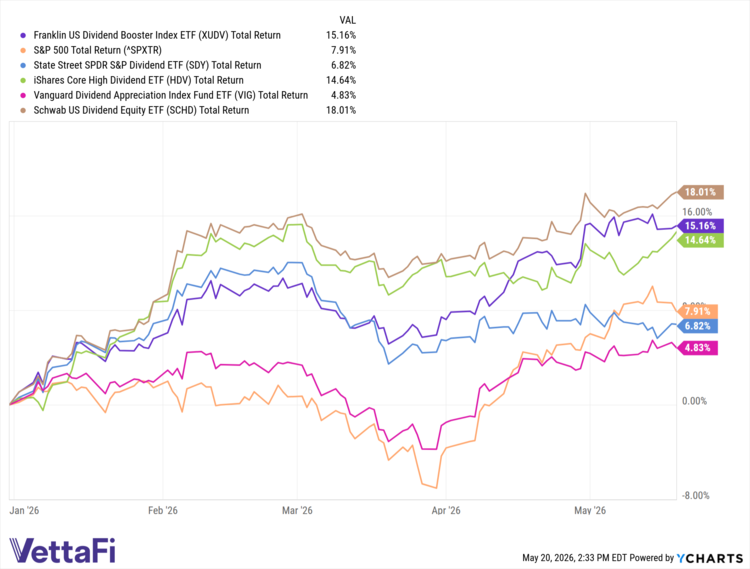
The Franklin U.S. Dividend Booster Index ETF (XUDV ) has emerged as one of the stronger-performing dividend ETFs in 2026, benefiting from a mix of income-focused positioning and selective exposure to AI infrastructure-related growth stocks.
According to YCharts, XUDV is up more than 15.16% year-to-date and roughly 25% over the past 12 months, outperforming many traditional large-cap value and dividend benchmarks.
XUDV’s underlying methodology — which seeks to maximize dividend yield while balancing volatility and concentration risk through an optimization process — has allowed the fund to maintain exposure to key growth themes without sacrificing its defensive income profile.
XUDV tracks the VettaFi New Frontier U.S. Dividend Select Index (NFUS), which results in a portfolio that looks meaningfully different from a traditional large-cap or tech-heavy benchmark.
Financials represent roughly a quarter of the fund, and have provided a tailwind amid a relatively resilient banking and asset management backdrop. At the same time, defensive allocations to consumer staples (around 13%) and healthcare (about 8.5%) have helped stabilize returns.
March Rebalance Emphasizes “Tech-Light” Yield Exposure
Rather than avoiding technology entirely, XUDV’s March quarterly rebalance. refined its exposure by shifting toward higher-yielding segments of the sector tied to hardware and semiconductor demand.
The fund added positions in Micron Technology (MU) and Western Digital (WDC), reflecting increased exposure to data storage and optical infrastructure names benefiting from cyclical demand trends.
At the same time, the rebalance reduced exposure to holdings that no longer met the strategy’s yield-to-volatility thresholds, including Palantir Technologies (PLTR), as capital was reallocated toward more income-generating positions within the portfolio.
Key Holdings Supporting XUDV’s Return Profile
Several core holdings have been key contributors to performance so far in 2026. Among the key examples in the top 10 holdings include:
- United Parcel Service (UPS) — 4.63% weight. UPS remains a significant position within the industrials allocation, contributing to the portfolio’s defensive and income-generating characteristics within the broader framework.
- HP Inc. (HPQ) — 4.20% weight. HP represents a more targeted technology exposure within XUDV’s generally “tech-light” construction. The company has benefited from incremental demand tied to AI-enabled hardware adoption. HP’s combination of dividend yield and moderate capital appreciation has also aligned with the fund’s yield optimization objectives.
- Pfizer (PFE) — 4.41% weight. Pfizer serves as a core healthcare allocation within XUDV. Restructuring initiatives and improving operational discipline have contributed to sentiment stabilization, while the stock continues to provide a relatively high dividend yield alongside recovery-driven upside potential.
- Best Buy (BBY) — 4.47% weight. Best Buy provides selective consumer discretionary exposure within XUDV, benefiting from improving electronics demand and stabilization in spending trends. Operational efficiency and disciplined inventory management have supported cash flow generation and margin stability, making the position consistent with the strategy’s emphasis on dividend sustainability and cyclical balance.
Why XUDV Stands out in 2026
What truly separates XUDV from other dividend ETFs is its three-stage optimization framework. Rather than simply chasing the market’s highest-yielding stocks, XUDV balances dividend yield, volatility control, and capital appreciation potential.
That positioning has helped the ETF maintain a 30-day SEC yield above 4.2% while still capturing gains from broader equity market gains. The fund’s low 0.09% expense ratio has also helped support stronger net returns for investors in 2026.
For more news, information, and analysis, visit the Thematic Investing Content Hub.
VettaFi LLC (“VettaFi”) is the index provider for XUDV, for which it receives an index licensing fee. However, XUDV is not issued, sponsored, endorsed, or sold by VettaFi, and VettaFi has no obligation or liability in connection with the issuance, administration, marketing, or trading of XUDV.

