


Portfolio diversification matters more than ever in this year’s challenging market environment. Tech investors looking for opportunities internationally would do well to consider China’s internet sector for its performance, attractive valuations, and AI positioning.
The tariff war between the U.S. and China appears quiet for now. However, given the unpredictable nature of U.S. tariff policy this year, it remains a risk that investors must weigh. That said, the unpredictable nature of tariff rates and their seeming weaponization against an ever-changing rotation of countries makes international investing fraught across the board for U.S. investors.
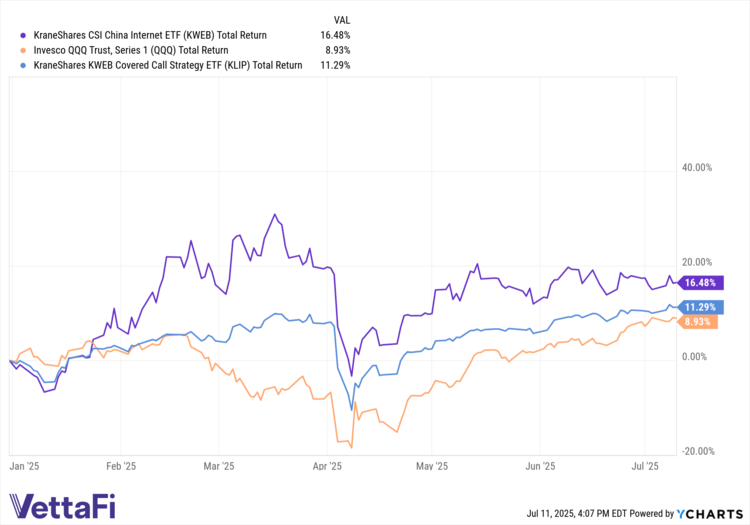
For investors with the risk tolerance, particularly tech investors looking for opportunity, China’s internet sector is a hub of activity and growth this year. The KraneShares CSI China Internet ETF (KWEB ) is up nearly double the Nasdaq-100 (measured by QQQ, the Invesco QQQ Trust Series 1 this year on a total returns basis. Ongoing innovation and supportive policies from China’s government create potential tailwinds for continued performance looking ahead.
Valuations & China’s Ongoing AI Innovations
In addition to performance, valuations make China’s internet sector attractive compared to U.S. peers. “KWEB’s holdings still trade at only 15 times earnings, on average, compared to 30 times for US internet companies,” KraneShares revealed in its latest China Internet Earnings Report.
Alibaba’s performance this year demonstrates the potential within the sector. Up nearly 75% mid-March on AI developments, the stock retreated on April tariff announcements but is currently up nearly 28% on a total return basis, according to Y-Charts data as of July 10.
While Alibaba’s stock soared this year on AI developments, many other major companies remain undervalued. As of the end of the first quarter, Baidu’s market cap was minimally higher than its cash balance, reported KraneShares. Furthermore, companies like Baidu and Kuaishou maintain earnings multiples "significantly below” the sector’s average.
A final reason tech investors shouldn’t overlook China’s internet sector is ongoing AI developments happening in China. The DeepSeek disruption that shook markets outside China underscores the innovation currently underway within the country. Manus, a Chinese-based startup, launched the most advanced AI agent in the first quarter. Companies like Alibaba and Kuaishou continue to develop and iterate on AI innovations as the playing field becomes increasingly competitive.
“Unlike in the United States, where chipmakers and privately held companies are leading the charge, China’s AI revolution is predominantly being led by its publicly listed internet giants,” KraneShares explained. It makes the sector worth consideration for those looking to diversify beyond the U.S.
Under the Hood of KWEB & KLIP
The KraneShares CSI China Internet ETF (KWEB ) measures the performance of publicly traded companies outside of mainland China that operate within China’s internet and internet-related sectors. It seeks to track the CSI Overseas China Internet Index. The Index provides exposure to the China internet equivalents of Google, Facebook, Amazon, and eBay. It trades in securities on the Nasdaq Stock Market, the Hong Kong Stock Exchange, and the New York Stock Exchange.
In the last few years, the fund has worked to convert all possible share classes to Hong Kong shares. It’s a calculated move away from ADRs to protect investors from added risk. Currently, 68.2% of assets held by KWEB list in Hong Kong. And 19% of assets are in U.S. ADRs with a secondary Hong Kong listing, while 12.8% are assets listed solely on U.S. exchanges.
Income investors don’t want to miss the KraneShares China Internet and Covered Call Strategy ETF (KLIP ). The fund capitalizes on China tech’s inherently greater volatility than its U.S. counterpart by writing covered calls on KWEB. Because of the increased volatility, KLIP can potentially offer a higher yield than investing in tech in the U.S. or other technology sectors globally. The fund currently outperforms QQQ this year on a total returns basis, according to Y-Charts data.
The income earned from the options strategy helps offset KWEB losses during periods of declines. This means that during market drawdowns, KLIP may outperform KWEB. During relatively flat markets, KLIP’s options premiums contribute to the fund’s expectations for stable performance. In periods of strong price appreciation, KLIP’s momentum is capped at the strike prices, and KWEB will outperform.
KWEB carries an expense ratio of 0.70%, while KLIP has an expense ratio of 0.93%.
For more news, information, and analysis, visit the China Insights Content Hub.

