
ETFdb Logo
  • ETF Database
  • Content Hubs
    • Themes
      • Active ETF
      • Alternatives
      • Artificial Intelligence
      • China Insights
      • Core Strategies
      • Crypto
      • Disruptive Technology
      • Energy Infrastructure
      • ETF Building Blocks
      • ETF Investing
      • ETF Strategist
      • Financial Literacy
      • Fixed Income
      • Free Cash Flow
      • Future ETFs
      • Innovative ETFs
      • Institutional Income Strategies
      • Leveraged & Inverse
      • Market Insights
      • Market Outlooks
      • Modern Alpha
      • Nuclear Energy
      • Portfolio Strategies
      • Sector Investing
      • Tax Efficient Income
      • Thematic Investing
    • Asset Class
      • Equity
        • U.S. Equity
        • Int'l Developed
        • Emerging Market Equities
      • Alternatives
        • Gold/Silver/Critical Materials
        • Cryptocurrency
        • Currency
        • Volatility
      • Fixed Income
        • Investment Grade Corporates
        • US Treasuries & TIPS
        • High Yield Corporates
        • Int'l Fixed Income
    • ETF Ecosystem
    • ETFs in Canada
    • Market Outlook
    • Crypto ETF Hub
  • Tools
    • ETF Screener
    • ETF Country Exposure Tool
    • ETF Database Categories
    • Indexes
    • Scenario Analysis
    • Watchlists
    • Head-To-Head ETF Comparison Tool
    • Mutual Fund To ETF Converter
    • ETF Stock Exposure Tool
    • ETF Issuer Fund Flows
  • Research
    • ETF Education
    • Equity Investing
    • Dividend ETFs
    • Leveraged ETFs
    • Inverse ETFs
    • Index Education
    • Index Insights
    • Top ETF Sectors
    • Top ETF Issuers
    • Top ETF Industries
  • Webcasts
  • Sectors
    • Sector Investing Content Hub
    • XLK
    • XLI
    • XLU
    • XLY
    • XLP
    • XLRE
    • Sector Power Rankings
    • XLE
    • XLC
    • XLF
    • XLV
    • XLB
  • Multimedia
    • ETF 360 Video Series
    • ETF of the Week Podcast
    • Gaining Perspective Podcast
    • ETF Prime Podcast
    • Video
  • Company
    • About VettaFi
  • PRO
    • Pro Content
    • Pro Tools
    • Advanced
    • FAQ
    • Free sign up
    • Login
  1. Commodities Content Hub
  2. Wheat & Corn Prices Rise After Russia Nixes Export Deal
Commodities Content Hub
Share

Wheat & Corn Prices Rise After Russia Nixes Export Deal

Ben HernandezNov 02, 2022
2022-11-02

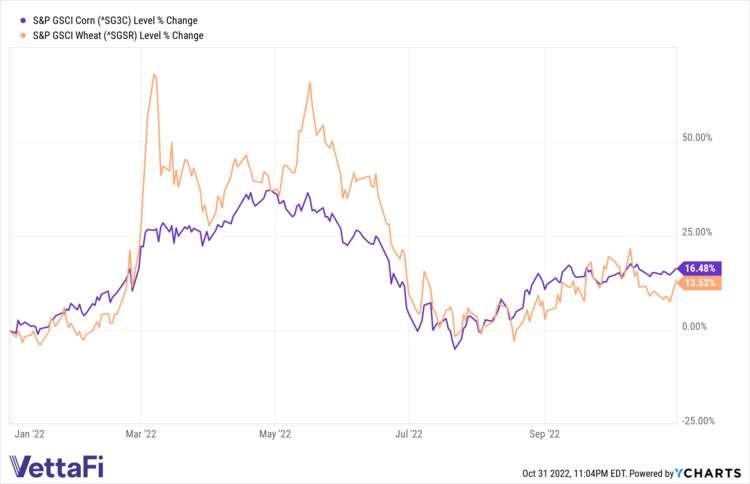
The conflict in Ukraine continues to put supply constraints on the global food crisis, forcing prices of wheat and corn to rise. This was further exacerbated recently by Russia nixing a grain exports deal that could help alleviate the crisis.

Russia’s occupation of the Black Sea is preventing exports of agricultural commodities, including corn and wheat, from leaving Ukraine. As such, the forces of supply and demand are weighing heavy on food prices that are already on the move higher amid inflation.

According to a CNN report, the grain exports deal has been helpful in at least allowing some exports to leave Ukraine. However, an apparent drone attack amid the ongoing conflict between the nations forced Russia to pull out of the deal completely.

“The United Nations-brokered deal, which was agreed to in July and ensured the safe passage of ships carrying grain from Ukraine through the Black Sea, has played a crucial role in lowering the prices of wheat and other commodities globally,” CNN noted.

2 ETFs for Consideration

Rising wheat prices should benefit exchange traded funds (ETFs) that focus on the commodity, such as the Teucrium Wheat Fund (WEAT C). The fund can be used as an ideal inflation hedge as wheat prices continue to rise alongside rising commodity prices, or investors can use the fund to add commodities to their portfolios for diversification.

ETF investors looking to get exposure to rising corn prices following the act becoming a law or to simply add diversification to a portfolio with commodities can take a look at ETFs from Teucrium. More specifically, they can look at the Teucrium Corn Fund (CORN B).

CORN tracks three futures contracts for corn that are traded on the Chicago Board of Trade, including 35% second to expire contracts, 30% third to expire contracts, and 35% December following the third to expire. The various contract exposures help the fund limit the negative effects of rolling contracts, especially during a market in contango.

While commodities have fallen as of late, this could be an ideal area of value for short-term traders. Should they rise again, it provides an ideal hedge against inflation.

For long-term buy-and-hold investors, getting corn and wheat exposure can provide an ideal hedge against inflation. Getting alternative assets that are non-correlated to the broad market can offset any weakness in the equities or bond market.

Content continues below advertisement

Wheat & Corn Prices Rise After Russia Nixes Export Deal
^SG3C data by YCharts

For more news, information, and strategy, visit the Commodities Channel.

Loading Articles...

Advertisement

Is Your Portfolio Positioned With Enough Global Exposure?

ETF Education Channel

How to Allocate Commodities in Portfolios

Tom LydonApr 26, 2022
2022-04-26

A long-running debate in asset allocation circles is how much of a portfolio an investor should...

Core Strategies Channel

Why ETFs Experience Limit Up/Down Protections

Karrie GordonMay 13, 2022
2022-05-13

In a digital age where information moves in milliseconds and millions of participants can transact...

}
X
