ETFdb Logo
  • ETF Database
  • Content Hubs
    • Themes
      • Active ETF
      • Alternatives
      • Artificial Intelligence
      • China Insights
      • Core Strategies
      • Crypto
      • Disruptive Technology
      • Energy Infrastructure
      • ETF Building Blocks
      • ETF Investing
      • ETF Strategist
      • Financial Literacy
      • Fixed Income
      • Free Cash Flow
      • Future ETFs
      • Innovative ETFs
      • Institutional Income Strategies
      • Leveraged & Inverse
      • Market Insights
      • Market Outlooks
      • Modern Alpha
      • Nuclear Energy
      • Portfolio Strategies
      • Sector Investing
      • Tax Efficient Income
      • Thematic Investing
    • Asset Class
      • Equity
        • U.S. Equity
        • Int'l Developed
        • Emerging Market Equities
      • Alternatives
        • Gold/Silver/Critical Materials
        • Cryptocurrency
        • Currency
        • Volatility
      • Fixed Income
        • Investment Grade Corporates
        • US Treasuries & TIPS
        • High Yield Corporates
        • Int'l Fixed Income
    • ETF Ecosystem
    • ETFs in Canada
    • Market Outlook
    • Crypto ETF Hub
  • Tools
    • ETF Screener
    • ETF Country Exposure Tool
    • ETF Database Categories
    • Indexes
    • Scenario Analysis
    • Watchlists
    • Head-To-Head ETF Comparison Tool
    • Mutual Fund To ETF Converter
    • ETF Stock Exposure Tool
    • ETF Issuer Fund Flows
  • Research
    • ETF Education
    • Equity Investing
    • Dividend ETFs
    • Leveraged ETFs
    • Inverse ETFs
    • Index Education
    • Index Insights
    • Top ETF Sectors
    • Top ETF Issuers
    • Top ETF Industries
  • Webcasts
  • Sectors
    • Sector Investing Content Hub
    • XLK
    • XLI
    • XLU
    • XLY
    • XLP
    • XLRE
    • Sector Power Rankings
    • XLE
    • XLC
    • XLF
    • XLV
    • XLB
  • Multimedia
    • ETF 360 Video Series
    • ETF of the Week Podcast
    • Gaining Perspective Podcast
    • ETF Prime Podcast
    • Video
  • Company
    • About VettaFi
  • PRO
    • Pro Content
    • Pro Tools
    • Advanced
    • FAQ
    • Free sign up
    • Login
  1. Core Strategies Content Hub
  2. KORP Helps Mitigate Investment Losses
Core Strategies Content Hub
Share

KORP Helps Mitigate Investment Losses

James ComtoisOct 27, 2022
2022-10-27

It’s been a rough year for bond markets, with 2022 shaping up to be the worst period for fixed income since at least 1926 (if not the late 18th Century). With markets continuing to be volatile, many investors are bracing for annual investment losses.

The one upside, however, is that investors can write off these losses during tax time through a process known as tax loss harvesting. Tax loss harvesting is when an investor sells underperforming assets at a loss and then uses those losses to offset capital gains made from other investments and/or ordinary income.

If losses exceed gains, or if only losses are incurred, then up to $3,000 can be used to offset ordinary income in the year. Any amount above $3,000 can be carried forward for use in future years.

Tax loss harvesting can come in handy during volatile markets. Market turbulence can be a perfect time to reassess a portfolio. Capitalizing on losses can help offset future gains while also offering the chance to rebalance.

“Investment losses can be hard to swallow, but tax-loss harvesting lets you take the losses of one investment to offset the gains of another,” according to American Century Investments. “Of course, taxes alone shouldn’t drive investment decisions. But harvesting losses in concert with your overall investment plan could help with tax planning when you are rebalancing your portfolio.”

Bond funds like the American Century Diversified Corporate Bond ETF (KORP B-) could be a good place for investors seeking tax loss harvesting options. The actively managed KORP offers investment-grade quality debt holdings. The fund seeks current income by emphasizing investment-grade debt while dynamically allocating a portion of the portfolio to high yield.

According to its product website, KORP creates a systematically managed portfolio that integrates fundamental and quantitative expertise that:

  • Adjusts investment-grade and high-yield components to balance interest rate and credit risk
  • Screens individual credits to seek those with sound fundamentals, reduced default risk, attractive valuations, and liquidity
  • Adjusts industry and duration exposures as risks and opportunities emerge

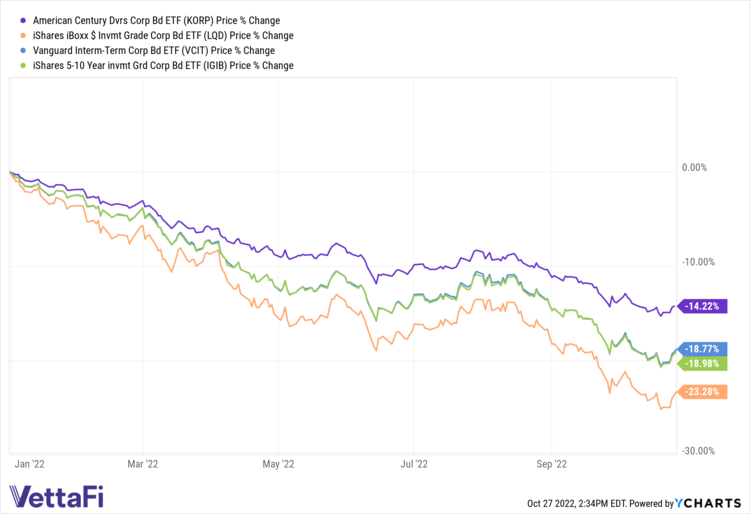
KORP has outperformed several other competing investment-grade corporate bond ETFs year-to-date, including the Vanguard Intermediate-Term Corporate Bond ETF (VCIT A), the iShares Intermediate-Term Corporate Bond ETF (IGIB A-), and the iShares iBoxx $ Investment Grade Corporate Bond ETF (LQD A).

KORP Helps Mitigate Investment Losses

“Most bond funds have seen a price decline this year,” said Ed Rosenberg, senior vice president and head of ETFs at American Century Investments. “Most people don’t think about bond funds as a place to look for tax loss harvesting.”

KORP has an expense ratio of 0.29%.

For more news, information, and strategy, visit the Core Strategies Channel.


Content continues below advertisement

Loading Articles...

Advertisement

Is Your Portfolio Positioned With Enough Global Exposure?

ETF Education Channel

How to Allocate Commodities in Portfolios

Tom LydonApr 26, 2022
2022-04-26

A long-running debate in asset allocation circles is how much of a portfolio an investor should...

Core Strategies Channel

Why ETFs Experience Limit Up/Down Protections

Karrie GordonMay 13, 2022
2022-05-13

In a digital age where information moves in milliseconds and millions of participants can transact...

}
X