


Among the current wave of altcoin ETF launches, a growing number of products are hitting the market that many advisors and investors still don’t know well. Bitcoin has a strong narrative at this point, and even ethereum’s story is becoming more mainstream — but other altcoins still remain relatively under-the-radar. Recently, I walked through Solana and why it resonated even in a period of falling prices. It is worth doing the same for XRP. Here’s what you need to know about XRP and how to invest through ETFs.
Why XRP?
XRP is a digital asset that is the native token of the XRP Ledger (XRPL). This blockchain has real world use cases. It is used globally to make cross-border payments faster and more efficient. It reduces the layers and complexity that can be involved while maintaining a high level of security. For instance, XRP can process 1,500 transactions per second while bitcoin can process only about 3. Transactions can settle in 3–5 seconds vs. 500 seconds for bitcoin (for more details, check out the XRP Ledger’s official site. )
XRP also increasingly overlaps with the tokenization and stablecoin narrative. The XRP Ledger supports issued tokens that can represent a wide range of assets. Franklin Templeton, for example, will issue its tokenized money market fund units on the XRP Ledger. Amplify launched both a stablecoin and a tokenization ETF (the Amplify Stablecoin Technology ETF (STBQ) and the Amplify Tokenization Technology ETF (TKNQ)) recently which both hold XRP ETFs as part of the growing infrastructure for these two related themes.
Finally, regulatory risk has been a barrier for XRP, but that has diminished. The SEC formally ended its lawsuit against Ripple in August 2025, closing a long chapter of uncertainty.
Despite Popularity as a Digital Asset, XRP Is Small Relative to Bitcoin
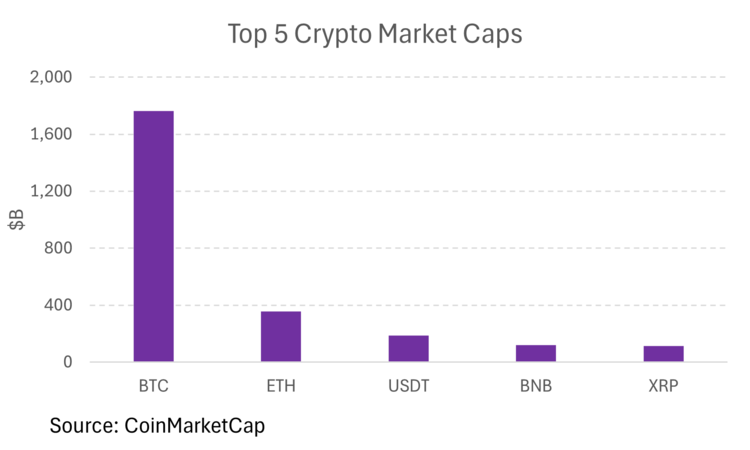
For advisors, XRP exposure usually fits best as a satellite rather than a core position. Bitcoin holds market dominance with over $1.7 trillion in market cap (according to data from CoinMarketCap). While XRP is currently the fifth largest cryptocurrency by market cap, it’s only $115 billion (relatively small compared to bitcoin). Investors with higher conviction for XRP’s role in the financials and banking world may want to add on a portion to their existing crypto allocation while keeping Bitcoin at a core. Alternatively, investors may prefer a diversified basket crypto ETF like the Grayscale CoinDesk Crypto 5 ETF GDLC, which has a 5% allocation to XRP.
XRP ETFs Steadily Gathering Assets
Like with many spot crypto ETFs, the story started with derivatives-based ETFs. The first wave, in early 2025, started with futures-based and 2x products launched by Teucrium and VolatilityShares, which were later followed by ProShares and REX-Shares.
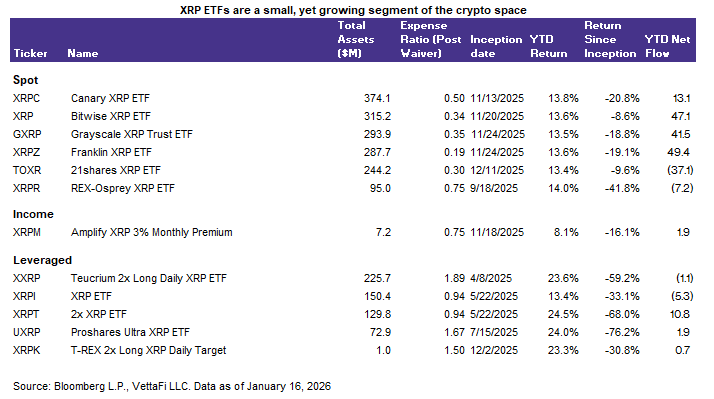
REX-Osprey launched the first spot XRP ETF on September 2025 (although this used the 1940 Act structure). And after the generic listing standards were introduced and streamlined launches, more spot ETFs arrived (in the traditional 1933 Act format). The first launched was the Canary XRP ETF (XRPC), soon followed by the Bitwise XRP ETF (XRP), the Grayscale XRP Trust ETF (GXRP), the Franklin XRP ETF (XRPZ), and the 21shares XRP ETF (TOXR).
Not every issuer has joined the crowd, however. CoinShares and WisdomTree actually withdrew filings for a spot XRP ETF recently. This is likely due to focusing on other strategies among a crowded product arena.
While Canary’s XRPC has the most assets ($374 million), the rest follow closely behind with all around $250 million in assets or higher. There is little differentiation for most investors, except for brand and fees. Grayscale and Franklin both have short-term fee waivers, but fees are generally in the 30 bps range. Franklin’s XRPZ has the lowest expense ratio (post-waiver) at 19 bps. So far, most have seen some healthy net inflows less than a month into the new year. Bitwise’s XRP, Grayscale’s GXRP, and Franklin’s XRPZ, for example, have gathered close to $50 million in net inflows each so far in January.
Bottom Line
For newer investors in the crypto ETF space, XRP may be attractive as a next-gen path for the banking and financials sector. It is important to remember that in a diversified portfolio, XRP is not typically a core holding, but instead a complement to core crypto holdings like bitcoin.
For more news, information, and strategy, visit ETFDB.

