


Comcast Corp. (CMCSA) sent shockwaves through the media landscape with the announcement that it would spin off its media business today. The telecommunications giant will divest its traditional cable television networks, namely NBCUniversal and Sky, into a standalone, publicly traded company. It accomplished the same in 2024 when it spun off cable channels like CNBC and MSNBC into Versant Media.
Key Takeaways
- Comcast announced a tax-free spinoff of NBCUniversal and Sky, creating a standalone media entity while retaining its core broadband and wireless connectivity business.
- The corporate breakup sent Comcast shares surging in early trading, providing a major lift to communication ETFs like XLC, FCOM, and VOX, which hold substantial positions in the company.
- Because Comcast is a foundational high-yield holding, dividend-tracking ETFs like RDIV and FDL are closely watching how the split will distribute cash-return profiles between the agile broadband business and the new media giant.
See More: Don’t Overlook the Potential of Communication Services ETFs
Comcast Stock Spikes
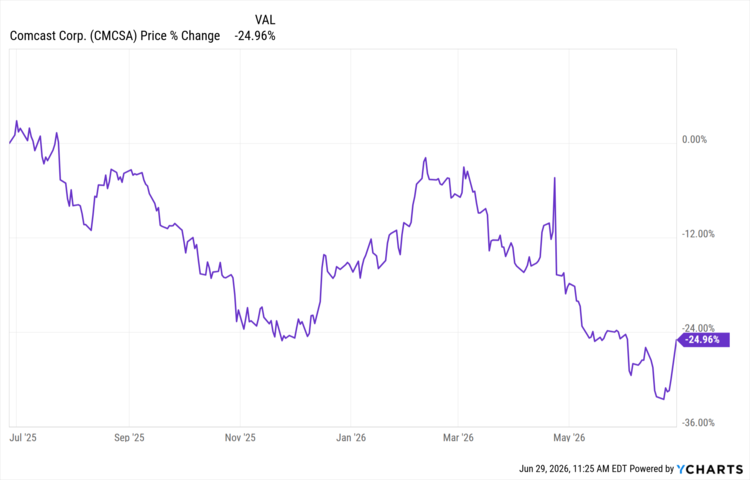
Once the news of the spinoff broke, traders pounced in the market’s early session. Comcast’s stock went up as much as 17% before profit-taking eventually ensued.
It was a much-needed resuscitation for Comcast shareholders, who’ve seen the stock price fall over 50% within the last five years, 37% the last three years, and 25% within the past year. Thus far in 2026, the stock is down about 12%.
In the long-term horizon, it could be a net positive for investors who think this spinoff could unlock value in Comcast. By separating its high-growth broadband, wireless, streaming (Peacock), and theme park businesses from its declining traditional cable networks, Comcast is essentially rewriting its operational playbook. With pressure from streaming rivals, Comcast is looking to achieve greater flexibility in a competitive market by scaling down its operations.
The effects of this corporate divorce extend beyond the walls of Comcast. The company is a cornerstone holding in various ETFs, affecting those with the biggest allocations to its stock. This includes sector and dividend-focused ETFs. For investors looking for a post-news drift effect that could prop up certain ETFs, below are some funds to consider.
Sector Impact: Communication ETFs
The gravity of this spinoff will be felt most in communication ETFs with the largest weight of Comcast. At just under a 4.5% allocation, the State Street Communication Services Select Sector SPDR Fund (XLC ) is the fund with the great exposure (as of June 26, 2026). At about a 4% allocation, the Fidelity MSCI Communication Services Index ETF (FCOM ) is noteworthy. Meanwhile, the Vanguard Communication Services ETF (VOX ) rounds out the top three with just under a 4% allocation.
Traditionally, Comcast’s cable infrastructure has been a somewhat defensive anchor within these tech-adjacent, high-beta sectors. A more streamlined Comcast, as a result of this pruning for growth strategy, could help breathe life back into the legacy cable company.
Dividend ETFs See Spinoff Impact
Income-focused funds with Comcast allocations are also feeling the weight of the news. Comcast has been a foundational holding for dividend trackers, which allows it to gain entry into funds like the Invesco S&P Ultra Dividend Revenue ETF (RDIV ) and the First Trust Morningstar Dividend Leaders Index Fund (FDL ). RDIV has a 3.8% allocation while FDL is at 2.9% (also as of June 26, 2026).
Lauded for its stable cash flows, Comcast’s dividend profile makes it a prime option for retail and institutional yield-seekers alike. Of course, given the latest news regarding the spinoff, it will be interesting to observe how the dividend policy will be affected between the parent broadband company and the newly formed media entity. If the pure-play broadband business maintains its cash-return profile, funds like RDIV and FDL may benefit from a more agile Comcast.
For more news, information, and analysis, visit the Equity ETF Content Hub.

