


United Kingdom equities offer investors developed market exposure to resilient, globally diversified sector leaders in energy, healthcare, and finance through ETFs. However, exposure requires an understanding of how regional and country-specific funds handle allocations to the UK. Prospective investors seeking exposure must decide between direct single-country funds or broader European strategies where UK inclusion can vary from fund to fund.
Key Takeaways:
- Single-country UK ETFs provide direct, concentrated access to British blue-chip and small-cap equities.
- Regional European ETFs take a market-cap-weighted approach that retains UK exposure alongside mainland markets.
- Certain active and currency-hedged European strategies exclude UK equities entirely to insulate portfolios from British pound currency volatility during domestic political shifts.
See More: Single-Country Swagger: Capture Localized Alpha With These ETFs
Direct UK Access: Single-Country ETFs
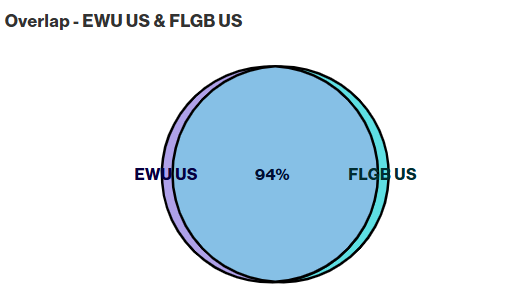
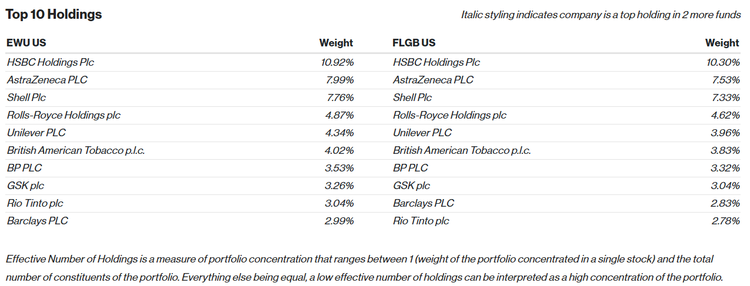
For investors seeking targeted exposure to British markets, single-country ETFs provide tailored options with varying exposures to market caps and fee structures. With brand recognition and over $4 billion in assets to boot, the iShares MSCI United Kingdom ETF (EWU ) tracks the MSCI United Kingdom Index and serves as the flagship fund for large-cap British equities. There’s also the Franklin FTSE United Kingdom ETF (FLGB ) that follows the FTSE UK RIC Capped Index to offer broader large- as well as mid-cap exposure. This, in effect, brings up the question: how are the two different? An analysis of both portfolios reveals a 94% holdings overlap with the top 10 holdings being nearly identical except for slight differences in weighting allocations. If cost is the prime motivator, then the 0.09% expense ratio of FLGB will attract those investors while EWU will appeal to those seeking a larger, more liquid fund.
Investors seeking localized economic growth and domestic revenue generation can tailor their exposure to small-cap companies in the UK. For this, they can turn to the iShares MSCI United Kingdom Small-Cap ETF (EWUS ) to add that level of country-specific growth exposure. Another interesting option is the First Trust United Kingdom AlphaDEX Fund (FKU ). The fund tracks the Nasdaq AlphaDEX United Kingdom Index and uses a rules-based quantitative model that ranks UK stocks by growth and value factors to select the top 75 holdings. These stocks are quintile-weighted and sector-constrained with semi-annual reconstitution to optimize exposure.
Regional Funds With UK Allocations
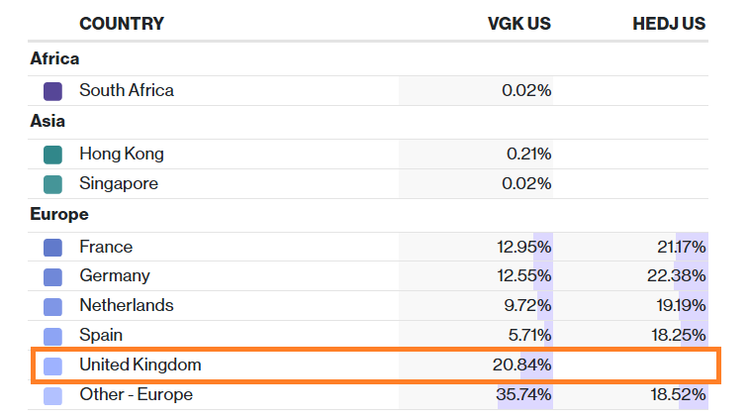
When using broader European funds for regional coverage, portfolio construction will vary when it comes to specific exposure to the UK market. Funds focused on broader geographic Europe, such as the Vanguard FTSE Europe ETF (VGK ), include the UK as a primary holding based on its market-cap weight. VGK tracks the FTSE Developed Europe All Cap Index using physical replication, incorporating the UK alongside countries such as France, Germany, and Switzerland. One notable aspect is VGK remains unhedged across multiple regional currencies.
Conversely, strategies targeting Eurozone exporters, such as the WisdomTree Europe Hedged Equity Fund (HEDJ ), completely exclude the UK. This exclusion can be beneficial when geopolitical events could cause wild fluctuations in the local currency. For example, the UK recently installed a new finance minister, which could bring a degree of uncertainty regarding the direction of the British pound and any spillover into the broader euro. As such, HEDJ focuses strictly on mainland Eurozone equities and systematically hedges against fluctuations between the US dollar and the euro. Because the UK operates outside the Eurozone using the British pound, it falls outside of HEDJ’s methodology.
Choosing the Right ETF
Selecting the optimal fund depends on how investors want to address portfolio granularity as well as currency exposure. Single-country vehicles like EWU, FLGB, and EWUS deliver complete direct target exposure to British equities while retaining British pound currency risk.
On the other hand, broader international allocation using VGK can naturally capture UK equity exposure as part of its multi-currency developed Europe mandate. Meanwhile, those utilizing currency-hedged Eurozone strategies like HEDJ will find that the UK is excluded entirely, requiring a standalone UK vehicle if they wish to attain comprehensive European coverage.
For more news, information, and analysis, visit the Equity ETF Content Hub.

