
ETFdb Logo
  • ETF Database
  • Content Hubs
    • Themes
      • Active ETF
      • Alternatives
      • Artificial Intelligence
      • China Insights
      • Core Strategies
      • Crypto
      • Disruptive Technology
      • Energy Infrastructure
      • ETF Building Blocks
      • ETF Investing
      • ETF Strategist
      • Financial Literacy
      • Fixed Income
      • Free Cash Flow
      • Future ETFs
      • Innovative ETFs
      • Institutional Income Strategies
      • Leveraged & Inverse
      • Market Insights
      • Market Outlooks
      • Modern Alpha
      • Nuclear Energy
      • Portfolio Strategies
      • Sector Investing
      • Tax Efficient Income
      • Thematic Investing
    • Asset Class
      • Equity
        • U.S. Equity
        • Int'l Developed
        • Emerging Market Equities
      • Alternatives
        • Gold/Silver/Critical Materials
        • Cryptocurrency
        • Currency
        • Volatility
      • Fixed Income
        • Investment Grade Corporates
        • US Treasuries & TIPS
        • High Yield Corporates
        • Int'l Fixed Income
    • ETF Ecosystem
    • ETFs in Canada
    • Market Outlook
    • Crypto ETF Hub
  • Tools
    • ETF Screener
    • ETF Country Exposure Tool
    • ETF Database Categories
    • Indexes
    • Scenario Analysis
    • Watchlists
    • Head-To-Head ETF Comparison Tool
    • Mutual Fund To ETF Converter
    • ETF Stock Exposure Tool
    • ETF Issuer Fund Flows
  • Research
    • ETF Education
    • Equity Investing
    • Dividend ETFs
    • Leveraged ETFs
    • Inverse ETFs
    • Index Education
    • Index Insights
    • Top ETF Sectors
    • Top ETF Issuers
    • Top ETF Industries
  • Webcasts
  • Sectors
    • Sector Investing Content Hub
    • XLK
    • XLI
    • XLU
    • XLY
    • XLP
    • XLRE
    • Sector Power Rankings
    • XLE
    • XLC
    • XLF
    • XLV
    • XLB
  • Multimedia
    • ETF 360 Video Series
    • ETF of the Week Podcast
    • Gaining Perspective Podcast
    • ETF Prime Podcast
    • Video
  • Company
    • About VettaFi
    • Get VettaFi’ed
  • PRO
    • Pro Content
    • Pro Tools
    • Advanced
    • FAQ
    • Free sign up
    • Login
  1. ETF Building Blocks Content Hub
  2. Mid Cap Stocks Matter Like Never BFOR
ETF Building Blocks Content Hub
Share

Mid Cap Stocks Matter Like Never BFOR

Tom LydonJan 15, 2021
2021-01-15

Small caps are soaring, stealing some thunder from their oft-overlooked mid cap brethren. Investors shouldn’t sleep on the stocks in the middle. One prudent mid cap play is the Barron’s 400 ETF (BFOR B).

BFOR tracks the Barron’s 400 Index (B400), which takes 400 stocks from the broader MarketGrader U.S. Coverage Universe by using a methodology that selects components based on the strength of their fundamentals in growth, valuation, profitability, and cash flow, and then screens components for certain criteria regarding concentration, market capitalization, and liquidity.

“The characteristics inherent in mid capitalization U.S. equities have led to nearly 35 years of consistent and meaningful outperformance relative to small and large cap equities,” according to RBC Global Asset Management. “Indeed, this asset class is ripe with opportunities to invest in high quality, established organizations with substantial growth potential.”

“Understanding the appropriate allocation to mid-cap equities within a broader asset allocation framework will depend on the individual investors’ risk and return profile,” adds State Street Global Advisors. “Investor preference notwithstanding, a distinct allocation to mid-caps should be a part of any strategic or tactical asset allocation mix, as basic examples show that the effects of avoiding the middle can potentially negatively impact portfolios.”
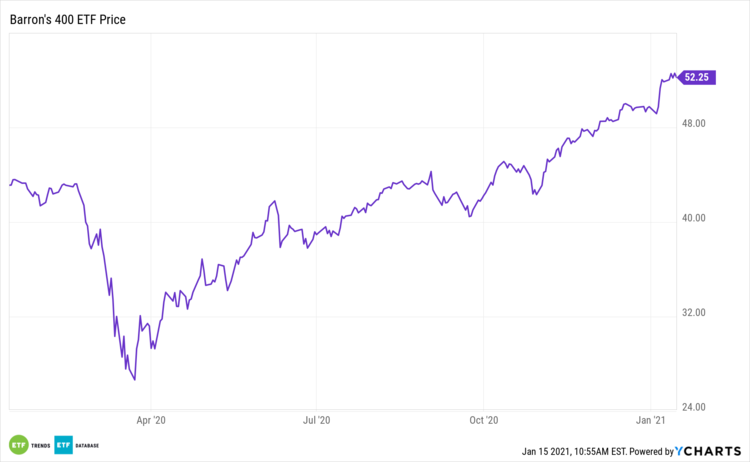
BFOR 1 Year Performance

Bet on BFOR in 2021

BFOR is classified as a mid cap growth fund, a factor combination that’s historically potent, but one that also comes with elevated valuations. BFOR looks to access that growth before it becomes too pricey.

Mid cap companies are slightly more diversified than their small cap peers, which allows many mid-sized companies to generate more consistent revenue and cash flow, along with more stable stock prices. Many are not so big that their size slows down growth.

“Mid cap companies tend to live in the “sweet spot” of the business life cycle—they offer the stability of more mature firms (having surpassed the high risk, early development stage associated with start-ups), but retain the high growth potential of younger firms (which generally abates as firms mature and grow),” notes RBC.

The mid cap category has also outperformed its larger peers, but with lower volatility than small caps. Moreover, the returns of mid cap stocks have also beaten those of small cap stocks during the trailing three-, five-, and 10-year periods, with lower volatility boot.

Alternatives to BFOR in the mid cap growth space include the iShares Russell Midcap Growth ETF (IWP A-), First Trust Mid Cap Growth AlphaDEX Fund (FNY C), and the iShares Morningstar Mid Growth ETF (JKH B-).

For more on cornerstone strategies, visit our ETF Building Blocks Channel.


Content continues below advertisement

Loading Articles...

Advertisement

Is Your Portfolio Positioned With Enough Global Exposure?

ETF Education Channel

How to Allocate Commodities in Portfolios

Tom LydonApr 26, 2022
2022-04-26

A long-running debate in asset allocation circles is how much of a portfolio an investor should...

Core Strategies Channel

Why ETFs Experience Limit Up/Down Protections

Karrie GordonMay 13, 2022
2022-05-13

In a digital age where information moves in milliseconds and millions of participants can transact...

}
X
