ETFdb Logo
  • ETF Database
  • Content Hubs
    • Themes
      • Active ETF
      • Alternatives
      • Artificial Intelligence
      • China Insights
      • Core Strategies
      • Crypto
      • Disruptive Technology
      • Energy Infrastructure
      • ETF Building Blocks
      • ETF Investing
      • ETF Strategist
      • Financial Literacy
      • Fixed Income
      • Free Cash Flow
      • Future ETFs
      • Innovative ETFs
      • Institutional Income Strategies
      • Leveraged & Inverse
      • Market Insights
      • Market Outlooks
      • Modern Alpha
      • Nuclear Energy
      • Portfolio Strategies
      • Sector Investing
      • Tax Efficient Income
      • Thematic Investing
    • Asset Class
      • Equity
        • U.S. Equity
        • Int'l Developed
        • Emerging Market Equities
      • Alternatives
        • Gold/Silver/Critical Materials
        • Cryptocurrency
        • Currency
        • Volatility
      • Fixed Income
        • Investment Grade Corporates
        • US Treasuries & TIPS
        • High Yield Corporates
        • Int'l Fixed Income
    • ETF Ecosystem
    • ETFs in Canada
    • Market Outlook
    • Crypto ETF Hub
  • Tools
    • ETF Screener
    • ETF Country Exposure Tool
    • ETF Database Categories
    • Indexes
    • Scenario Analysis
    • Watchlists
    • Head-To-Head ETF Comparison Tool
    • Mutual Fund To ETF Converter
    • ETF Stock Exposure Tool
    • ETF Issuer Fund Flows
  • Research
    • ETF Education
    • Equity Investing
    • Dividend ETFs
    • Leveraged ETFs
    • Inverse ETFs
    • Index Education
    • Index Insights
    • Top ETF Sectors
    • Top ETF Issuers
    • Top ETF Industries
  • Webcasts
  • Sectors
    • Sector Investing Content Hub
    • XLK
    • XLI
    • XLU
    • XLY
    • XLP
    • XLRE
    • Sector Power Rankings
    • XLE
    • XLC
    • XLF
    • XLV
    • XLB
  • Multimedia
    • ETF 360 Video Series
    • ETF of the Week Podcast
    • Gaining Perspective Podcast
    • ETF Prime Podcast
    • Video
  • Company
    • About VettaFi
  • PRO
    • Pro Content
    • Pro Tools
    • Advanced
    • FAQ
    • Free sign up
    • Login
  1. ETF Education Content Hub
  2. Nasdaq-100 Inclusion Boosts Liquidity in Foreign Stocks
ETF Education Content Hub
Share

Nasdaq-100 Inclusion Boosts Liquidity in Foreign Stocks

Tom LydonOct 01, 2021
2021-10-01

The Nasdaq-100 Index (NDX) differs from broad market competitors, such as the S&P 500, in a variety of ways. For example, NDX significantly overweights technology stocks and features no exposure to the financial services sector.

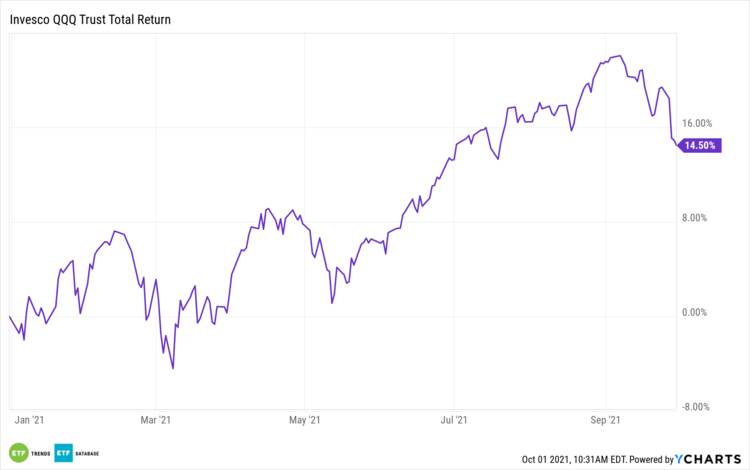
Something that goes overlooked, however, is that the Nasdaq-100 includes foreign companies, which the S&P 500 does not. That means that popular exchange traded funds tracking NDX, such as the Invesco QQQ Trust (QQQ B) and the Invesco NASDAQ 100 ETF (QQQM B+), include some ex-U.S. equities on their respective rosters.
Invesco QQQ Trust Total Return
Invesco Nasdaq 100 ETF

Content continues below advertisement

The reason that QQQ and QQQM hold some foreign stocks is simple. While the S&P 500 and Russell 1000 indexes require companies to be based in the U.S. for entry into those benchmarks, NDX simply requires that a firm be listed on the Nasdaq. For foreign companies gaining entry into the Nasdaq-100, there are liquidity benefits.

“Index tracking helps attract more investors. Exchange-traded products tracking the Nasdaq-100 have an aggregate asset base of over $230 billion. That means for every 1% in Nasdaq-100 index weight, a company can expect to have around $2 billion of additional index investor interest,” notes Phil Mackintosh of Nasdaq.

While many ETF investors, particularly those embracing a cost-effective fund like QQQM, are long-term investors, that doesn’t harm liquidity. In fact, the Nasdaq-100 has some of the best liquidity among the major equity gauges.

“The QQQ’s, one of the most liquid ETFs in the world, trading around $15 billion each day,” adds Mackintosh. “Nasdaq-100 futures that trade over $176 billion each day across E-mini Micro E-mini. Nasdaq-100 options that have average notional trading, based on option prices, of $25 billion each day.”

For investors seeking exposure to individual foreign equities, the Nasdaq-100 serves as a solid frame of reference because international stocks residing in the benchmark are highly liquid, and that liquidity can lead to lower transaction costs.

“The data shows that, for the large-cap stocks from the average and median spread (in basis points) are also lower for the foreign listings included in the Nasdaq-100,” says Mackintosh. “That should translate to lower trading costs and lower costs of capital for those listings.”

While QQQ and QQQM aren’t heavily allocated to foreign stocks, the ETFs are home to some familiar ex-U.S. names, such as JD.com (NASDAQ:JD) and MercadoLibre (NASDAQ:MELI), among others. Enhanced liquidity across NDX, regardless of components’ home country, is a plus for investors because it can lead to tighter spreads and lower costs for investors transacting in QQQ and QQQM.

For more news, information, and strategy, visit the ETF Education Channel.

Loading Articles...

Advertisement

Is Your Portfolio Positioned With Enough Global Exposure?

ETF Education Channel

How to Allocate Commodities in Portfolios

Tom LydonApr 26, 2022
2022-04-26

A long-running debate in asset allocation circles is how much of a portfolio an investor should...

Core Strategies Channel

Why ETFs Experience Limit Up/Down Protections

Karrie GordonMay 13, 2022
2022-05-13

In a digital age where information moves in milliseconds and millions of participants can transact...

}
X