

ETFdb Logo
  • ETF Database
  • Content Hubs
    • Themes
      • Active ETF
      • Alternatives
      • Artificial Intelligence
      • China Insights
      • Core Strategies
      • Crypto
      • Disruptive Technology
      • Energy Infrastructure
      • ETF Building Blocks
      • ETF Investing
      • ETF Strategist
      • Financial Literacy
      • Fixed Income
      • Free Cash Flow
      • Future ETFs
      • Innovative ETFs
      • Institutional Income Strategies
      • Leveraged & Inverse
      • Market Insights
      • Market Outlooks
      • Modern Alpha
      • Nuclear Energy
      • Portfolio Strategies
      • Sector Investing
      • Tax Efficient Income
      • Thematic Investing
    • Asset Class
      • Equity
        • U.S. Equity
        • Int'l Developed
        • Emerging Market Equities
      • Alternatives
        • Gold/Silver/Critical Materials
        • Cryptocurrency
        • Currency
        • Volatility
      • Fixed Income
        • Investment Grade Corporates
        • US Treasuries & TIPS
        • High Yield Corporates
        • Int'l Fixed Income
    • ETF Ecosystem
    • ETFs in Canada
    • Market Outlook
    • Crypto ETF Hub
  • Tools
    • ETF Screener
    • ETF Country Exposure Tool
    • ETF Database Categories
    • Indexes
    • Scenario Analysis
    • Watchlists
    • Head-To-Head ETF Comparison Tool
    • Mutual Fund To ETF Converter
    • ETF Stock Exposure Tool
    • ETF Issuer Fund Flows
  • Research
    • ETF Education
    • Equity Investing
    • Dividend ETFs
    • Leveraged ETFs
    • Inverse ETFs
    • Index Education
    • Index Insights
    • Top ETF Sectors
    • Top ETF Issuers
    • Top ETF Industries
  • Webcasts
  • Sectors
    • Sector Investing Content Hub
    • XLK
    • XLI
    • XLU
    • XLY
    • XLP
    • XLRE
    • Sector Power Rankings
    • XLE
    • XLC
    • XLF
    • XLV
    • XLB
  • Multimedia
    • ETF 360 Video Series
    • ETF of the Week Podcast
    • Gaining Perspective Podcast
    • ETF Prime Podcast
    • Video
  • Company
    • About VettaFi
  • PRO
    • Pro Content
    • Pro Tools
    • Advanced
    • FAQ
    • Free sign up
    • Login
  1. Fixed Income Content Hub
  2. 2 Investment-Grade Options as Investors Eschew Risky Debt
Fixed Income Content Hub
Share

2 Investment-Grade Options as Investors Eschew Risky Debt

Ben HernandezJul 15, 2024
2024-07-15

The scramble for attaining higher yields before central bank rate cuts doesn’t mean investors aren’t exercising due diligence. In fact, they’re eschewing risky debt and opting for higher-quality options,  according to the Financial Times.

The move comes amid an increased number of bankruptcy filings as debt service costs remain elevated in the current high-interest-rate environment. As such, a number of traders are reducing their exposure to risky corners of the debt market.

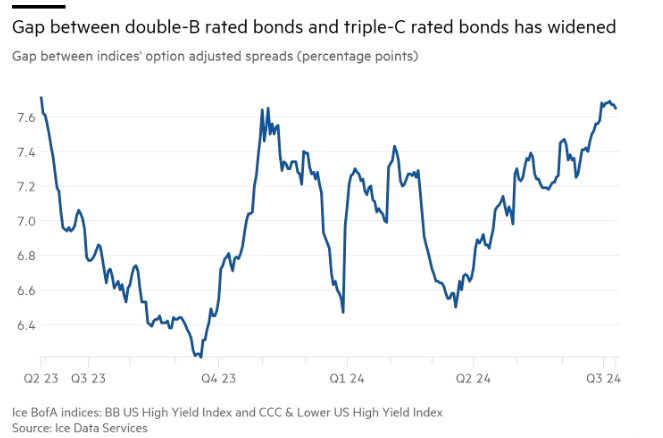
From a technical standpoint, the disparity in yields is showing up between BB-rated and CCC-rated debt. There’s increasing concern that companies saddled with heavy debt cannot continue operating with high borrowing costs.

“The gap in borrowing costs between companies rated triple-C and lower — the lowest rungs of the $1.3tn US junk bond market — and double-B — the highest rung — has surged to almost its widest level since May last year, according to Ice BofA data, as investors seek safer names,” the FT article explained.

As the expectation of rate cuts gets pushed farther out, the gap between these two debt ratings could widen further as debt service costs mount. According to Torsten Slok, chief economist at investment firm Apollo, this is “a reflection of worries about the cocktail of higher for longer and the risk of a recession, which would ultimately be of course very bad news for the most highly levered companies.”
Core, Investment-Grade Options

Core, Investment-Grade Options

Investors looking for yield and core bond exposure who want to stay within the confines of investment-grade debt can consider passive and active options from Vanguard.

For a passive option, investors should opt for the Vanguard Total Bond Market Index Fund ETF Shares (BND A-). It seeks to track the performance of the Bloomberg U.S. Aggregate Float Adjusted Index. That index represents a wide spectrum of public, investment-grade, taxable, fixed income securities in the U.S., including government, corporate, and international dollar-denominated bonds, as well as mortgage-backed and asset-backed securities, all with maturities of more than one year.

An active option to consider is the Vanguard Core Bond ETF (VCRB B), which can be beneficial with its added market flexibility. The ETF mitigates credit risk via diversified exposure to the U.S. investment-grade bond market. However, the actively managed VCRB also extends its exposure to other fixed income assets for diversification, including mortgage-backed securities and corporate securities. The fund harnesses the portfolio management capabilities of the Vanguard Fixed Income Group at a low 0.10% expense ratio.


Content continues below advertisement

For more news, information, and analysis, visit the Fixed Income Channel.

Loading Articles...

Advertisement

Is Your Portfolio Positioned With Enough Global Exposure?

ETF Education Channel

How to Allocate Commodities in Portfolios

Tom LydonApr 26, 2022
2022-04-26

A long-running debate in asset allocation circles is how much of a portfolio an investor should...

Core Strategies Channel

Why ETFs Experience Limit Up/Down Protections

Karrie GordonMay 13, 2022
2022-05-13

In a digital age where information moves in milliseconds and millions of participants can transact...

}
X
