


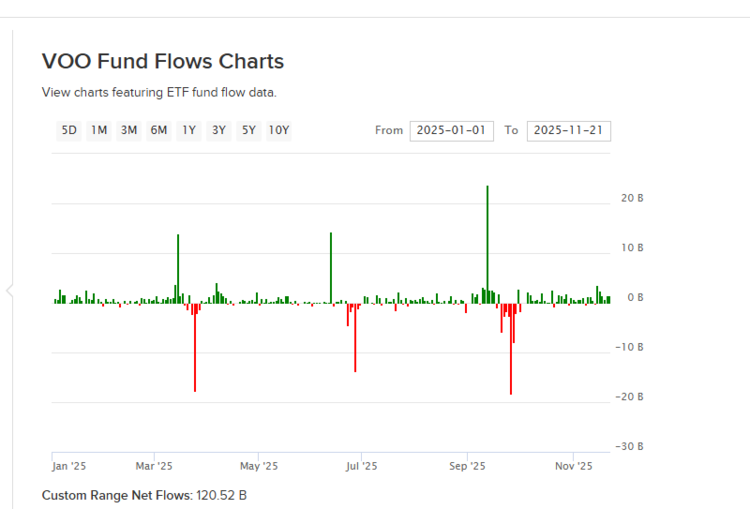
The CBOE Volatility Index (VIX) rising 30% within the past month didn’t get in the way of inflows for the +Vanguard S&P 500 ETF+ (VOO ). The ETF notched just over $120.5 billion inflows through November 21, beating out last year’s $116 billion.
As mentioned, the final leg of the race to cross the $120 billion mark was fraught with some recent market volatility, but VOO continues to shine as the prime choice for getting S&P 500 exposure. From a macro perspective, it’s also an amazing feat. 2025 was full of obstacles such as a new presidential administration, tariffs, geopolitical tensions, a government shutdown, and other factors potentially tripping up inflows. It’s not just a win for VOO, but the entire ETF industry that surpassed last year’s trillion-dollar record.
“VOO has become the go to vehicle for many investors to gain US equity exposure,” noted TMX VettaFi head of research Todd Rosenbluth. “With the ETF industry hitting a new industry-wide flows record in 2025, it is no surprise that the Vanguard ETF has done so too. ETF adoption has never been stronger.”
A Magnificent Year
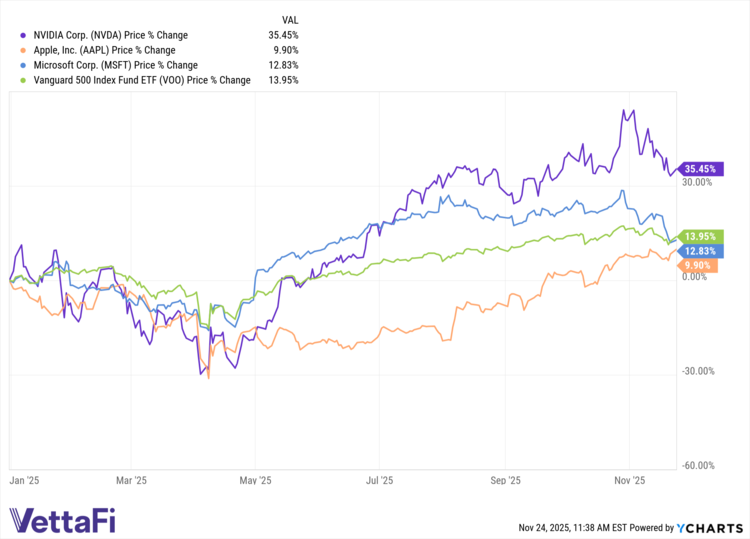
Of course, much credit to VOO is attributed to its portfolio composition. The fund features prominent roles for the Magnificent Seven: Alphabet, Amazon, Apple, Meta, Microsoft, Nvidia, and Tesla. Nvidia occupies the top spot in terms of allocation, comprising about 8.5% of the fund as of October 31. Apple is the runner up with a 6.87% allocation and Microsoft rounds out the top three with a 6.59% allocation.
Much of the Magnificent Seven’s run this year continues to be propelled by the artificial intelligence (AI) theme, which may be showing signs of waning as investors question whether valuations are in line with fundamentals. Nvidia may have quelled some concerns last week after reporting record revenue for the 2026 third quarter fiscal. Nonetheless, if the AI theme continues to propel the market, VOO will benefit in return.
Cost-Effective and Flexible
VOO was already hot coming out of the gate, surpassing the vaunted SPDR S&P 500 ETF Trust (SPY ) to become the largest ETF back in February in terms of assets under management (AUM). The ETF is representative of Vanguard’s credo of offering low-cost, indexed funds to the masses. VOO has a scant three basis points for its expense ratio. This is six basis points less than SPY, which only adds to the appeal.
Another discerning feature of VOO is its fund structure. SPY was initially set up as a unit investment trust that can’t reinvest its dividends, use derivatives to equitize cash, or lend securities as Morningstar indicated. VOO follows the more commonly seen ETF structure as an open-ended fund.
Because it tracks the S&P 500, VOO could serve as a standalone fund for U.S. equities exposure in a portfolio. Its flexibility also makes it easy to pair VOO with other funds to construct a diversified portfolio. For instance, VOO could work in conjunction with the Vanguard Total Bond Market ETF (BND ) to create a complete 60-40 portfolio with just two ETFs.
For more news, information, and analysis, visit the Fixed Income Content Hub.

