


Benchmarks are broken. That was the premise established in a conversation with Samarth Sanghavi, head of fixed income index product at TMX VettaFi, when the problem was first addressed in a previous article. TMX VettaFi creates innovative index solutions, and with the premise established that benchmarks are indeed broken, here is the fix.
Key Takeaways:
- TMX VettaFi is re-engineering fixed income benchmarks by shifting away from traditional, debt-heavy market-cap-weighted indexes toward smart beta frameworks that focus on structural liquidity and credit quality.
- Investors do not need to pay an active management fee premium to escape broken benchmarks, as enhanced passive indexes can systematically screen out excessive default risk and capture pure credit premium.
- The VettaFi Fixed Income Index Analyzer can dynamically slice and evaluate benchmarks by duration, credit quality, geography, and sector. This reduces the time required to build custom indexes from weeks to minutes.
See more: Benchmarks Are Broken: Why Antiquated Methodologies Fail Fixed Income
From Research to Direct Monetization
To reiterate the issue, the financial industry has relied on market cap weighting for over half a century. This indexing methodology systematically rewards the most indebted issuers with the heaviest index allocations. This indexing practice essentially decouples an investor’s portfolio from underlying credit quality. In short, those investing in a typical market-cap-weighted index are exposed to the most indebted rather than the highest quality. Again, how does this get fixed?
At TMX VettaFi, Sanghavi is helping to lead the structural shift to re-engineer fixed income benchmarks. The ultimate fix is a benchmark that accurately captures the breadth of the broad fixed income landscape rather than one that systematically rewards the most indebted issuers with the largest weights.
TMX VettaFi's Approach
To understand TMX VettaFi’s approach, it’s necessary to reconstruct the origins of its fixed income index product suite. Many of the firm’s 73-and-counting fixed income indexes carry deep operational track records. In a prior life, these benchmarks resided inside the walls of Credit Suisse where Sanghavi, along with Brian Coco, TMX VettaFi’s head of index products, previously managed the indexes. Under the investment banking model of Credit Suisse, however, the firm relegated these indexes to a secondary role.
“At Credit Suisse, these indices were always research products,” Sanghavi explained. “We were part of an investment bank and indexing wasn’t the primary business. Trading was our business. Indices were ancillary to the entire story.”
This changed when TMX VettaFi ultimately acquired the Credit Suisse indexes in the beginning of 2025. Summarily, the transition fundamentally re-imagined that legacy. Now, Sanghavi is focused on building structural utility with these indexes.
“The opportunity is straightforward — these indices have real, demonstrable value that has not yet been fully monetized,” said Sanghavi. “The real work is connecting this story to the right client set and creating innovative products for our clients.”
The Passive Solution to Active
Enhanced passive indexes create an array of possibilities. But what about actively managed fixed income funds where portfolio managers have the ability to dynamically adjust to changing market conditions? It’s a fair question to ask given the rising number of exchange-traded funds (ETFs) hitting the market with an actively managed mandate.
For decades, the standard response to broken, debt-weighted indexes is to simply pivot to active management. However, Sanghavi argues that investors do not need to pay an active fee premium to unshackle themselves from traditional market cap-weighted indexing.
“There’s enough juice on the passive side that I feel needs to get better advertised,” Sanghavi noted, adding that “you don’t have to go active to win.”
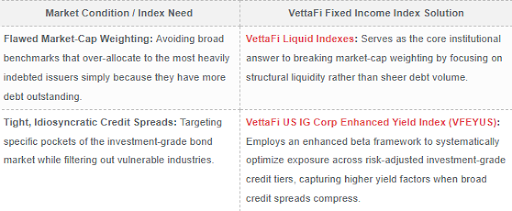
That said, TMX VettaFi now has a suite of customized smart beta indexes. Because these frameworks break the tie between an index allocation and the volume of a company’s outstanding debt, they allow passive allocators to capture pure credit premium while systematically screening out excessive default risk.
Below are sample use cases:
Unlocking Precision: Fixed Income Index Analyzer
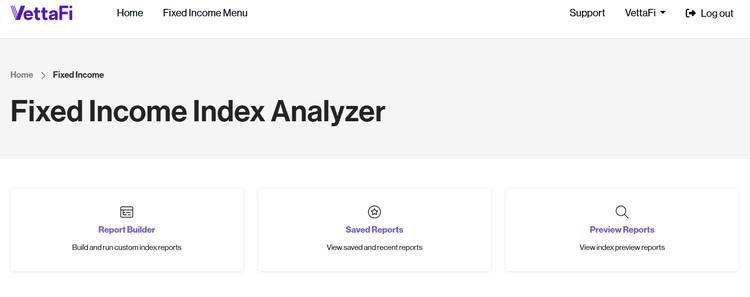
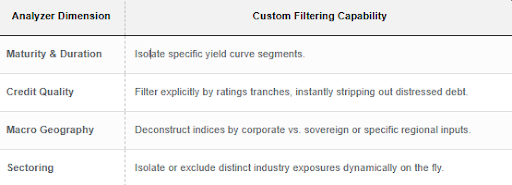
For issuers looking for custom, tailormade indexes, there’s the VettaFi Fixed Income Index Analyzer. Serving as a sophisticated front-end portal into the indexing architecture, the tool allows institutional issuers and allocators to slice, dice, and evaluate benchmarks across multiple custom risk parameters.
The primary strength of the Index Analyzer is speed and programmatic optimization. In fixed income, legacy index providers often require weeks of manual calculation to build a tailored benchmark concept. Sanghavi cited a recent example involving a prominent Canadian asset manager who was seeking a bespoke variation of the high-yield index. While speaking to another index provider, the asset manager said that the benchmark concept would take two weeks to create.
“I had the report ready for them in five minutes,” Sanghavi said.
A Smarter Roadmap for Fixed Income
By pairing deep historical data with on-the-fly index generation through its Fixed Income Index Analyzer, TMX VettaFi is transforming fixed income benchmarks from static debt registries into customizable tactical instruments. As macroeconomic environments require increased portfolio precision, the era of blindly tracking market-cap-weighted indexes is giving way to a smarter, credit-centric indexing framework. By allowing users to bypass rigid legacy baskets, these indexes are paragons of absolute precision.
“The Analyzer allows you to view index performance across a variety of dimensions.” Sanghavi said. “I can create an index that captures the short term, $300m to $500m segment of the US high-yield universe filtered to show only BBs and Bs within Financials in Europe on the fly. Some crazy esoteric slices”
As the saying goes, crazy is as crazy does. The ability for TMX VettaFi to execute these uncanny levels of customization on the fly is what turns antiquated, debt-heavy indexes into agile, high-precision tools that are built for today’s modern markets.
For more news, information, and analysis, visit the Fixed Income Content Hub.

