

ETFdb Logo
  • ETF Database
  • Content Hubs
    • Themes
      • Active ETF
      • Alternatives
      • Artificial Intelligence
      • China Insights
      • Core Strategies
      • Crypto
      • Disruptive Technology
      • Energy Infrastructure
      • ETF Building Blocks
      • ETF Investing
      • ETF Strategist
      • Financial Literacy
      • Fixed Income
      • Free Cash Flow
      • Future ETFs
      • Innovative ETFs
      • Institutional Income Strategies
      • Leveraged & Inverse
      • Market Insights
      • Market Outlooks
      • Modern Alpha
      • Nuclear Energy
      • Portfolio Strategies
      • Sector Investing
      • Tax Efficient Income
      • Thematic Investing
    • Asset Class
      • Equity
        • U.S. Equity
        • Int'l Developed
        • Emerging Market Equities
      • Alternatives
        • Gold/Silver/Critical Materials
        • Cryptocurrency
        • Currency
        • Volatility
      • Fixed Income
        • Investment Grade Corporates
        • US Treasuries & TIPS
        • High Yield Corporates
        • Int'l Fixed Income
    • ETF Ecosystem
    • ETFs in Canada
    • Market Outlook
    • Crypto ETF Hub
  • Tools
    • ETF Screener
    • ETF Country Exposure Tool
    • ETF Database Categories
    • Indexes
    • Scenario Analysis
    • Watchlists
    • Head-To-Head ETF Comparison Tool
    • Mutual Fund To ETF Converter
    • ETF Stock Exposure Tool
    • ETF Issuer Fund Flows
  • Research
    • ETF Education
    • Equity Investing
    • Dividend ETFs
    • Leveraged ETFs
    • Inverse ETFs
    • Index Education
    • Index Insights
    • Top ETF Sectors
    • Top ETF Issuers
    • Top ETF Industries
  • Webcasts
  • Sectors
    • Sector Investing Content Hub
    • XLK
    • XLI
    • XLU
    • XLY
    • XLP
    • XLRE
    • Sector Power Rankings
    • XLE
    • XLC
    • XLF
    • XLV
    • XLB
  • Multimedia
    • ETF 360 Video Series
    • ETF of the Week Podcast
    • Gaining Perspective Podcast
    • ETF Prime Podcast
    • Video
  • Company
    • About VettaFi
  • PRO
    • Pro Content
    • Pro Tools
    • Advanced
    • FAQ
    • Free sign up
    • Login
  1. Fixed Income Content Hub
  2. Stocks/Bonds Divergence Benefits Portfolio Diversification
Fixed Income Content Hub
Share

Stocks/Bonds Divergence Benefits Portfolio Diversification

Ben HernandezMar 11, 2025
2025-03-11

Unlike 2022, stocks and bonds are diverging once again, just as they should. This allows investors to reap the benefits of portfolio diversification, giving bond ETFs credence if economic growth slows and the stock market recedes.

In 2022, high inflation pummeled stocks, as investors posted that higher debt service costs would eat into corporate earnings. As equities fall, bonds can typically counteract the downside as an uncorrelated asset relative to the stock market, but that wasn’t the case. High inflation also pushed up yields, thereby applying downward pressure on bond prices.

Fast-forward to today and it appears bonds have returned to normalcy as a safe haven asset when equities falter. That divergence can be seen in the one-year time frame of the S&P 500 Bond Index juxtaposed with the S&P 500. The ebbs and flows in the broad market S&P have been countervailed by the bond index, acting as a shock absorber when equities trend lower. For the investor in a typical 60/40 stock/bond portfolio, this is the ideal scenario.

“The good news, as I see it, is that bonds and stocks have been moving in opposite directions,” said Morningstar columnist Dan Lefkovitz. “From a diversification perspective, that’s what we call negative correlation, and it means that one asset is zigging while the other asset is zagging. And that’s what you want in your portfolio. You want assets that are going to respond to different stimuli and move in different directions.”
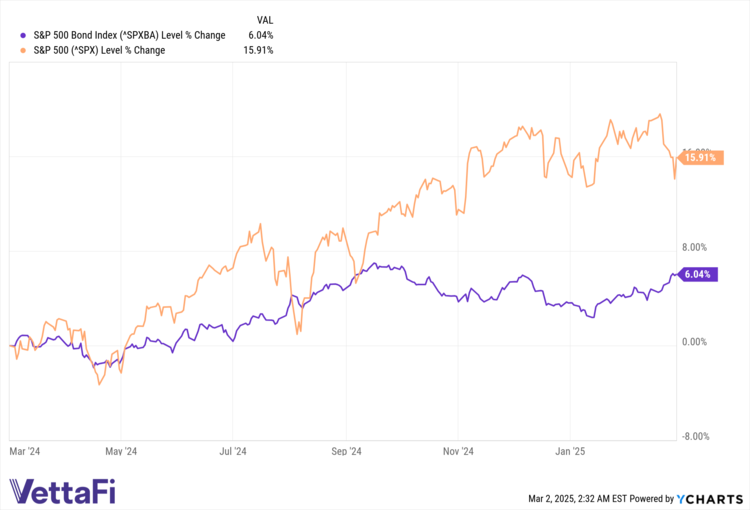
^SPXBA data by YCharts

An Active Approach to Core Bonds

As also seen in the index comparison, equities have obviously been outperforming bonds. However, if the economy starts to show signs of cooling, investors will want that shock-absorbing feature that bonds can offer.

One option is to go active, or more specifically, get exposure to the Vanguard Core Bond ETF (VCRB B). Compared to passive funds, actively managed funds allow investors to tap into the knowledge of experienced portfolio managers from the Vanguard Fixed Income Group who use their own approach to active fixed income. They can adjust holdings based on current market conditions, allowing for flexibility in volatile times as opposed to their passive counterparts.

In addition, cost-conscious investors will like the 0.10% expense ratio. In totality, VCRB invests in U.S. Treasury, mortgage-backed, and corporate securities of varying yields and maturities (short-, intermediate-, and long-term issues) for added diversification.

For more news, information, and analysis, visit the Fixed Income Channel.


Content continues below advertisement

Loading Articles...

Advertisement

Is Your Portfolio Positioned With Enough Global Exposure?

ETF Education Channel

How to Allocate Commodities in Portfolios

Tom LydonApr 26, 2022
2022-04-26

A long-running debate in asset allocation circles is how much of a portfolio an investor should...

Core Strategies Channel

Why ETFs Experience Limit Up/Down Protections

Karrie GordonMay 13, 2022
2022-05-13

In a digital age where information moves in milliseconds and millions of participants can transact...

}
X
