


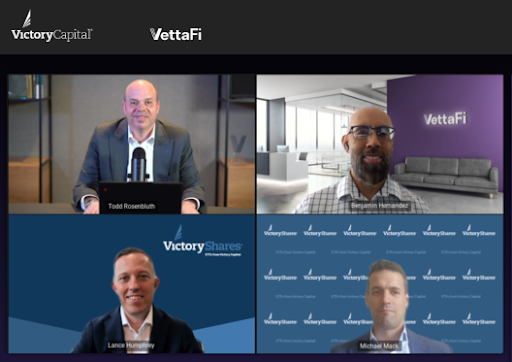
Free cash flow (FCF) is a critical measure for identifying high-quality companies, particularly in a market environment marked by ongoing uncertainty. Companies that consistently generate strong cash flow often have the financial flexibility to strengthen their businesses, return capital to shareholders, and create long-term value. One of the most visible ways they do this is through stock buybacks. In a recent webinar, “Beyond the Style Box: Finding Quality Companies With Free Cash Flow,” the VictoryShares team discussed how FCF can help investors identify companies with the potential for durable growth, attractive valuations, and shareholder-friendly capital allocation.
FCF is the cash that remains after capital expenditures are subtracted from operating cash flow. Topics included how companies deploy FCF to build shareholder value through share repurchases (or buybacks), dividends and reinvestment.
See more: Free Cash Flow: The Signal and Not the Noise
“Stock buybacks are important,” said Michael Mack, Client Portfolio Manager for VictoryShares and Solutions, citing the strategic use of cash flow alongside dividends and reinvestment in building shareholder value.
Fiscal 2026 earnings from several large-cap names underscored a trend: the return of capital to shareholders through sizable repurchase programs. Salesforce, Dell and Omnicom are each deploying FCF to buy back stock, a pattern that aligns with the FCF-based selection criteria of the VictoryShares Free Cash Flow ETF (VFLO ).
Salesforce, Dell and Omnicom: Three Buyback-Heavy VFLO Holdings
Salesforce’s (CRM) 2026 fiscal year earnings report disclosed $14.4 billion in free cash flow, up 16% year-over-year. The company returned $12.7 billion to shareholders through repurchases and authorized a new $50 billion buyback program — a move management has framed as a signal of confidence in its long-term cash generation.
Dell Technologies (DELL) grew quarterly and full-year revenue in fiscal year 2026, which helped to generate record annual cash flow from operations of $11.2 billion and $8.6 billion in free cash flow. This allowed Dell to return a record $7.5 billion to shareholders and repurchase roughly 54 million shares. Furthermore, the company authorized a $10 billion increase in share repurchases alongside a 20% dividend hike.
See more: Are Pharmaceuticals Poised for a Rebound? The Key Metric to Keep in Mind
Omnicom Group (OMC) rounded out the trio by announcing a new $5 billion buyback program in February of 2026, including $2.5 billion in accelerated share repurchase (ASR) arrangements.
How VFLO's Methodology Identifies Free Cash Flow Leaders
Each of the three is a top-10 VFLO holding. The ETF’s underlying index favors firms with the FCF strength to fund sustained buybacks. As of April 30, 2026, Salesforce was a 2.90% position, Dell 3.56% and Omnicom 3.22%.
VFLO tracks the Victory U.S. Large Cap Free Cash Flow Index, which screens companies on expected FCF, a measure that blends trailing and forward-looking estimates rather than relying on past results alone. A growth filter further screens out the slowest-growing names.
For investors looking to anchor portfolios in companies with the cash generation to reward shareholders directly, VFLO offers a disciplined, methodology-driven approach.
For more news, information, and analysis, visit the Free Cash Flow Content Hub
VettaFi LLC (“VettaFi”) is the index provider for VFLO, for which it receives an index licensing fee. However, VFLO is not issued, sponsored, endorsed, or sold by VettaFi, and VettaFi has no obligation or liability in connection with the issuance, administration, marketing, or trading of VFLO.
| VFLO’s Top 10 Holdings Weightsas of 4/30/2026 | Ticker | Weight (%) |
|---|---|---|
| Sandisk Corporation | SNDK | 4.47 |
| Dell Technologies, Inc. Class C | DELL | 3.56 |
| Cigna Group | CI | 3.38 |
| Omnicom Group Inc | OMC | 3.22 |
| Zoom Communications, Inc. Class A | ZM | 3.15 |
| Adobe Inc. | ADBE | 2.94 |
| Salesforce, Inc. | CRM | 2.9 |
| Accenture Plc Class A | ACN | 2.78 |
| Expedia Group, Inc. | EXPE | 2.74 |
| Merck & Co., Inc. | MRK | 2.50 |
Source: FactSet. Fund holdings and sector allocations are subject to change, may differ from the Index, and should not be considered investment advice.
Disclosure Information
Carefully consider a fund’s investment objectives, risks, charges, and expenses before investing. To obtain a prospectus or summary prospectus containing this and other important information, visit http://www.vcm.com/prospectus. Read it carefully before investing.
All investing involves risk, including the potential loss of principal. The market prices of securities may go up or down, sometimes rapidly or unpredictably, due to general market conditions, such as real or perceived adverse economic, political, or regulatory conditions, recessions, inflation, or changes in interest or currency rates. VFLO has the same risks as the underlying securities traded on the exchange throughout the day. ETFs may trade at a premium or discount to their net asset value. Investing in companies with high free cash flows could lead to underperformance when such investments are unpopular or during periods of industry disruptions. The fund could also be affected by company-specific factors that could jeopardize the generation of free cash flow. Index Funds invest in securities included in, or representative of securities included in, the Index, regardless of their investment merits. The performance of the Fund may diverge from that of the Index. Large shareholders, including other funds advised by the Adviser, may own a substantial amount of the Fund’s shares. The actions of large shareholders, including large inflows or outflows of cash, may adversely affect other shareholders, including potentially increasing capital gains. Investments concentrated in an industry or group of industries may face more risks and exhibit higher volatility than investments that are more broadly diversified over industries or sectors. Investments in companies in the energy sector may be subject to substantial government regulation, as well as risks involving changes in energy prices, international political instability, and liability for environmental damage and accidents resulting in loss of life or property. The profitability of companies in the healthcare sector may be affected by government regulations and healthcare programs, fluctuations in the cost of, and demand for, medical products and services and product liability claims. Derivatives may not work as intended and may result in losses. The Fund may frequently change its holdings, resulting in higher fees, lower returns, and more capital gains. The value of your investment is also subject to geopolitical risks such as wars, terrorism, trade disputes, environmental disasters, and public health crises; the risk of technology malfunctions or disruptions; and the responses to such events by governments and/or individual companies.
The Victory U.S. Large Cap Free Cash Flow Index* aims to select high quality companies from its starting universe by applying profitability* screens. It then selects companies with the strongest free cash flow yield that exhibit higher growth. The Index is rebalanced and reconstituted quarterly. This Index calculates free cash flow yield by dividing expected free cash flow by enterprise value. Expected free cash flow is the average of trailing 12-month FCF and next 12-month forward free cash flow. Enterprise value (EV) measures a company’s total value, often used as a more comprehensive alternative to equity market capitalization.
VictoryShares ETFs distributed by Victory Capital Services, Inc. (VCS). VCS is not affiliated with VettaFi.
©2026 Victory Capital Management Inc. All Rights Reserved.
20260602-5536449

