

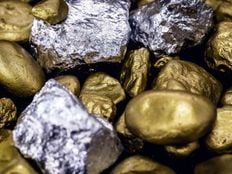
Central banks’ willingness to buy more precious metals could help buoy prices for both gold and silver. Around the globe, central banks continue to quench their thirst for both, providing investment opportunities in ETFs with exposure to both metals.
More central banks are increasing their gold reserves, but they’re harboring a home bias when mining for gold. This is especially the case with emerging market economies like the Philippines and Ecuador, which are bolstering reserves but also leaning on local mining operations. A recent World Gold Council (WGC) survey revealed that more countries are purchasing gold from domestic sources versus last year.
“One trend that we’re seeing is that some central banks, especially in Africa, Latin America, are starting to buy gold directly from domestic, small-scale gold mines, which have really proliferated because of the higher price,” said Shaokai Fan, WBC global head of central banks.
Gold also recently shrugged off the threat of potential tariffs, before U.S. president Donald Trump laid those fears to rest with the announcement of no tariffs on imported gold. The precious metal continues to hover above $3,400 per ounce, gaining almost 30% for the year.
When it comes to silver, Russia’s central bank has been a strong buyer of the precious-industrial metal. The country’s precious metal reserves as part of its State Reserve Fund are still dominated by gold and platinum. However, the country’s government announced last year that it would begin stockpiling silver as well. While it doesn’t have the central bank purchasing appeal of its more expensive brethren just yet, the move by Russia could spur others to follow suit.
“Silver has been slower off the mark, lacking buyers with the firepower of central banks or well-funded exchange-traded funds and rich private buyers,” noted journalist Tim Treadgold, who covers global mining businesses for Forbes. “But if the Russian central bank is quietly building a silver stockpile, as seems to be the case, then it is possible to see other banks aligned to Russia following its lead.”
Dynamic Duo Trending Higher
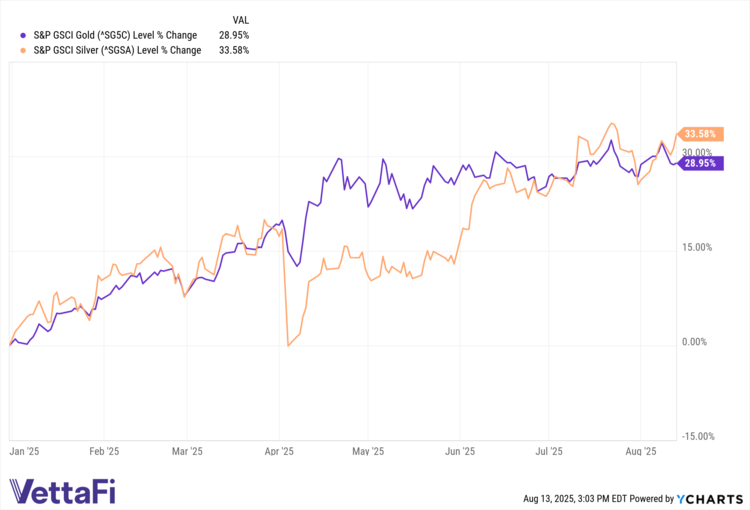
The strength in both gold and silver this year is translating into upward trends for both their S&P indexes, the S&P GSCI Gold and S&P GSCI Silver. Because of gold’s purpose as a store value during heightened volatility, it’s more closely identified as a safe haven asset. As such, it performed better during and after April’s tariff sell-off. Silver, however, is more skewed towards its industrial metal usage, though it can serve as a precious metal as well. As seen by its S&P index, it has overtaken gold as of late.
Given the investment dynamics of both gold and silver, prospective investors considering exposure may want to take a look at the Sprott Active Gold & Silver Miners ETF (GBUG). Exposure to mining companies provide investors with an alternate way to track bullion prices or, as seen in more recent market activity, allow for catch-up potential in miners.
Diversified & Actively Managed
With GBUG, investors don’t have to decide whether they want gold or silver exposure. Furthermore, GBUG is actively managed. The fund allows portfolio managers to tailor its holdings to suit market conditions that are privy to both metals.
Furthermore, the diversification may be beneficial to a portfolio. When silver falters and gold exhibits strength or vice versa, exposure to both metals could offset any opposing market forces. This adds an inherent hedging component in the fund.
Under the hood, GBUG holds companies engaged in mining, developing, exploring, and financing operations in relation to gold and silver. Country exposure also adds to the potential diversification benefits of the fund. 70% of the fund’s holdings can be found in Canada. Meanwhile, the rest is spread over the U.S., Australia, and Great Britain. This allows the fund to capture potential global upside in mining opportunities, and overall precious metals exposure in the two primary avenues: gold and silver.
“The precious metals rally reflects not only a flight to traditional safe havens, but also growing concerns about persistent inflation, currency debasement and central banks approaching the limits of policy normalization amid burgeoning levels of debt both domestically and globally,” said Sprott senior portfolio manager Shree Kargutkar.
For more news, information, and analysis, visit the Gold/Silver/Critical Minerals Content Hub.
The S&P GSCI Gold is a benchmark that tracks the price of gold through futures contracts. It helps investors see how gold is performing in the global market without needing to buy physical gold.
The S&P GSCI Silver tracks the price of silver using futures contracts. It shows how silver is doing as both a precious metal and an industrial material.
An investor should consider the investment objectives, risks, charges, and expenses carefully before investing. To obtain a Prospectus, which contains this and other information, contact your financial professional or call 888.622.1813. Read the Prospectus carefully before investing, which can also be found by clicking one of the links below.
Past performance is no guarantee of future results. One cannot invest directly in an index.
Gold and precious metals are referred to with terms of art like “store of value,” “safe haven” and “safe asset.” These terms should not be construed to guarantee any form of investment safety. While “safe” assets like gold, Treasuries, money market funds and cash generally do not carry a high risk of loss relative to other asset classes, any asset may lose value, which may involve the complete loss of invested principal.
Funds that emphasize investments in small/mid-cap companies will generally experience greater price volatility. Diversification does not eliminate the risk of investment losses. ETFs are considered to have continuous liquidity because they allow an individual to trade throughout the day. A higher portfolio turnover rate may indicate higher transaction costs and may result in higher taxes when Fund shares are held in a taxable account. These costs, which are not reflected in annual fund operating expenses, affect the Fund’s performance.
Sprott Asset Management USA, Inc. is the Investment Adviser to the ETFs. ALPS Distributors, Inc. is the Distributor for the ETFs and is a registered broker-dealer and FINRA Member. ALPS Distributors, Inc. is not affiliated with Sprott Asset Management USA, Inc. or VettaFi.
Exchange Traded Funds (ETFs): GBUG, SLVR, SETM, LITP, URNM, URNJ, COPP, COPJ, NIKL, SGDM and SGDJ

