


Market uncertainty is also affecting the cryptocurrency space. In a broad sell-off of U.S. equities during the month of February, fund flows for gold outpaced those of crypto assets.
Looking specifically at bitcoin’s price, the cryptocurrency saw a steep drop-off during February. Bitcoin fell 16%, marking its worst drop since in a month since June 2022.
In the meantime, gold maintained its momentum amid all the market uncertainty caused by tariffs and inflation. That caused a flight to safe haven assets, benefiting the precious metal and reupping its rally from 2024.
“‘Digital gold’ fell out of favor in February, but real gold did not,” Morningstar noted.
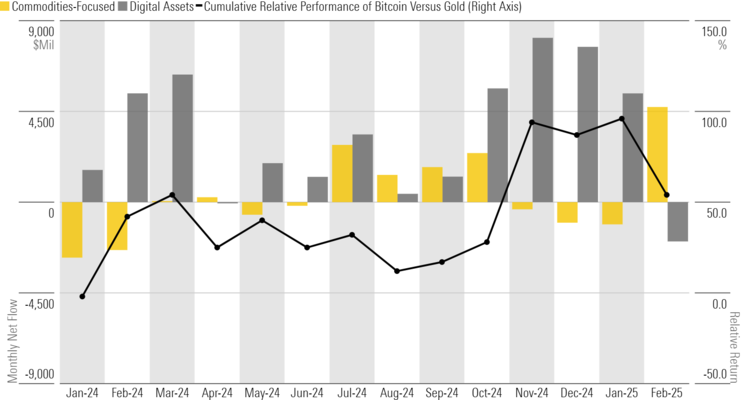
In that linked report, Morningstar also included a bar chart highlighting the performance of gold as seen in commodities-focused funds versus those housing digital assets. Bitcoin’s drop-off in February is also apparent in this chart when looking at the line graphed for the cumulative relative performance of bitcoin versus gold. Gold receded following the U.S. presidential election. Bitcoin gained momentum, but February changed that narrative.
“The commodities-focused category, which houses gold exchange-traded funds, took in $4.7 billion for the month (the most since March 2022),” Morningstar confirmed. “Digital-assets funds shed $1.9 billion as investors noted Bitcoin’s 17.4% slide in February.”
Monthly Flows for the Commodities-Focused & Digital-Assets Morningstar Categories
Getting Gold Exposure: 2 Options
When it comes to getting gold exposure, a few ways include physical bullion and an indirect way via miners. Sprott offer both in the Sprott Physical Gold Trust (PHYS) and the Sprott Gold Miners ETF (SGDM).
PHYS offers easy access to pure-play gold exposure through its fund. But it also adds a degree of flexibility by allowing investors to convert their fund shares into physical bullion. With exposure to gold via funds, investors avoid the logistics of storing gold. But they can convert their shares to bullion if they want a more tangible investment feel.
Another option for exposure is via miners. As demand for the metal rises, supportive services in the gold industry like mining can also exhibit bullishness. Rather than choosing individual mining stocks, SGDM adds broad-based exposure to miners. That eschews the overconcentration risk inherent in shares of single companies.
SGDM Seeks Specific Investment Results
SGDM seeks investment results that correspond generally to the performance of the Solactive Gold Miners Custom Factors Index. This index tracks the performance of large-cap gold companies that trade on Canadian and U.S. exchanges.
For more news, information, and analysis, visit the Gold/Silver/Critical Minerals Channel.
Disclosure Information
An investor should consider the investment objectives, risks, charges, and expenses carefully before investing. To obtain a Prospectus, which contains this and other information, contact your financial professional or call 888.622.1813. Read the Prospectus carefully before investing, which can also be found by clicking one of the links below.
Gold and precious metals are referred to with terms of art like store of value, safe haven and safe asset. These terms should not be construed to guarantee any form of investment safety. While “safe” assets like gold, Treasuries, money market funds and cash generally do not carry a high risk of loss relative to other asset classes, any asset may lose value, which may involve the complete loss of invested principal. A “bull” market is one in which prices are rising.
Past performance is no guarantee of future results. One cannot invest directly in an index.
Funds that emphasize investments in small/mid-cap companies will generally experience greater price volatility. Diversification does not eliminate the risk of investment losses. ETFs are considered to have continuous liquidity because they allow an individual to trade throughout the day. A higher portfolio turnover rate may indicate higher transaction costs and may result in higher taxes when Fund shares are held in a taxable account. These costs, which are not reflected in annual fund operating expenses, affect the Fund’s performance.
Sprott Asset Management USA, Inc. is the Investment Adviser to the ETFs. ALPS Distributors, Inc. is the Distributor for the ETFs and is a registered broker-dealer and FINRA Member. ALPS Distributors, Inc. is not affiliated with Sprott Asset Management USA, Inc. or VettaFi.
Exchange Traded Funds (ETFs): SETM, LITP, URNM, URN, COPP, COPJ, NIKL, SGDM SGDJ

