


Rare earth elements (REEs) and critical materials, despite their sometimes interchangeable use, are categorized differently. Understanding the nuances can help investors navigate the strategic shifts in 2026, which include geopolitical uncertainty.
Is It Rare Earths or Critical Materials?
Rare earth elements are critical materials, but not all critical materials are rare earths. This presents a simplified way to discern between the two, but a closer look under the proverbial microscope reveals the differences.
Critical materials is a broad umbrella term, further defined by governmental policy measures. For example, the U.S. Department of the Interior (DOI) defines critical materials as those that are essential to economic or national security. Furthermore, critical materials can also be those with associated supply chains that are vulnerable to disruption. Under the DOI, this includes a wide array of materials, including lithium, cobalt, copper, and uranium.
On the other hand, rare earths represent a specific sub-category of critical materials. In particular, these 17 metallic elements are relatively abundant in the Earth’s crust, but rarely found together and concentrated in ample supply. Furthermore, they can be difficult to extract and refine. That said, achieving economical extraction is one of the primary hurdles in the rare earths industry.
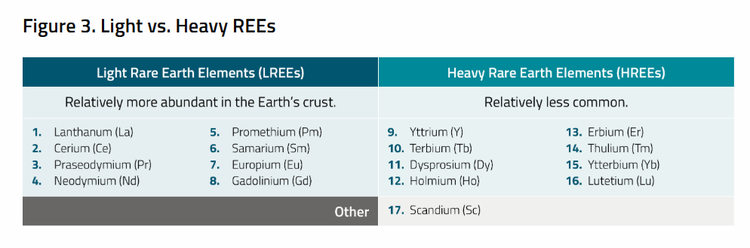
“Rare earth elements (REEs) are critical to many strategic sectors of developed economies, including defense, high-tech industries and energy, making securing their supply chain a top national priority,” explained Jacob White, Sprott’s Director of ETF product management, in a report: Rare Earths as a National Security Asset: Why Ex-China Supply Matters.
See More: Why Invest in Rare Earths? Consider These Three Use Cases
A Rare (Earths) Opportunity
For an investor looking potential opportunities in rare earths, one option to consider is the Sprott Rare Earths Ex-China ETF (REXC). This fund tracks the Nasdaq Sprott Rare Earths Ex-China Index, which offers investors a targeted way to potentially capitalize on an ex-China supply chain.
This newly launched fund offers a more concentrated, niche play in the rare earths space. The fund essentially de-monopolizes China’s influence in the rare earths supply chain to mitigate geopolitically charged risk.
“As countries continue to re-focus their priorities amid shifting economies and ongoing geopolitical challenges, ex-China supply chains will be at the center of policy, capital and strategic objectives,” White said further in the Sprott report. “For investors, understanding the importance and value of rare earths means harnessing the future of global power, technology and security.”
See More: Reworking the Rare Earths Supply Chain With Sprott’s REXC
For more news, information, and analysis, visit the Gold/Silver/Critical Minerals Content Hub.
An investor should consider the investment objectives, risks, charges, and expenses carefully before investing. To obtain a Prospectus, which contains this and other information, contact your financial professional or call 888.622.1813. Read the Prospectus carefully before investing, which can also be found by clicking one of the links below.
Past performance is no guarantee of future results. One cannot invest directly in an index.
Sprott Rare Earths Ex-China ETF is new and has limited operating history.
Nasdaq Sprott Rare Earths Ex‑China™ Index is designed to track the performance of global companies engaged in the mining, separation, refining, or production of rare earth elements, while excluding companies domiciled in or primarily operating in China.
Funds that emphasize investments in small/mid-cap companies will generally experience greater price volatility. Diversification does not eliminate the risk of investment losses. ETFs are considered to have continuous liquidity because they allow an individual to trade throughout the day. A higher portfolio turnover rate may indicate higher transaction costs and may result in higher taxes when Fund shares are held in a taxable account. These costs, which are not reflected in annual fund operating expenses, affect the Fund’s performance.
Sprott Asset Management USA, Inc. is the Investment Adviser to the ETFs. ALPS Distributors, Inc. is the Distributor for the ETFs and is a registered broker-dealer and FINRA Member. ALPS Distributors, Inc. is not affiliated with Sprott Asset Management USA, Inc. or VettaFi.
Exchange Traded Funds (ETFs): SETM, LITP, URNM, URN, COPP, COPJ, NIKL, SGDM, SGDJ, SLVR, GBUG, METL, REXC

