ETFdb Logo
  • ETF Database
  • Content Hubs
    • Themes
      • Active ETF
      • Alternatives
      • Artificial Intelligence
      • China Insights
      • Core Strategies
      • Crypto
      • Disruptive Technology
      • Energy Infrastructure
      • ETF Building Blocks
      • ETF Investing
      • ETF Strategist
      • Financial Literacy
      • Fixed Income
      • Free Cash Flow
      • Future ETFs
      • Innovative ETFs
      • Institutional Income Strategies
      • Leveraged & Inverse
      • Market Insights
      • Market Outlooks
      • Modern Alpha
      • Nuclear Energy
      • Portfolio Strategies
      • Sector Investing
      • Tax Efficient Income
      • Thematic Investing
    • Asset Class
      • Equity
        • U.S. Equity
        • Int'l Developed
        • Emerging Market Equities
      • Alternatives
        • Gold/Silver/Critical Materials
        • Cryptocurrency
        • Currency
        • Volatility
      • Fixed Income
        • Investment Grade Corporates
        • US Treasuries & TIPS
        • High Yield Corporates
        • Int'l Fixed Income
    • ETF Ecosystem
    • ETFs in Canada
    • Market Outlook
    • Crypto ETF Hub
  • Tools
    • ETF Screener
    • ETF Country Exposure Tool
    • ETF Database Categories
    • Indexes
    • Scenario Analysis
    • Watchlists
    • Head-To-Head ETF Comparison Tool
    • Mutual Fund To ETF Converter
    • ETF Stock Exposure Tool
    • ETF Issuer Fund Flows
  • Research
    • ETF Education
    • Equity Investing
    • Dividend ETFs
    • Leveraged ETFs
    • Inverse ETFs
    • Index Education
    • Index Insights
    • Top ETF Sectors
    • Top ETF Issuers
    • Top ETF Industries
  • Webcasts
  • Sectors
    • Sector Investing Content Hub
    • XLK
    • XLI
    • XLU
    • XLY
    • XLP
    • XLRE
    • Sector Power Rankings
    • XLE
    • XLC
    • XLF
    • XLV
    • XLB
  • Multimedia
    • ETF 360 Video Series
    • ETF of the Week Podcast
    • Gaining Perspective Podcast
    • ETF Prime Podcast
    • Video
  • Company
    • About VettaFi
  • PRO
    • Pro Content
    • Pro Tools
    • Advanced
    • FAQ
    • Free sign up
    • Login
  1. Index Insights
  2. Is It Time to Go All In on MLPs? (Or Is DCA the Smarter Choice?)
Index Insights
Share

Is It Time to Go All In on MLPs? (Or Is DCA the Smarter Choice?)

Maria HalmoAug 13, 2015
2015-08-13

I grew up in rural America, and despite my Irish/German/Slovakian community, my parents were quite fond of a Chinese proverb. The best time to plant a tree was twenty years ago. Or yesterday. (Depends which of my parents you’re talking to.) The second best time is now. This analogy is all well and good, but I moved to Denver at the beginning of the summer, and two weeks after my girlfriend and I planted our balcony garden, we had two intense hailstorms that reduced our poor tomato, pepper, and strawberry plants to mere stems, while completely decimating the seedlings that had just started to appear. So, obviously (in hindsight), we really should have waited a couple of weeks before planting.

Similar sentiments are, of course, applied to investing. Since the future is unknown, is it better to invest now? Or, is the risk of (additional) loss too great? Perhaps we can take advantage of the remaining summer days while hedging our risk by planting something new every week, instead of all at once.

In doing this study we looked at four potential ways to approach the timing of MLP investing: Lump sum (LS), dollar-cost averaging (DCA) over a 3-month period, DCA over 6 months, and DCA over 12 months.  For the DCA portfolios, the money was split into equal parts, invested one month apart, with the first tranche invested concurrent with the LS investment. Until invested, the remaining tranches were held in cash, and no interest was accrued. Trading costs were not factored into performance.

The portfolios were all held for a period of 5 years, and the study begins 10 years ago. The first studied period begins on December 31, 2004 and runs through December 31, 2009. The 3-month DCA portfolio is fully invested by March 1, 2005, the 6-month portfolio by June 1, 2005, and the 12-month portfolio by December 1, 2005. The next period studied begins on January 31, 2005, and ends on January 29, 2010. The study iterates from there, comparing LS to various DCAs on each successive month. A total of 68 five-year periods were examined, given these parameters, and MLPs are represented by the total return version of the Alerian MLP Index (AMZ).

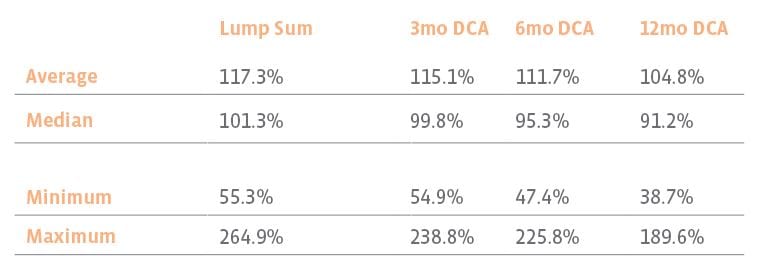
In holding with conventional wisdom that LS investing outperforms, the worst portfolio performance was an investor using 12-month DCA beginning on July 30, 2010, who sold on July 31, 2015, just a few short weeks ago. Even having ridden through the recent downturn, that investor would have made 38.7%. The best an investor could have done was to make an LS investment on December 31, 2008, ridden the whole way through December 31, 2013, to sell with a 264.9% profit. On average, the LS portfolio outperforms.

This is the image alt text

Over time, no matter how or when the MLP investment was made, as long as the portfolio got invested, that portfolio did well.

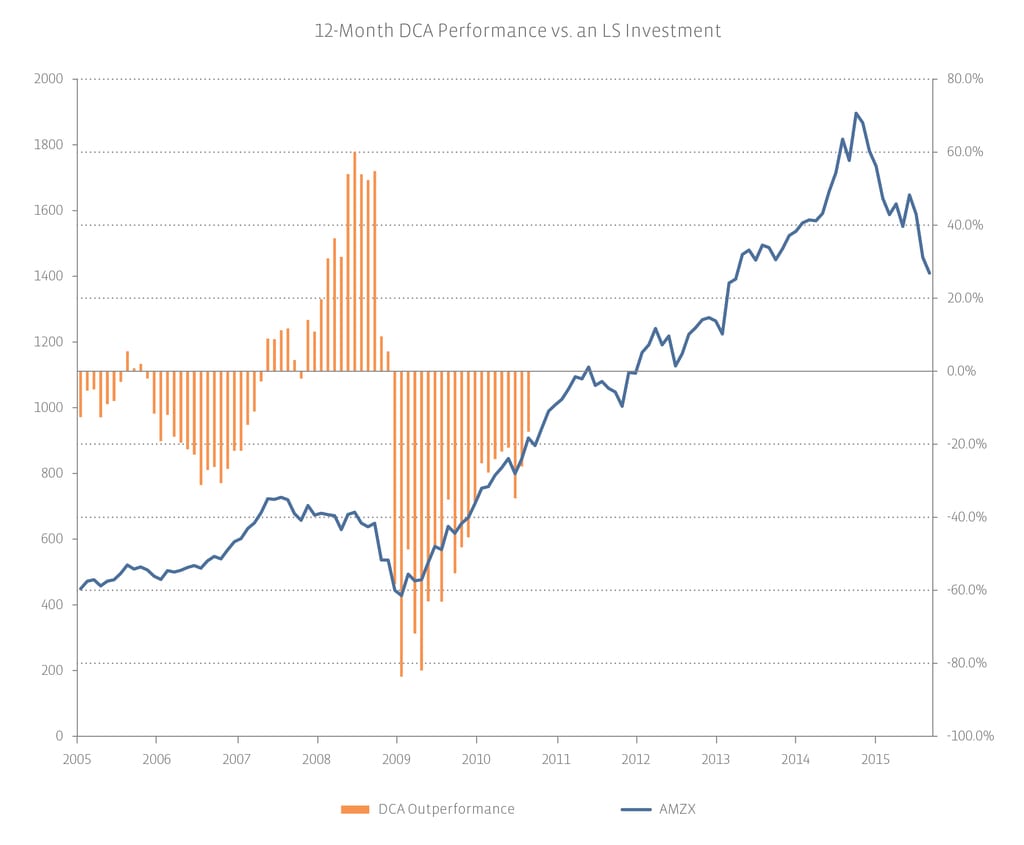
There are, however, notable times when the DCA portfolios outperform the LS ones—specifically, during a major downturn. Unfortunately, if you don’t know when or where the bottom is, it’s also impossible to know whether LS or DCA would be the best choice.

Content continues below advertisement

2015.08_lump_sum_vs_dca_1_-01_1024

To provide some background: MLP performance started to suffer in mid-2007, before the financial crisis even began. At that time, among other things, institutions had highly levered positions (in MLPs and other sectors) that they began to unwind. It took months for this to begin to impact the banks and the broader financial system, leading to the crisis in mid-2008.

If an investor had used DCA to buy MLPs starting a few months before their July 2007 peak, all the way up until a few months before the December 2008 bottom, she would have significantly outperformed lump sum investors during that time. In other words, if you have been buying MLPs all the way down these past 11 months, take comfort in the fact that at least you didn’t deploy all your capital in that first transaction. Additional solace can be found in fund flows data and sell-side analyst recommendations suggesting that you weren’t and aren’t alone.

If you went all in on MLPs around the peak last fall, it’s worth mentioning that investors who bought in around the last major peak in July 2007, regardless of whether they used LS or DCA, still made between 50% and 96% over a five-year investment horizon.

MLPs are down over 20% year to date. In 2008, they finished the year down over 35%. I hope, for our collective sanity, that MLPs trade up from here and do so in the near term. I am my parents’ daughter, so I believe the right time to invest in MLPs was yesterday. Unless you’re my brother, you’re somebody else’s parents’ child. If you want protection in case MLPs fall further, perhaps DCA investing can help you sleep at night.


» Popular Pages

  • Tickers
  • Articles

Jun 25

American Century’s Gotelli Talks Muni Bond Trends

Jun 25

Qualcomm Data Center Plans Put These ETFs in the Spotlight

Jun 25

Emerging Markets See Historical Discount: Get Exposure in GSEE

Jun 25

How AI Turned Infrastructure Into a Must-Own Asset

Jun 25

Two Measures of Inflation: May 2026

Jun 25

Advanced Nuclear Power Projects: Commercial SMR Deals Boost NUKZ

Jun 25

ETF of the Week: T. Rowe Price Value ETF (TVAL)

Jun 25

What Rising Structural Inflation Means for Your Bond Portfolio

Jun 25

Capturing the Memory Boom: How ETFs Are Winning With Micron

Jun 25

ETF Prime: The SpaceX IPO & MANGOS ETFs

QQQ

Invesco QQQ Trust Series I

VOO

Vanguard S&P 500 ETF

GLD

SPDR Gold Shares

DRAM

Roundhill Memory ETF

SMH

VanEck Semiconductor ETF

SOXX

iShares Semiconductor ETF

PPLT

abrdn Physical Platinum...

SIVR

abrdn Physical Silver Shares...

SCHD

Schwab US Dividend Equity ETF...

SOXL

Direxion Daily Semiconductor...

Loading Articles...

Advertisement

Is Your Portfolio Positioned With Enough Global Exposure?

ETF Education Channel

How to Allocate Commodities in Portfolios

Tom LydonApr 26, 2022
2022-04-26

A long-running debate in asset allocation circles is how much of a portfolio an investor should...

Core Strategies Channel

Why ETFs Experience Limit Up/Down Protections

Karrie GordonMay 13, 2022
2022-05-13

In a digital age where information moves in milliseconds and millions of participants can transact...

}
X