
ETFdb Logo
  • ETF Database
  • Content Hubs
    • Themes
      • Active ETF
      • Alternatives
      • Artificial Intelligence
      • China Insights
      • Core Strategies
      • Crypto
      • Disruptive Technology
      • Energy Infrastructure
      • ETF Building Blocks
      • ETF Investing
      • ETF Strategist
      • Financial Literacy
      • Fixed Income
      • Free Cash Flow
      • Future ETFs
      • Innovative ETFs
      • Institutional Income Strategies
      • Leveraged & Inverse
      • Market Insights
      • Market Outlooks
      • Modern Alpha
      • Nuclear Energy
      • Portfolio Strategies
      • Sector Investing
      • Tax Efficient Income
      • Thematic Investing
    • Asset Class
      • Equity
        • U.S. Equity
        • Int'l Developed
        • Emerging Market Equities
      • Alternatives
        • Gold/Silver/Critical Materials
        • Cryptocurrency
        • Currency
        • Volatility
      • Fixed Income
        • Investment Grade Corporates
        • US Treasuries & TIPS
        • High Yield Corporates
        • Int'l Fixed Income
    • ETF Ecosystem
    • ETFs in Canada
    • Market Outlook
    • Crypto ETF Hub
  • Tools
    • ETF Screener
    • ETF Country Exposure Tool
    • ETF Database Categories
    • Indexes
    • Scenario Analysis
    • Watchlists
    • Head-To-Head ETF Comparison Tool
    • Mutual Fund To ETF Converter
    • ETF Stock Exposure Tool
    • ETF Issuer Fund Flows
  • Research
    • ETF Education
    • Equity Investing
    • Dividend ETFs
    • Leveraged ETFs
    • Inverse ETFs
    • Index Education
    • Index Insights
    • Top ETF Sectors
    • Top ETF Issuers
    • Top ETF Industries
  • Webcasts
  • Sectors
    • Sector Investing Content Hub
    • XLK
    • XLI
    • XLU
    • XLY
    • XLP
    • XLRE
    • Sector Power Rankings
    • XLE
    • XLC
    • XLF
    • XLV
    • XLB
  • Multimedia
    • ETF 360 Video Series
    • ETF of the Week Podcast
    • Gaining Perspective Podcast
    • ETF Prime Podcast
    • Video
  • Company
    • About VettaFi
    • Get VettaFi’ed
  • PRO
    • Pro Content
    • Pro Tools
    • Advanced
    • FAQ
    • Free sign up
    • Login
  1. Innovative ETFs Content Hub
  2. Tax Talk: Considerations for Municipal Bond ETFs
Innovative ETFs Content Hub
Share

Tax Talk: Considerations for Municipal Bond ETFs

Ben HernandezMay 24, 2021
2021-05-24

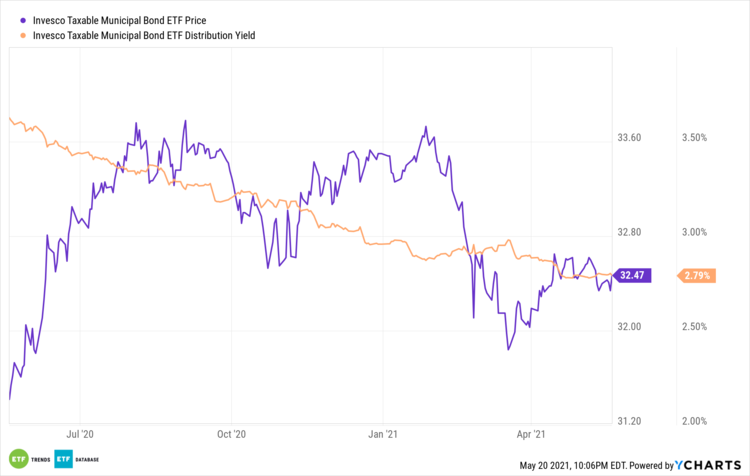
To combat low yields, fixed income investors can opt for taxable municipal bonds via ETFs like the Invesco Taxable Municipal Bond ETF (BAB A-).

Getting taxable municipal bonds might seem counterintuitive given that one of the main reasons investors gravitate to munis is because of their tax advantages. However, investors can also get higher yield in lieu of these tax benefits.
BAB Performance Figures

BAB seeks to track the investment results of the ICE BofAML US Taxable Municipal Securities Plus Index. The fund generally will invest at least 80% of its total assets in securities that comprise the index. ICE Data Indices, LLC, oversees the underlying index, which is designed to measure the performance of U.S. dollar-denominated taxable municipal debt publicly issued by U.S. states and territories, and their political subdivisions, in the U.S. market.

“Unlike most municipal bonds, Build America Bonds are taxable securities, eliminating one of the advantages that has traditionally allowed municipalities to issue debt at lower rates than otherwise comparable corporate debt,” an ETF Database analysis explained. “BAB invests primarily in investment grade debts, giving investors safety during unstable markets, and with an average coupon rate above 5%, the ETF will also offer an attractive yield.”


Content continues below advertisement

Tax Comparisons Bonds

A Tax-Free Option

For bond investors who are seeking the tax-free aspect of municipal bonds, there’s the Invesco National AMT-Free Municipal Bond ETF (PZA B+). PZA seeks to track the investment results of the ICE BofAML National Long-Term Core Plus Municipal Securities Index, which is composed of U.S. dollar-denominated, tax-exempt municipal debt publicly issued by U.S. states and territories and their political subdivisions in the U.S. domestic market.

“Muni bonds are used by local entities to pay for a variety of services or to make improvements to infrastructure paying for everything from new sewer systems to school renovations and bridge construction as such, they are relatively low risk instruments,” an ETF Database analysis explained. “This is especially true in the case of PZA since the fund only targets munis that are insured or in other words, have bought insurance from a private company that will pay out if the underlying bond defaults.”

“As a result PZA is a solid choice for investors seeking broad exposure to the muni market but with much lower levels of risk; allowing investors the safety of an insured product but with the tax advantages of the muni sector,” the analysis added.

For more news and information, visit the Innovative ETFs Channel.

Loading Articles...

Advertisement

Is Your Portfolio Positioned With Enough Global Exposure?

ETF Education Channel

How to Allocate Commodities in Portfolios

Tom LydonApr 26, 2022
2022-04-26

A long-running debate in asset allocation circles is how much of a portfolio an investor should...

Core Strategies Channel

Why ETFs Experience Limit Up/Down Protections

Karrie GordonMay 13, 2022
2022-05-13

In a digital age where information moves in milliseconds and millions of participants can transact...

}
X
