
ETFdb Logo
  • ETF Database
  • Content Hubs
    • Themes
      • Active ETF
      • Alternatives
      • Artificial Intelligence
      • China Insights
      • Core Strategies
      • Crypto
      • Disruptive Technology
      • Energy Infrastructure
      • ETF Building Blocks
      • ETF Investing
      • ETF Strategist
      • Financial Literacy
      • Fixed Income
      • Free Cash Flow
      • Future ETFs
      • Innovative ETFs
      • Institutional Income Strategies
      • Leveraged & Inverse
      • Market Insights
      • Market Outlooks
      • Modern Alpha
      • Nuclear Energy
      • Portfolio Strategies
      • Sector Investing
      • Tax Efficient Income
      • Thematic Investing
    • Asset Class
      • Equity
        • U.S. Equity
        • Int'l Developed
        • Emerging Market Equities
      • Alternatives
        • Gold/Silver/Critical Materials
        • Cryptocurrency
        • Currency
        • Volatility
      • Fixed Income
        • Investment Grade Corporates
        • US Treasuries & TIPS
        • High Yield Corporates
        • Int'l Fixed Income
    • ETF Ecosystem
    • ETFs in Canada
    • Market Outlook
    • Crypto ETF Hub
  • Tools
    • ETF Screener
    • ETF Country Exposure Tool
    • ETF Database Categories
    • Indexes
    • Scenario Analysis
    • Watchlists
    • Head-To-Head ETF Comparison Tool
    • Mutual Fund To ETF Converter
    • ETF Stock Exposure Tool
    • ETF Issuer Fund Flows
  • Research
    • ETF Education
    • Equity Investing
    • Dividend ETFs
    • Leveraged ETFs
    • Inverse ETFs
    • Index Education
    • Index Insights
    • Top ETF Sectors
    • Top ETF Issuers
    • Top ETF Industries
  • Webcasts
  • Sectors
    • Sector Investing Content Hub
    • XLK
    • XLI
    • XLU
    • XLY
    • XLP
    • XLRE
    • Sector Power Rankings
    • XLE
    • XLC
    • XLF
    • XLV
    • XLB
  • Multimedia
    • ETF 360 Video Series
    • ETF of the Week Podcast
    • Gaining Perspective Podcast
    • ETF Prime Podcast
    • Video
  • Company
    • About VettaFi
  • PRO
    • Pro Content
    • Pro Tools
    • Advanced
    • FAQ
    • Free sign up
    • Login
  1. Leveraged & Inverse ETF Content Hub
  2. Enjoy the Index Swings? A High Beta ETF for the Ride
Leveraged & Inverse ETF Content Hub
Share

Enjoy the Index Swings? A High Beta ETF for the Ride

Ben HernandezNov 25, 2020
2020-11-25

As the anticipation of a COVID-19 vaccine grows, positivity is giving the capital markets a boost, but as sellers start to do their profit-taking the markets should dip, adding another dose of volatility to an already interesting year. If traders like this high correlation to the movement of the major indexes, they might want to tap into their sensitive side using high beta funds with leverage like the Daily S&P 500® High Beta Bull (HIBL B-).

HIBL seeks daily investment results, before fees and expenses, of 300% of the daily performance of the S&P 500® High Beta Index. The fund, under normal circumstances, invests at least 80% of its net assets (plus borrowing for investment purposes) in financial instruments that track the index and other financial instruments that provide daily leveraged exposure to the index or to ETFs that track the index.

The index provider selects 100 securities to include in the index from the S&P 500® Index that have the highest sensitivity to market movements, or “beta” over the past 12 months as determined by the index provider. If you’re familiar with Direxion’s leveraged funds, you may already know they provide the ability for traders to:

  • Magnify short-term perspective with daily 3X leverage;
  • Go where there’s opportunity, with bull and bear funds for both sides of the trade; and
  • Stay agile  with liquidity to trade through rapidly changing markets
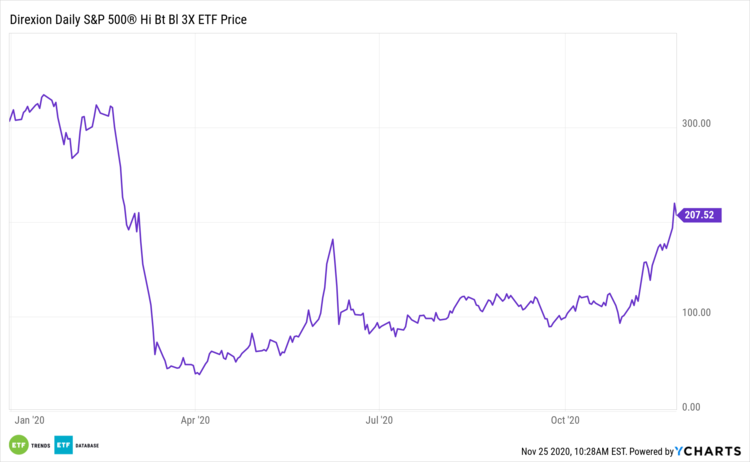
HIBL YTD Performance

High beta fund aren’t for the weak at heart, so Investopedia gives a quick primer:

“High beta index companies exhibit greater sensitivity than the broader market. Sensitivity is measured by the beta of an individual stock. A beta of 1 indicates the asset moves in line with the market. Anything less than 1 represents an asset less volatile than the market, while greater than 1 suggests a more volatile asset,” Investopedia noted. “For example, a beta of 1.2 means the asset is 20% more volatile than the market. Conversely, a beta of 0.70 is theoretically 30% less volatile than the market. Beta is measured against a widely followed index such as the S&P 500 Index.”

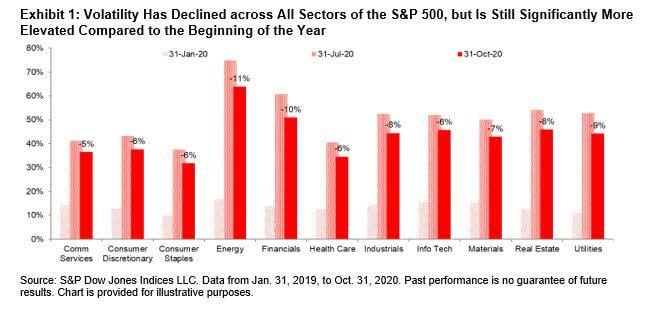
An article by Fei Mei Chan in Seeking Alpha also noted the rise in volatility, which novice traders should take note of before giving high beta funds a try:

“So far, 2020 has brought us a global pandemic, a coordinated global economic shutdown, and, in the U.S., a notably contentious election. So it’s no surprise that volatility has been, and remains, elevated. Despite all this, equities have fared reasonably (some would say surprisingly) well, with the S&P 500® climbing 13% through Nov. 19 since the end of 2019,” Chan noted.

Content continues below advertisement

Exhibit 1 Volatility Has Declined

For more news and information, visit the Leveraged & Inverse Channel.

Loading Articles...

Advertisement

Is Your Portfolio Positioned With Enough Global Exposure?

ETF Education Channel

How to Allocate Commodities in Portfolios

Tom LydonApr 26, 2022
2022-04-26

A long-running debate in asset allocation circles is how much of a portfolio an investor should...

Core Strategies Channel

Why ETFs Experience Limit Up/Down Protections

Karrie GordonMay 13, 2022
2022-05-13

In a digital age where information moves in milliseconds and millions of participants can transact...

}
X
