


As mentioned, AI continues to be a central theme that drives earnings for both companies. More specifically, reports highlighted Microsoft’s partnership with OpenAI as well as Meta bolstering its AI capabilities with key acquisitions. “The strong performance this quarter is largely thanks to AI unlocking greater efficiency and gains across our ad system,” said Meta CEO Mark Zuckerberg.
While the growth potential of revenue generation from AI was welcome news, investors have also been eyeing AI-related capital expenditures (CapEx) and its effects on the bottom line.
MSFT Cloud Revenue Shines
Once Wednesday’s closing bell ran, Microsoft exceeded Wall Street expectations for its fiscal fourth quarter — $3.65 EPS (versus $3.37 expected) and $76.44 billion in revenue (compared to $73.81 billion expected).
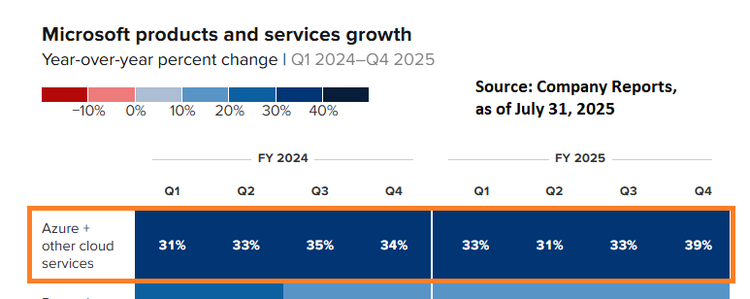
While the market is fixated on AI, it was actually Microsoft’s cloud computing business that’s been a heavy revenue generator. Cloud revenue rose by 27% year-over-year, and those worried about CapEx saw that the software maker’s operating income also rose 23%.
“Cloud and AI is the driving force of business transformation across every industry and sector," said Satya Nadella, chairman and chief executive officer of Microsoft, in a press release. “We’re innovating across the tech stack to help customers adapt and grow in this new era, and this year, Azure surpassed $75 billion in revenue, up 34 percent, driven by growth across all workloads.”
Compared to previous fiscal quarters, this marks the highest growth witnessed in Microsoft’s cloud products/services.
More Friend Requests for Meta
One of the catalysts boosting Meta’s stock heading into its Q2 earnings report was the increased usage of AI. The social media giant has been adding to its AI acquisitions portfolio, but investors were ultimately wondering if these potential revenue trees will bear fruit.
Q2 earnings may have answered any lingering questions for now and, based on the numbers, META more than likely had more friend requests from investors — $7.14 EPS (compared to $5.92 expected) and $47.52 billion in revenue (versus $44.8 billion expected). CNBC did report that the company’s initial forecasts on spending were higher than expected — costs and expenses did rise 12% year-over-year.
“The largest single driver of growth will be infrastructure costs, driven by a sharp acceleration in depreciation expense growth and higher operating costs as we continue to scale up our infrastructure fleet,” said Meta CFO Susan Li.
Single-Stock ETFs to Use
Confident traders who think Microsoft and Meta will continue to climb can add 200% exposure, or those leery of their earnings reports can take the bearish side, with single-stock ETFs. Both names are just part of Direxion Investments’ growing line of single-stock ETFs that give traders the flexibility to play both sides. This is certainly beneficial during earnings season, as volatility can sway one stock heavily in one direction or the other. Given both are high volume trading names, having the flexibility to go bullish or bearish is imperative.
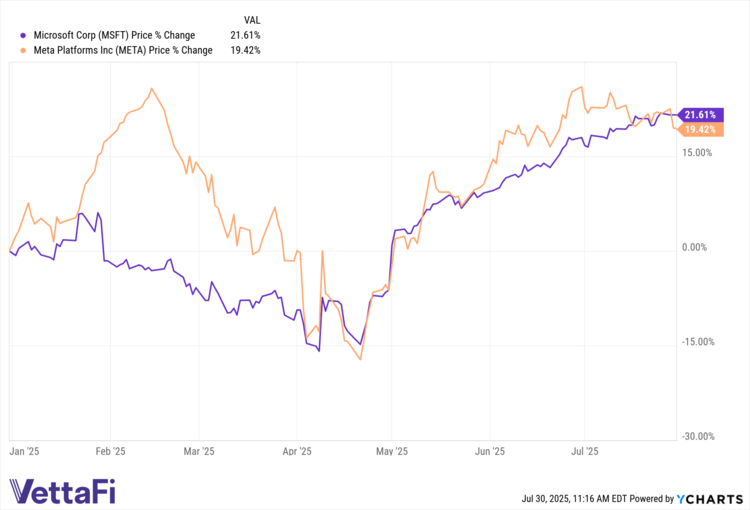
Can Microsoft build off its Q2 earnings and continue its YTD upside? If so, traders with that conviction can add 2x exposure with the Direxion Daily MSFT Bull 2X Shares (MSFU ). On the other hand, if profit-taking occurs and a sell-off ensues, traders can profit via the Direxion Daily MSFT Bear 1X Shares (MSFD ).
For Meta, traders can also double up their exposure with the Direxion Daily META Bull 2X Shares (METU ). On the flip side of the trade, there’s the Direxion Daily META Bear 1X Shares (METD ).
To protect and grow their trading capital, seasoned market players should certainly give single-stock ETFs a look. They can add to a trader’s arsenal, allowing for profitable moves regardless if a stock moves up or down.
For more news, information, and analysis, visit the Leveraged & Inverse Content Hub.

