
ETFdb Logo
  • ETF Database
  • Content Hubs
    • Themes
      • Active ETF
      • Alternatives
      • Artificial Intelligence
      • China Insights
      • Core Strategies
      • Crypto
      • Disruptive Technology
      • Energy Infrastructure
      • ETF Building Blocks
      • ETF Investing
      • ETF Strategist
      • Financial Literacy
      • Fixed Income
      • Free Cash Flow
      • Future ETFs
      • Innovative ETFs
      • Institutional Income Strategies
      • Leveraged & Inverse
      • Market Insights
      • Market Outlooks
      • Modern Alpha
      • Nuclear Energy
      • Portfolio Strategies
      • Sector Investing
      • Tax Efficient Income
      • Thematic Investing
    • Asset Class
      • Equity
        • U.S. Equity
        • Int'l Developed
        • Emerging Market Equities
      • Alternatives
        • Gold/Silver/Critical Materials
        • Cryptocurrency
        • Currency
        • Volatility
      • Fixed Income
        • Investment Grade Corporates
        • US Treasuries & TIPS
        • High Yield Corporates
        • Int'l Fixed Income
    • ETF Ecosystem
    • ETFs in Canada
    • Market Outlook
    • Crypto ETF Hub
  • Tools
    • ETF Screener
    • ETF Country Exposure Tool
    • ETF Database Categories
    • Indexes
    • Scenario Analysis
    • Watchlists
    • Head-To-Head ETF Comparison Tool
    • Mutual Fund To ETF Converter
    • ETF Stock Exposure Tool
    • ETF Issuer Fund Flows
  • Research
    • ETF Education
    • Equity Investing
    • Dividend ETFs
    • Leveraged ETFs
    • Inverse ETFs
    • Index Education
    • Index Insights
    • Top ETF Sectors
    • Top ETF Issuers
    • Top ETF Industries
  • Webcasts
  • Sectors
    • Sector Investing Content Hub
    • XLK
    • XLI
    • XLU
    • XLY
    • XLP
    • XLRE
    • Sector Power Rankings
    • XLE
    • XLC
    • XLF
    • XLV
    • XLB
  • Multimedia
    • ETF 360 Video Series
    • ETF of the Week Podcast
    • Gaining Perspective Podcast
    • ETF Prime Podcast
    • Video
  • Company
    • About VettaFi
    • Get VettaFi’ed
  • PRO
    • Pro Content
    • Pro Tools
    • Advanced
    • FAQ
    • Free sign up
    • Login
  1. Multi-Asset Content Hub
  2. Shield Against Volatility From Fed Tapering With QLV
Multi-Asset Content Hub
Share

Shield Against Volatility From Fed Tapering With QLV

Ben HernandezNov 15, 2021
2021-11-15

The U.S. Federal Reserve was going to eventually taper its stimulus measures once the economy was strong enough, and now that the time is here, low volatility funds can be of benefit.

Forthcoming volatility in the equities market could be ahead, especially with headwinds like inflation looming. Investment banks are already shoring up client portfolios in order to prep for the roller coaster ride.

“Wall Street banks are intensifying preparations for the Federal Reserve’s withdrawal of pandemic stimulus to ensure they are able to handle spikes in market volatility, help clients manage their risks — and score a profit,” Reuters said.

With the official announcement from the Fed, “sales and trading teams are hearing more from clients concerned about the ramifications for their portfolios and the longer-term implications of rising rates and higher inflation, several senior bankers said.”

There are a number of ways to help mute the volatility, especially when it comes to the equities markets. Diversifying risk away by adding other uncorrelated assets can be an option, but there’s an all-encompassing option that investors can get with one exchange traded fund (ETF).

A Low Volatility ETF Option
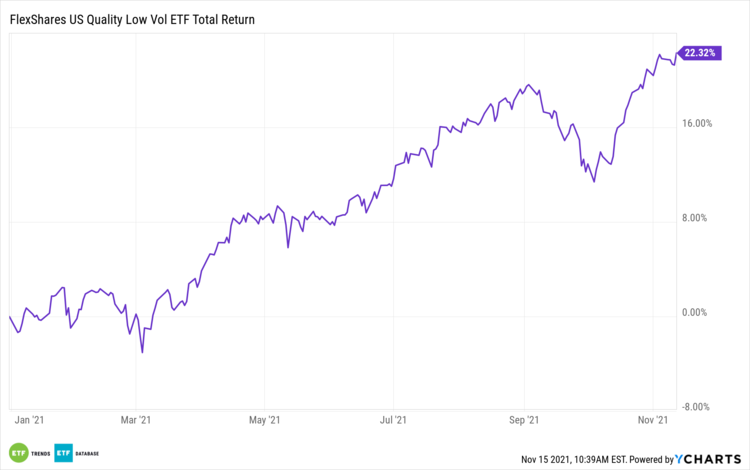
FlexShares US Quality Low Vol ETF

Content continues below advertisement

An option to consider is the FlexShares US Quality Low Volatility Index Fund (QLV ). With a 0.22% net expense ratio, the added low volatility feature doesn’t come at a high cost.

QLV tracks a proprietary index of U.S. companies that aims for a portfolio bias toward quality and reduced volatility. The index methodology first assesses financial strength and stability based on quality metrics like profitability, management efficiency, and cash flow. The lowest-scoring companies are excluded.

QLV seeks investment results that correspond generally to the price and yield performance, before fees and expenses, of the Northern Trust Quality Low Volatility Index. The underlying index is designed to reflect the performance of a selection of companies that, in aggregate, possess lower overall absolute volatility characteristics relative to the Northern Trust 1250 Index, a float-adjusted market capitalization-weighted index of U.S. domiciled large- and mid-capitalization companies.

“The FlexShares US Quality Low Volatility Index Fund (QLV) is designed to provide exposure to US-based companies that possess lower overall absolute volatility and that also exhibit financial strength and stability, which we believe are quality characteristics,” a FlexShares Fund Focus said.

For more news, information, and strategy, visit the Multi-Asset Channel.

Loading Articles...

Advertisement

Is Your Portfolio Positioned With Enough Global Exposure?

ETF Education Channel

How to Allocate Commodities in Portfolios

Tom LydonApr 26, 2022
2022-04-26

A long-running debate in asset allocation circles is how much of a portfolio an investor should...

Core Strategies Channel

Why ETFs Experience Limit Up/Down Protections

Karrie GordonMay 13, 2022
2022-05-13

In a digital age where information moves in milliseconds and millions of participants can transact...

}
X
