

ETFdb Logo
  • ETF Database
  • Content Hubs
    • Themes
      • Active ETF
      • Alternatives
      • Artificial Intelligence
      • China Insights
      • Core Strategies
      • Crypto
      • Disruptive Technology
      • Energy Infrastructure
      • ETF Building Blocks
      • ETF Investing
      • ETF Strategist
      • Financial Literacy
      • Fixed Income
      • Free Cash Flow
      • Future ETFs
      • Innovative ETFs
      • Institutional Income Strategies
      • Leveraged & Inverse
      • Market Insights
      • Market Outlooks
      • Modern Alpha
      • Nuclear Energy
      • Portfolio Strategies
      • Sector Investing
      • Tax Efficient Income
      • Thematic Investing
    • Asset Class
      • Equity
        • U.S. Equity
        • Int'l Developed
        • Emerging Market Equities
      • Alternatives
        • Gold/Silver/Critical Materials
        • Cryptocurrency
        • Currency
        • Volatility
      • Fixed Income
        • Investment Grade Corporates
        • US Treasuries & TIPS
        • High Yield Corporates
        • Int'l Fixed Income
    • ETF Ecosystem
    • ETFs in Canada
    • Market Outlook
    • Crypto ETF Hub
  • Tools
    • ETF Screener
    • ETF Country Exposure Tool
    • ETF Database Categories
    • Indexes
    • Scenario Analysis
    • Watchlists
    • Head-To-Head ETF Comparison Tool
    • Mutual Fund To ETF Converter
    • ETF Stock Exposure Tool
    • ETF Issuer Fund Flows
  • Research
    • ETF Education
    • Equity Investing
    • Dividend ETFs
    • Leveraged ETFs
    • Inverse ETFs
    • Index Education
    • Index Insights
    • Top ETF Sectors
    • Top ETF Issuers
    • Top ETF Industries
  • Webcasts
  • Sectors
    • Sector Investing Content Hub
    • XLK
    • XLI
    • XLU
    • XLY
    • XLP
    • XLRE
    • Sector Power Rankings
    • XLE
    • XLC
    • XLF
    • XLV
    • XLB
  • Multimedia
    • ETF 360 Video Series
    • ETF of the Week Podcast
    • Gaining Perspective Podcast
    • ETF Prime Podcast
    • Video
  • Company
    • About VettaFi
  • PRO
    • Pro Content
    • Pro Tools
    • Advanced
    • FAQ
    • Free sign up
    • Login
  1. Nasdaq Portfolio Solutions Content Hub
  2. QQQ Offspring QQQJ Proves Success Breeds More Success
Nasdaq Portfolio Solutions Content Hub
Share

QQQ Offspring QQQJ Proves Success Breeds More Success

Tom LydonDec 16, 2020
2020-12-16

The Invesco NASDAQ Next Gen 100 ETF (QQQJ B) is part of this year’s bumper crop of new exchange traded funds. As a relative of the famed Invesco QQQ Trust (QQQ B), the rookie ETF has a big legacy to live up to.

QQQJ, which is almost two months old, extends the QQQ ETF further by offering access to the “next 100” non-financial companies listed on the Nasdaq, outside of the NASDAQ-100 Index, offering a mid-cap alternative to the NASDAQ-100. In other words, QQQJ is a proving ground for companies that could eventually be added to the popular QQQ.

Data confirm that investors are responding to what QQQJ has to offer. The new ETF already has $410.5 million in assets under management, making it one of this year’s most successful rookie ETFs of any stripe.

Investors who are looking for growth opportunities should consider what it means to invest in innovation, and how those investments will be impacted by changes in policy. QQQJ can provide an innovative, mid-cap approach that thrives in any political climate.
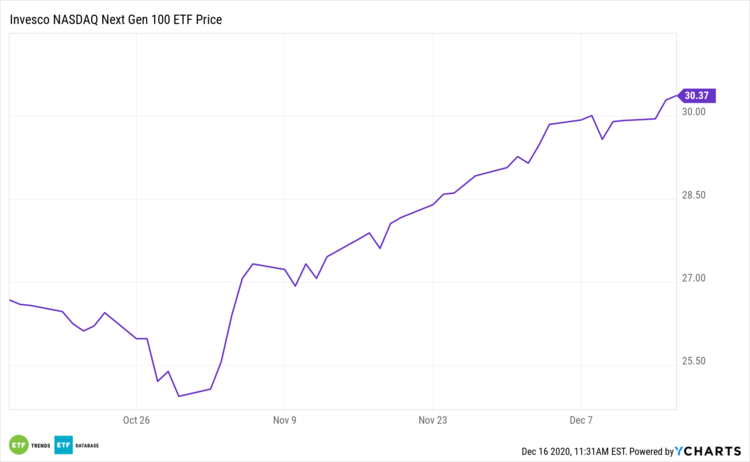
QQQJ YTD Performance

The QQQJ ETF Is Not Just A Mirror Image Of QQQ

Importantly, QQQJ isn’t a carbon copy of QQQ. The differences between the two can work in favor of investors looking to augment QQQ’s mega-cap exposure with smaller names found in the new ETF.

“Yes, both indexes are overweight Technology but the Nasdaq-100 tends to average more than half its weight in Technology, with approximately 56% as of September 30, 2020. On the other hand, the Nasdaq Next Generation 100 allocated roughly 36% to Technology,” according to Nasdaq Global Indexes research.

QQQJ gives ETF investors tech exposure, but with a mid-cap twist. While large-cap companies in tech like Apple or Microsoft are solid plays, there are also opportunities to be had in mid-cap companies that investors may not know about due to a lack of media exposure.

“Another difference is the exposure to Industrials, with the Nasdaq Next Generation 100 at a 17% allocation compared to only 5% in the Nasdaq-100. Health Care is another major differentiator, as the Nasdaq Next Generation 100 recently had nearly triple the exposure to this industry, 20% versus only 7% for the Nasdaq-100,” notes Nasdaq.

QQQJ can capitalize on mid-cap market trends that can power through the pandemic. With more government scrutiny aimed at more tech heavyweights, QQQJ may help investors sidestep any negative exposure.

QQQJ’s underlying index is also overweight tech and consumer services stocks relative to old guard mid-cap benchmarks, giving the new ETF more of a growth feel than many traditional mid-cap strategies.

Content continues below advertisement

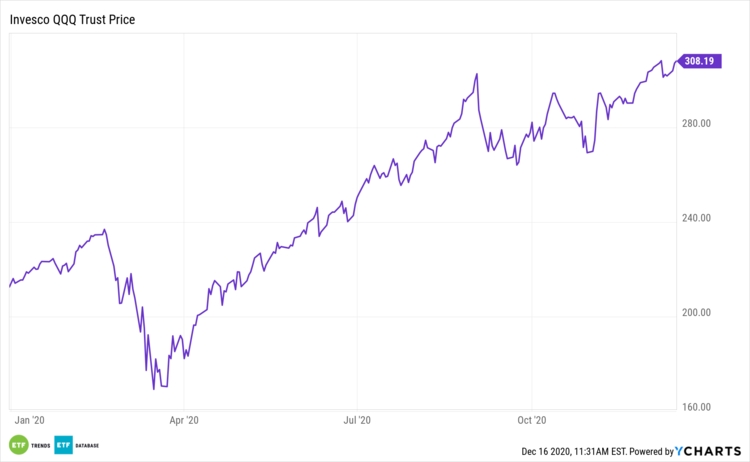
QQQ YTD Performance

For more on innovative portfolio ideas, visit our Nasdaq Portfolio Solutions Channel.

Loading Articles...

Advertisement

Is Your Portfolio Positioned With Enough Global Exposure?

ETF Education Channel

How to Allocate Commodities in Portfolios

Tom LydonApr 26, 2022
2022-04-26

A long-running debate in asset allocation circles is how much of a portfolio an investor should...

Core Strategies Channel

Why ETFs Experience Limit Up/Down Protections

Karrie GordonMay 13, 2022
2022-05-13

In a digital age where information moves in milliseconds and millions of participants can transact...

}
X
