

Despite labor market woes and the ability of the Fed to navigate a soft landing, the U.S. economy continues to grow. Because of recent significant investments, it’s growing in long-neglected areas and changing the geography of economic development.
That’s according to Joseph Politano, writer at Apricitas Economics. Politano recently shared a deep dive into how the CHIPS Act, Inflation Reduction Act (IRA), and Bipartisan Infrastructure Law are changing the economic growth landscape in the U.S. It’s a trend worth understanding, as it could portend a longer-term shift in how, and more importantly, where, economic growth happens in the U.S.
Changing the Growth Fundamentals in the U.S.
A number of industries benefited from the bills that targeted semiconductor, infrastructure, and clean energy growth in the U.S. And while these benefits proved a boon to U.S. companies at large, the regional impacts cannot be understated.
That’s because all three bills contained clauses that focused growth into specific regional areas. Examples include a focus on infrastructure growth in low-income areas, building new regional industry hubs, and revitalizing rural support and growth. It’s also brought a focus to traditional fossil-fuel towns by aiding to convert to clean energy supply chains. The list goes on, with impacts stretching across the Rust Belt, Sun Belt, and more.
“The end goal of America’s investment push was not simply to rebuild US industry but to also use investment spending as a way to fundamentally change how growth is spread across the country,” Politano explained.
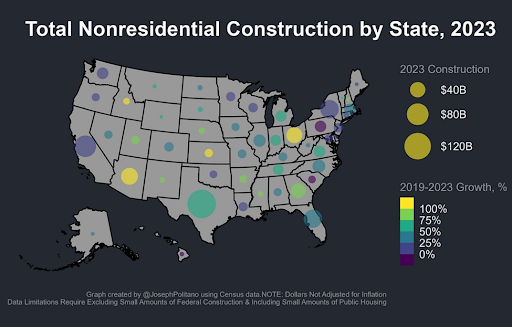
A Breakdown of Where Current Growth Is Occurring
Since the passage of the bills beginning in 2022, the White House detailed in a press release. last month that construction projects funded by one of the bills are underway in over 99% of high-poverty counties across the country. Furthermore, the press release revealed that 75% of investments in clean energy from the private sector went to counties with household incomes below the median.
It’s still early stages for much of this development, but it carries long-ranging implications for economic growth. “The most important prong of America’s investment push comes from the surge in factory and fabricator construction as a result of the CHIPS Act semiconductor projects & IRA cleantech manufacturing projects,” wrote Politano.
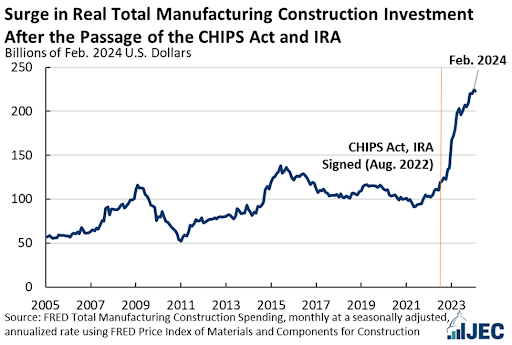
The CHIPS Act, with its focus on bringing semiconductor manufacturing and supply chains to the U.S., created a boom in factory and fabricator construction, Politano noted. Arizona, Texas, Ohio, and Georgia have been the main recipients of the massive semiconductor industry scale-out.
The Inflation Reduction Act and Bipartisan Infrastructure Law brought about the fastest growth of clean energy in U.S. history, with a major focus on solar power plants. Investments into these wind-alternative sources of power grew from $8 billion in 2019 to $29 billion in 2023. The construction of large-scale battery storage facilities, necessary for grid security with renewable energy sources, also grew exponentially. Texas took the top spot here in terms of building out renewable energy capabilities in the last two years. Solar-oriented investment and construction in Sun Belt states such as Florida, Arizona, California, Nevada, and New Mexico also grew substantially.
Public Investment
Public investment plays a pivotal role as well in shaping the changing tides of economic growth in the U.S. Politano noted that public-sector construction, carried out at the state or municipality level, focused primarily on public schools and roadways. Highway spending grew by 51% ($47 billion) since 2019, while education spending grew 22% ($18 billion).
Because the bills primarily target rural, lower-income, or fossil-fuel communities, construction surged in states within any of these categories while construction in wealthier states lagged in the last four years. Construction spending in states like California, New York, or Pennsylvania grew less than the national average (smaller than 25%).
“Conversely, the largest raw increases in public construction activity came from booming states like Texas, Florida, Georgia, and Utah,” Politano explained. “The states with largest percent increases in state & local construction activity are those like Louisiana, Mississippi, Missouri, and Arkansas.” Other states that benefited include Michigan, Indiana, Ohio, and Illinois.
Job Growth: Concentrated, for Now
Beyond the physical build-out of factories and clean energy sites, the labor market also benefits from these investment priorities. Unsurprisingly, construction continues to see the most growth, as many new projects begin under these bills. Power, water, and communication utility construction employment reached record highs in February, Politano noted. Roadway construction employment attained new highs in March, and heavy and civil engineering jobs hit record highs in June.
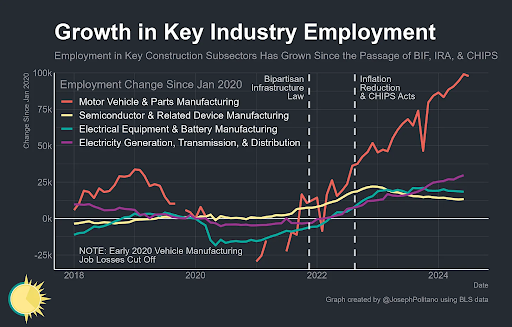
For now, most growth directly linked to the bills remains constrained to the construction sector. For example, the motor vehicle manufacturing industry experienced growth as a whole, which included but wasn’t limited to electric vehicles. Jobs are anticipated to pick up as construction projects reach completion and factories begin operation, requiring more workers across a range of industries. The timeline on when this happens remains uncertain, however, as the Fed attempts to navigate a soft landing for the economy and cyclical factors create challenges to industries.
“That investment boom is already having profound local and regional effects,” Politano wrote. Therefore, “to the degree that these industrial policies successfully achieve their long-term goals, they will continue reshaping the geography of the US economy.”
For investors, the changing landscape presents a broad swath of opportunities depending on risk appetite and desired exposures. From companies within the semiconductor industry to municipal bonds in traditionally rural areas, there are many ways to harness the economic growth happening in nontraditional hubs. However you perceive it, this new phase of economic growth is a trend worth watching in the coming months and years.
For more news, information, and analysis, visit VettaFi | ETFDB.

