

ETFs expanded their market share in recent years by bringing mutual and hedge fund strategies to a wider variety of investors. Taking strategies previously locked behind high entry fees and significant management fees, ETFs work to broaden the investing playing field. Managed futures are one such strategy that continue to expand into a growing number of ETFs.
Once walled off to a small portion of hedge fund investors, this alternatives strategy is now available in a number of ETFs. Managed futures hold strong appeal for their low-to-negative correlations to stocks and bonds. They make strong portfolio diversifiers. While they invest in a number of common asset classes, they do so via futures. In an environment where advisors and investors increasingly look to alternatives, these strategies increasingly draw attention, and flows.
Managed Futures Bring Trend Following to the Masses
Managed futures are a trend strategy — arguably, the trend strategy. They rely on trading signals to determine long and short positions in a variety of asset classes. If an asset trends higher, long positions via futures prove beneficial. These strategies stand out in their ability to short underperforming asset classes. Through a short position, managed futures profit on drawdowns.
Notably, these strategies remove much of the sentiment tendencies inherent to investing. They invest based on how an asset currently trades, not on expectations of performance. It’s this type of positioning and the ability to rapidly respond to changing market dynamics that earned them the reputation as “crisis alpha” generators.
While the strategies all build off the ability to go long and short in a variety of asset classes, how issuers and managers express that leads to a wide range of performance. Hedge fund managers have made (and lost) careers on deciphering trend signals and translating them into performance. Deciding which signals are worth paying attention to, how to best capture a trend, and timing all come into play. It’s a space that often offers wildly differentiated performance.
Diversification and Variation in Abundance
The variety of expressions in these strategies are easily apparent in the current ETFs in the market. The KraneShares Mount Lucas Managed Futures Index Strategy ETF (KMLM ) tracks futures contracts across commodities, currencies, and bonds, while excluding equities. The Simplify Managed Futures Strategy ETF (CTA ) invests across 15 asset classes but does not invest in equities or currencies.
Meanwhile, the First Trust Managed Futures Strategy Fund (FMF ) invests across commodities, equities, currencies, and bonds, while also shorting the energy sector when applicable. The WisdomTree Managed Futures Strategy Fund (WTMF ) now includes bitcoin futures as part of its strategy.
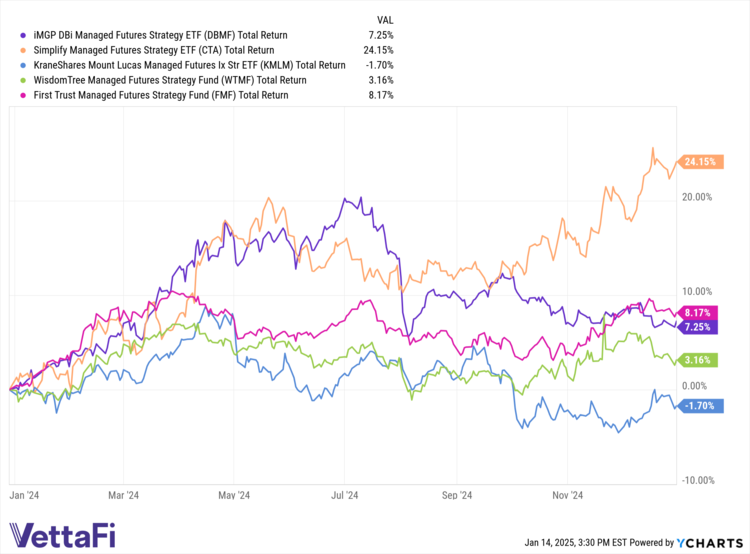
With over $1 billion in AUM, the largest managed futures ETF, the iMGP DBi Managed Futures Strategy ETF (DBMF ), takes a somewhat unique approach. The strategy seeks to capture the average performance of the 20 largest managed futures hedge funds via replication. Instead of crafting its own approach, it uses a proprietary model to track the performance of the largest hedge funds. The model then determines positions across a minimal number of asset class futures that replicate the performance. Through replication, it seeks to offer fee alpha via similar performance to hedge funds at substantially reduced management fees.
In the last two months, both Blackrock and Invesco have filed for managed futures ETFs. It marks a turning point for the category as some of the largest global asset managers make the strategy more readily available to investors via the ETF wrapper. At first blush, both strategies appear fairly standard in their coverage across the four main asset classes. However, in such a nuanced space, methodology matters. I, for one, look forward to seeing how these two titans of investing choose to capture the category.
For more news, information, and analysis, visit "VettaFi | ETF Trends":http://etfdb.com.

