

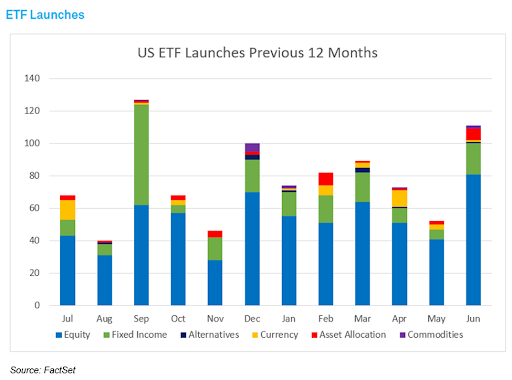
June brought with it a flurry of ETF launches, doubling May’s muted numbers. While many funds expanded on existing trends such as the growth of active management or single-stock exposures, three ETF strategies stand out, bringing something interesting to the table for investors.
A grand total of 111 ETFs launched in June, with equities continuing to dominate the mix, according to FactSet data. Eighty-one ETFs focused on equity exposures, nearly three-quarters of all funds launched. The trend also continues in favor of active, with 84% of all ETFs launched in June falling under the active management umbrella.
ProShares Narrows Buffer Windows to Single Day
Launched at the end of the month, ProShares brought three dynamic buffer ETFs to market, all using an innovative strategy. The ProShares S&P 500 Dynamic Buffer ETF (FB ), ProShares Nasdaq-100 Dynamic Buffer ETF (QB ), and the ProShares Russell 2000 Dynamic Buffer ETF (RB ) trade on the Nasdaq. Each fund tracks a Dynamic Buffer Index related the respective benchmarks. The funds offer single-day buffer investment periods as opposed to many buffer strategies with a yearlong investment period.
The patent-pending methodology developed by ProShares seeks to capture the performance of the respective underlying indexes up to a daily cap. At the same time, the buffer protects anywhere from the initial 1%-5% of any loss each day. The cap and amount protected both dynamically adjust depending on anticipated volatility. In environments of high volatility, the cap will be higher, as well as the percent buffered.
The strategy accomplishes this performance through a long position in each fund’s respective benchmark index. It combines this long exposure with three option positions with one-day expiry. These include a purchased put, a written (sold) put, and a written (sold) call on the underlying index that establish the buffer, the buffer percentage, and the cap, respectively.
Calamos Launches UHNW Strategy via ETF While Minimizing Risks
Another first-of-its-kind ETF, the Calamos Autocallable Income ETF (CAIE ) brings the sophistication of high net worth investors to the wider investment world and trades on the NYSE. The fund seeks high monthly income and lower downside risk through a portfolio of autocallables. Autocallables are structured products that pay out coupons if the underlying security reaches a certain price threshold. This payout automatically triggers on specific dates, referred to as auto-call dates.
See More: Calamos Teams Up With JPM for New Autocallable ETF
These instruments offer income linked to equities instead of bonds, with greater income potential. However, they do carry risk, as coupon generation requires the underlying security or index to not fall below a certain amount. In sharp market declines, autocallable coupons may not generate coupons and could end in principal loss for investors.
While experienced investors may hold a single or handful of autocallables, CAIE provides exposure to over 50 laddered autocallables. This helps to reduce timing risk with the potential for better downside risk than single-autocallable investment. The autocallable portfolio’s coupons and principal at maturity are tied to the MerQube US Large Cap Vol Advantage Autocallable Index. MerQube serves as the index provider, while JP Morgan serves as the counterparty for the Index swap. The strategy adds another diversified alternative for income investors looking beyond bonds for opportunity.
JPMorgan Brings Big Money to Junk Bond ETF
The JPMorgan Active High Yield ETF (JPHY ) launched June 24, 2025 on the Cboe BZX Exchange. The fund seeks high income, capital appreciation, and notable risk-adjusted returns within junk bonds. The strategy uses bottom-up, fundamental credit analysis to select below investment-grade bonds. At the same time, it works to mitigate downside risk compared to the ICE BofA US High Yield Constrained Index over the business cycle. JPHY is the ETF version of the firm’s mutual fund, run by several of the same portfolio managers.
See More: JPMorgan Expands Fixed Income Lead With Record High-Yield ETF Launch
While the JPHY strategy itself isn’t doing anything groundbreaking, the fund made waves with its seed capital. It launched with $2 billion in assets, a record for J.P. Morgan Asset Management, and an eye-catching number for investors. In the sea of ETF launches this year, JPHY stands out for that alone.
As the largest active U.S. fixed income issuer at $55 billion in AUM, JPMAM offers an impressive array of ETFs for investors. To come to market with $2 billion seeded at a time when junk bonds appear attractively positioned makes this a fund to watch in the second half.
Originally published at Advisor Perspectives
For more news, information, and analysis, visit VettaFi | ETFDB.

