

Market turbulence has become a hallmark of today’s investing landscape. Against the shifting sands of monetary policy and elevated macro uncertainty, investors are increasingly seeking strategies that offer stability without sacrificing long-term returns. Enter low volatility ETFs — a compelling solution for those looking to dampen risk while staying invested. In an era where “slow and steady” might just win the race, these ETFs provide a defensive anchor. That’s because they help portfolios weather storms while still participating in growth.
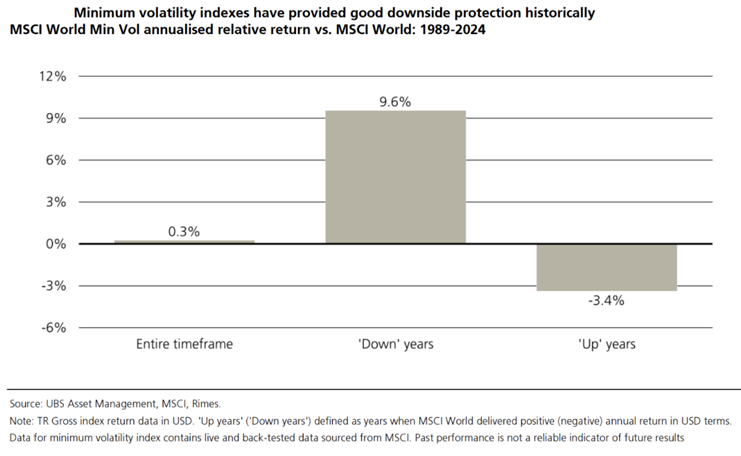
Despite rising bullishness, there’s still plenty of money parked on the sidelines. Money market fund assets swelled to more than $7 trillion at the start of July. That’s a near-record cash pile. The Federal Reserve has signaled a delayed rate-cutting cycle, keeping borrowing costs elevated. Tighter financial conditions could pressure corporate earnings, particularly for high-beta growth names. Meanwhile, defensive, low volatility sectors like utilities, healthcare, and consumer staples, tend to hold up better in late-cycle environments.
Beyond the more complicated buffer and options-based ETFs that boast downside protection, low volatility ETFs present a much simpler, more straightforward replacement for bonds in a portfolio. At the same time, they offer equitylike returns with less turbulence. Investors nearing retirement or those with lower risk tolerance benefit from smoother equity exposure. Many low volatility sectors have pricing power, helping them weather inflationary pressures. If growth slows, these ETFs provide downside protection compared to cyclical sectors.
Shelter From the Storm
Top-down strategists from two of the world’s largest ETF managers have been emphasizing low-volatility strategies. Kristy Akullian, head of iShares Investment Strategy, Americas, just released her latest market outlook. In it, she says she expects rougher waters ahead.
“Markets have boosted their immunity to uncertainty,” she wrote. “While we have ample evidence that the U.S. economy remains in rude health, the combination of low liquidity and moderately high complacency could lead to some summer choppiness ahead. We still see MinVol strategies as sensible ones for investors looking to avoid potential [pullbacks. But] ultimately we expect dips to be bought.”
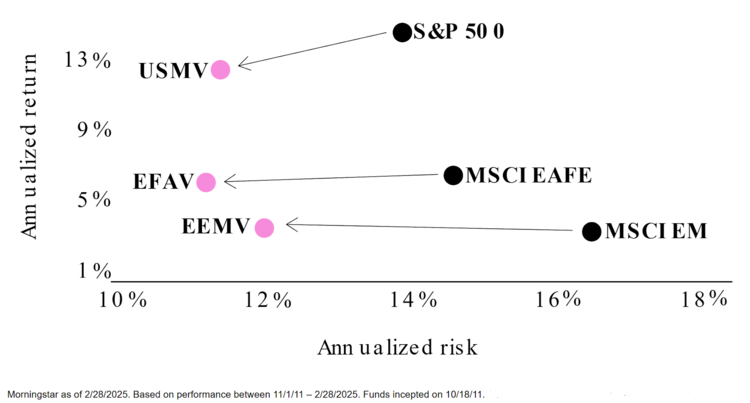
Akullian points to the iShares MSCI USA Min Vol Factor ETF (USMV ) as a prime tool for navigating said choppiness. Boasting $23 billion in assets, USMV is the largest of its kind. It homes in on U.S. large-caps. But it offers a balanced approach that has historically delivered far less volatility than conventional market indexes. The fund currently offers a 30-day SEC yield of 1.45% and charges an expense ratio of 0.15%. For more than a decade, iShares’ minimum volatility ETFs have generated benchmarklike returns with lower risk across the globe. That means investors haven’t had to give up that much upside by moving to minimum volatility strategies.
Invesco issued a similarly cautionary note last week. Alessio de Longis, senior portfolio manager and head of Asset Allocation at Invesco Solutions, noted that risk-taking sentiment has stabilized but remains weaker.
“Global risk appetite has improved, but not enough to trigger a sustained increase in growth expectations,” he wrote. “We maintain a defensive posture … favoring defensive sectors and a moderate underweight in developed ex-US equities and emerging markets.” In the case of equities, he added, Invesco favors quality and low volatility characteristics, tilting toward larger capitalizations over value, mid- and small-caps.
Invesco has several low volatility products on hand. By far the most established and most liquid is the Invesco S&P 500 Low Volatility ETF (SPLV ). The fund is relatively selective, limiting its portfolio to only large domestic stocks that are part of the S&P 500, then taking the top 100 names off that list that have the lowest realized volatility over the past year. Right now, SPLV, which commands nearly $8 billion in total assets and charges a fee of 0.25%, has seen positive net inflows for the year. Top holdings include Coca-Cola, Atmos Energy, and Realty Income.
A Balanced Approach
In a similar vein, dividend strategies have also fared well. The Vanguard International High Dividend Yield ETF (VYMI ) just hit a new all-time high this week. From a flows perspective, the Franklin International Low Volatility High Dividend Index ETF (LVHI ) is topping the charts this year, at $1.3 billion in net inflows.
A recent Goldman Sachs report argued risks still exist in both directions. The report says that investors should not be clearly cyclical or defensive in their sector allocation. Within defensives, it recommends investors own rate-sensitive utilities, real estate and consumer staples. Those sectors are still a bargain and typically benefit most from lower bond yields. All three happen to fall under the minimum volatility umbrella.
As market conditions remain uncertain, low volatility ETFs present a balanced approach for navigating choppy waters. Their ability to reduce turbulence while still capturing equitylike returns makes them an attractive alternative to bonds and a stabilizing force in diversified portfolios. In a market where complacency and sudden swings can upend portfolios, low volatility strategies offer both shelter from the storm and a path forward, proving that sometimes, the best offense is a strong defense.
Originally published at Advisor Perspectives
For more news, information, and analysis, visit VettaFi | ETFDB.

