

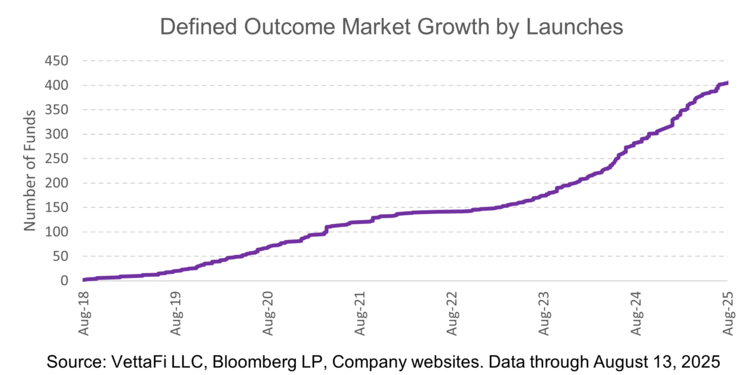
One year ago, I wrote a research note on defined outcome strategies — which most commonly include buffer strategies. There are many unknowns in the investment world, so having a known level of loss can be very valuable. Investors have experienced volatile markets over the past few years. Therefore, their risk aversion (in combination with a potentially overvalued equity market) has caused these strategies to grow in popularity in terms of both new launches and net inflows. With over 400 defined outcome ETFs, this note provides a brief review of the space and an update on the market.
Review: Why Defined Outcome ETFs?
Defined outcome ETFs let investors stay in an investment while managing risk. Over a set window (usually 12 months) investors give up some upside (a stated cap) in exchange for a clear downside buffer (e.g., the first 10–20% of losses). That structure can help reduce risk, lower volatility, and help investors stick to a plan during uncertain markets.
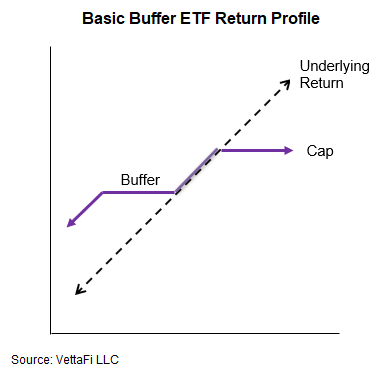
One of the biggest disadvantages of this strategy is giving up upside — especially if an investor is using these as a replacement for their equity allocation and missing out on potential equity market returns. Many investors — particular those with longer time horizons — may not find this an attractive strategy, since S&P 500 returns are typically the core behind a growth portfolio.
Bitcoin, however, is a more relatable example across investor types. Calamos released the first bitcoin Protected ETFs earlier this year (recent products include the Calamos Bitcoin Structured Alt Protection ETF – July (CBOY ), Calamos Bitcoin 90 Series Structured Alt Protection ETF – July (CBXY ), and the Calamos Bitcoin 80 Series Structured Alt Protection ETF – July (CBTY ). These were also followed by products from First Trust/FT Vest — the FT Vest Bitcoin Strategy Floor15 ETF – July (BFJL ) and the Innovator (the Innovator Uncapped Bitcoin 20 Floor ETF – Quarterly (QBF ).
Many investors have avoided bitcoin due to its volatility, but these strategies offer a more cautious entry point: some exposure to a risky asset’s growth potential with clearer downside. In the case of bitcoin, a protected strategy could bring in investors who normally don’t invest in the cryptocurrency, rather than water down returns for investors that value uncapped bitcoin exposure in their portfolio.
Defined Outcome ETFs: The Outlook
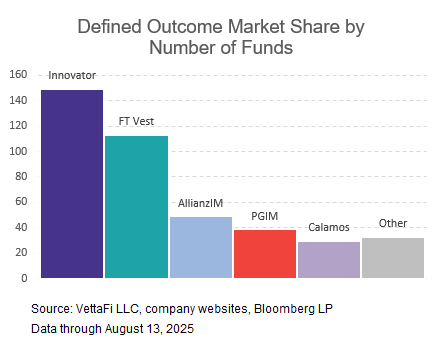
To define the defined outcome universe, I searched issuer websites to come up with the total amount of tickers. Then I used assets and net inflow figures from Bloomberg, from 2018 to 2025. There are now over 400 defined outcome ETFs. That number built slowly at the beginning and began increasing significantly starting in 2023, as investor appetite grew. Products are now more complex than the traditional buffer strategy. (VettaFi’s Cinthia Murphy, recently wrote a research note about some of the innovations in this space, including dual direction, daily resets, and more.) In terms of assets, the defined outcome category holds about $70 billion in assets. Year-to-date, defined outcome ETFs have seen over $8 billion in net inflows.
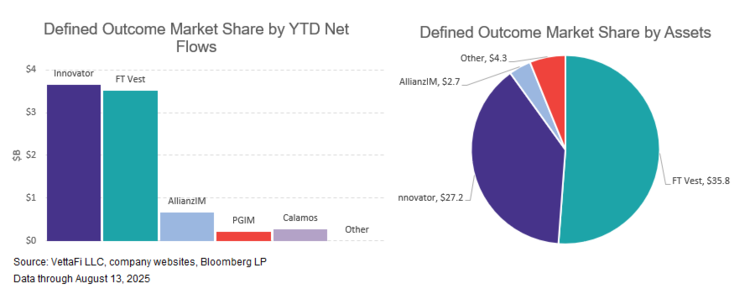
Innovator and First Trust (FT Vest) remain the leaders in this category. While Innovator leads with number of funds, FT Vest leads in assets. Together they command over 90% of AUM in the category and almost two thirds of the number of funds. At least one other issuer has defined outcome assets over $1 billion — AllianzIM. Calamos is a more recent entrant in the space (mid-2024 to present). It is approaching the $1 billion mark with its “defined protection” designs, which have resonated with investors.
Bottom Line:
Defined outcome ETFs have moved from a niche to a broader toolkit. These strategies are used to reshape equity risk in an unknown world with known trade-offs (cap for buffer). Growth has also been driven by both risk aversion and new product innovation (e.g., more choices in underlying indexes, buffer levels, etc.).
Interested in hearing more about defined outcome strategies in addition to more of this year’s popular ETF trends? VettaFi will be hosting a webcast on Thursday, August 21 at 12:30 PM ET. For more information, see this link to register.
For more information, please visit VettaFi.com | ETF Trends.

