

Last week FTSE made its annual review of country classification within its global equity indices (see the announcement here). One of the most interesting changes was Vietnam’s upgrade from frontier to emerging market. This will affect all FTSE indexes as of September 2026, likely with a phased implementation. This comes after years on the watch list for upgrade as the Vietnam market matured.
The benefits are multifold: 1) Existing Vietnam ETFs see price benefits and more potential net inflows; 2) emerging market indexes (and therefore ETFs) may add exposure to Vietnam in 2026; and 3) longer-term, Vietnam’s economy may also benefit from increased sentiment and exposure, particularly IPOs in the equity market. Here’s what to watch to capture an emerging opportunity in the emerging markets.
First of All — What Is a Frontier Market?
The term “frontier” market is less familiar than developed and emerging (and for good reason). FTSE classifies countries as developed, advanced emerging, secondary emerging, and frontier (in order from most to least developed). Close to 30 countries are currently classified as frontier markets, including Bulgaria, Croatia, Kenya, Morocco, and Pakistan. Frontier status reflects markets that meet minimum investability and accessibility standards, but fall short of secondary emerging thresholds. Notably, FTSE allows end-of-day (rather than real-time) prices for a market to qualify at the frontier level, which implies significantly less liquidity and pricing transparency at a frontier level.
For full details on FTSE’s classification system, see their paper here.
No ETF Opportunities in the Frontier Segment
Not surprisingly, U.S.-listed frontier ETFs no longer exist due to liquidity issues. Those countries with greater liquidity were often updated to emerging market status, leaving very illiquid countries behind. Previously, there were two recent frontier market ETFs that closed, most likely due to liquidity and accessibility issues to some extent. Invesco announced the termination and liquidation of its Frontier Markets ETF (FRN) in late 2019, with the last trading day in February 2020. BlackRock also announced the termination and liquidation of the iShares Frontier and Select EM ETF (FM) in 2024, with the last trading day in January 2025.
Change to Emerging Market ETFs
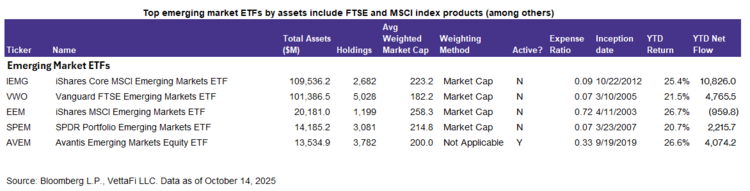
As stated above, changes to the FTSE index will begin rolling out in September 2026 (additionally, there will be a review period in March 2026). This means that Vietnam exposures could be added to certain ETFs — notably those that track FTSE emerging market indexes. The Vanguard FTSE Emerging Markets ETF (VWO ) is the second largest emerging market ETF (although it is a close race, at $102 billion versus $110 billion for the largest ETF). However, I would expect a small allocation in the low single digits. Currently, VWO is heavily weighted toward larger markets like China, Taiwan, and India. It allocates 4% or less weight to the remaining countries. Another ETF which could be affected would be the Schwab Emerging Markets Equity ETF (SCHE ), which also tracks a FTSE emerging markets index.
While it may seem obvious to some readers, it is worth clarifying that MSCI has its own classification system and review process, which is unaffected by FTSE’s change. Several of the largest emerging market ETFs follow MSCI indexes including the iShares Core MSCI Emerging Markets ETF (IEMG ) and the iShares MSCI Emerging Markets ETF (EEM ).
Vietnam ETFs May Be Used to Express Bullish Views Beyond a Broad Emerging Market Allocation
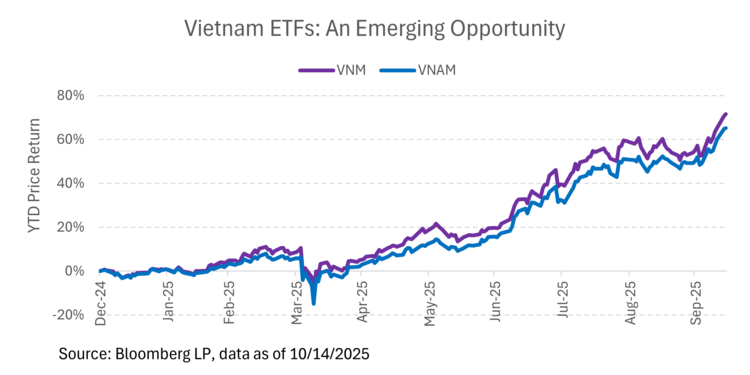
With Vietnam’s upgrade, Vietnam ETF prices already saw a boost (VNM is up around 8% and VNAM is up around 7% since the announcement). The effects will likely be longer-term, however, as Vietnam equity markets mature, which could also stimulate some IPO activity. Vietnam also has some tailwinds that existed before the upgrade. For example, Apple recently announced that it would move its home device manufacturing hub to Vietnam to reduce its dependence on China. That reliance on Vietnam should widely increase, as manufacturers diversify operations away from China into nearby countries which also offer relatively cheap labor. YTD, Vietnam ETFs have been up around 70%.
There are currently two Vietnam ETFs:
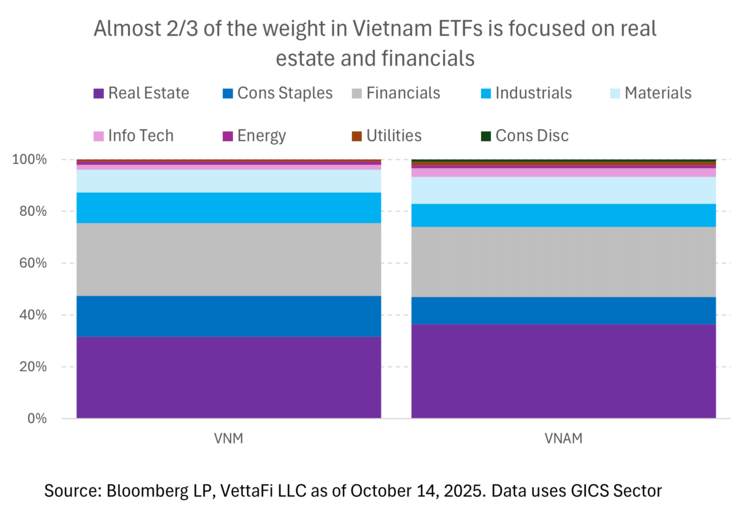
- The VanEck Vietnam ETF (VNM ) is the oldest and largest Vietnam ETF. Launched in August 2009, it now has $609 million assets. Almost two thirds of its weight is in real estate and financials. Its top-ten holdings make up around 60% of the ETF’s weight.
- The Global X MSCI Vietnam ETF (VNAM ) was launched relatively recently, in December 2021, and reasonably has less assets because of this (around $25 million). Although smaller, VNAM has a slightly lower fee than its peer (51 basis points versus 68 basis points). VNAM has a similar makeup as VNM, with the majority of its weight in real estate and financials. VNAM, however, has slightly more weight in the top holding Vingroup (VIC VN) at 17% versus 12% for VNM.

Where to Use Vietnam ETFs in a Portfolio?
Even if Vietnam is potentially added to emerging market ETFs, that allocation will likely be in the low-single digit range in market-cap weighted ETFs. Single country ETFs like VNM or VNAM can supplement that exposure. They can serve as satellite positions alongside a more diversified international portfolio. Alternatively, investors can also use them as shorter-term tactical positions to express a bullish view. Its sector makeup also complements larger economies like U.S. and China, since Vietnam’s exposure to technology and consumer discretionary is extremely small.
Bottom Line
Several interesting implications stem from FTSE’s upgrade of Vietnam to emerging market status. Investors will potentially get access to Vietnam in certain emerging market ETFs next year. However, this will likely be in very small amounts. For investors who are bullish on Vietnam’s growth opportunities, single-country vehicles (VNM, VNAM) offer targeted exposure.
For more news, information, and strategy, visit ETFDB.

