
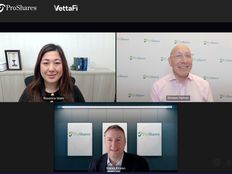
In a recent ProShares webcast, Global Investment Strategist Simeon Hyman and Director of Investment Strategy Kieran Kirwan zeroed in on a persistent frustration for income-focused investors: why traditional covered call strategies tend to fall behind when markets rebound. With geopolitical tensions persisting and economic data sending mixed signals, the discussion framed what the firm has dubbed the “covered call conundrum” — and a potential fix built on daily options.
A Market That’s Starting to Broaden
Moderated by Roxanna Islam, Head of Sector and Industry Research at TMX VettaFi, Hyman opened by putting recent volatility into perspective. Historically, he noted, equities have often rallied in the aftermath of major geopolitical conflicts, with gains in the range of 25% to 30% not uncommon.
What’s different now, he argued, is the market’s shifting leadership. The dominance of mega-cap tech — often grouped as the Magnificent Seven — is beginning to give way to broader participation. Earnings growth across the wider S&P 500 is starting to close the gap with the Nasdaq-100, a dynamic that could support a more balanced rally.
At the same time, bonds are reasserting their role. With the 10-year Treasury yield hovering in what Hyman described as a more “normal” 4% to 4.5% range, fixed income is once again positioned to act as a portfolio diversifier in a downturn.
See More: ProShares Debuts Money Market ETF to Meet the GENIUS Act
The Cost of Income
Kirwan then turned to covered call strategies. These have grown in popularity as a source of portfolio income but, he said, come with structural tradeoffs that are often underappreciated.
Most traditional products rely on monthly option cycles, a design that effectively exchanges upside participation for steady premium income. In rising markets, positions are frequently called away, limiting gains relative to core equity benchmarks.
In some cases, he said, covered call strategies capture only about one-third of the upside of indices such as the S&P 500 or Nasdaq-100. Their lower sensitivity to equity markets — typically reflected in a beta around 0.6 — can also lead to lagging performance during recoveries.
A Daily Reset
The firm has responded with a suite of ETFs built on daily options strategies: the ProShares S&P 500 High Income ETF (ISPY ), the ProShares Nasdaq-100 High Income ETF (IQQQ ) and the ProShares Russell 2000 High Income ETF (ITWO ).
The shift to daily option writing, Kirwan said, is intended to preserve income generation while improving participation in rising markets.
By selling out-of-the-money calls each day, the funds seek to generate a steady stream of option premiums alongside underlying dividends. The shorter time horizon also reduces the likelihood of being locked into positions that cap gains during gradual market advances.
The strategy is further adjusted through a rules-based volatility framework. When markets become more volatile, strike prices are set further out of the money. This allows additional room for potential upside.
ProShares says the approach results in behavior more closely aligned with equities, with a beta closer to 0.9.
Not A Hedge
The webcast also underscored a key limitation of covered call strategies: they are not effective downside hedges. Kirwan said the approach offers little in the way of true protection. He pointed to tariff-driven volatility in early 2025. Then, traditional covered call strategies failed to cushion losses and lagged again during the subsequent rebound.
Hyman echoed the point more bluntly, arguing that investors seeking downside protection should look elsewhere. He cited bonds and managed futures as more appropriate tools for that role. Additionally, he characterized covered calls instead as income strategies with equity exposure rather than hedging vehicles.
Tax Angle
The strategies may also offer tax considerations. A portion of distributions from ISPY, IQQQ and ITWO can be classified as return of capital. This allows investors to defer taxes until the underlying position is sold.
For more news, information, and analysis, visit VettaFi | ETFDB.

