

ETFdb Logo
  • ETF Database
  • Content Hubs
    • Themes
      • Active ETF
      • Alternatives
      • Artificial Intelligence
      • China Insights
      • Core Strategies
      • Crypto
      • Disruptive Technology
      • Energy Infrastructure
      • ETF Building Blocks
      • ETF Investing
      • ETF Strategist
      • Financial Literacy
      • Fixed Income
      • Free Cash Flow
      • Future ETFs
      • Innovative ETFs
      • Institutional Income Strategies
      • Leveraged & Inverse
      • Market Insights
      • Market Outlooks
      • Modern Alpha
      • Nuclear Energy
      • Portfolio Strategies
      • Sector Investing
      • Tax Efficient Income
      • Thematic Investing
    • Asset Class
      • Equity
        • U.S. Equity
        • Int'l Developed
        • Emerging Market Equities
      • Alternatives
        • Gold/Silver/Critical Materials
        • Cryptocurrency
        • Currency
        • Volatility
      • Fixed Income
        • Investment Grade Corporates
        • US Treasuries & TIPS
        • High Yield Corporates
        • Int'l Fixed Income
    • ETF Ecosystem
    • ETFs in Canada
    • Market Outlook
    • Crypto ETF Hub
  • Tools
    • ETF Screener
    • ETF Country Exposure Tool
    • ETF Database Categories
    • Indexes
    • Scenario Analysis
    • Watchlists
    • Head-To-Head ETF Comparison Tool
    • Mutual Fund To ETF Converter
    • ETF Stock Exposure Tool
    • ETF Issuer Fund Flows
  • Research
    • ETF Education
    • Equity Investing
    • Dividend ETFs
    • Leveraged ETFs
    • Inverse ETFs
    • Index Education
    • Index Insights
    • Top ETF Sectors
    • Top ETF Issuers
    • Top ETF Industries
  • Webcasts
  • Sectors
    • Sector Investing Content Hub
    • XLK
    • XLI
    • XLU
    • XLY
    • XLP
    • XLRE
    • Sector Power Rankings
    • XLE
    • XLC
    • XLF
    • XLV
    • XLB
  • Multimedia
    • ETF 360 Video Series
    • ETF of the Week Podcast
    • Gaining Perspective Podcast
    • ETF Prime Podcast
    • Video
  • Company
    • About VettaFi
    • Get VettaFi’ed
  • PRO
    • Pro Content
    • Pro Tools
    • Advanced
    • FAQ
    • Free sign up
    • Login
  1. Portfolio Strategies Content Hub
  2. A Dollar in Decline Supports Case for International Equities
Portfolio Strategies Content Hub
Share

A Dollar in Decline Supports Case for International Equities

Ben HernandezOct 15, 2025
2025-10-15

A declining dollar continues to strengthen the investment case for international equities. However, before investors dive into international equities exposure, it’s imperative to examine the options presented to them — namely passive versus active fund options.

The investor appeal for international equities continues to strengthen following the first rate cut of 2025. The expectation is that the Federal Reserve will continue to follow a path toward easing, which should, in turn, prop up the local currencies of countries abroad. Because oftentimes a country’s market strength is tied to the strength of its native currency versus the U.S. dollar, the Fed’s easing should smoothen the pathway for upside in international equities.

The strength abroad is visually apparent in the performance disparity between the MSCI World Ex USA and the ICE US Dollar Index. Juxtaposing the performances of both indexes in a year-to-date time frame immediately shows the strength of the MSCI index. Ensuing interest rate cuts could widen the performance gap between the two indices even further. This is a microcosm of the broader trend of de-dollarization in which more and more countries are turning away from the dollar as the world’s reserve currency.
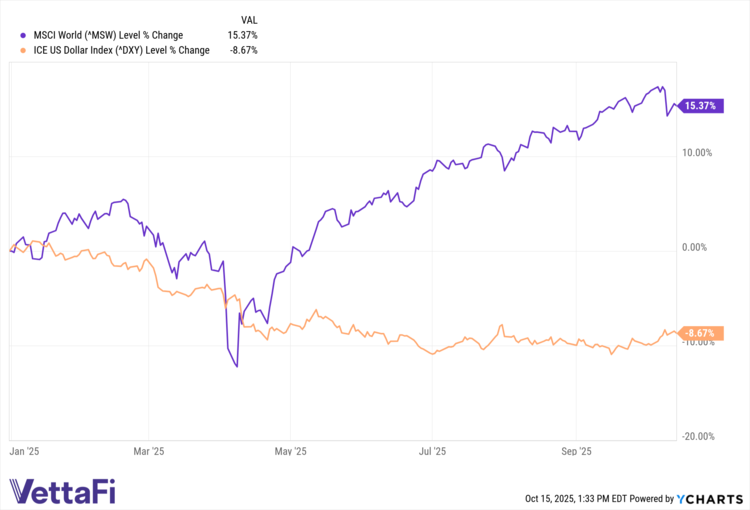
This is a chart of MSW
^MSW data by YCharts

In addition to the macroeconomic effects of the dollar, international equities carry their own nuanced risks investors must take into consideration. These risks include political and economic risk associated with specific countries. Furthermore, tariffs in the current market environment only add to the already-complex nature of international stocks. Given these factors, passive funds are typically tied to an index, which doesn’t allow for customization of its holdings when volatility strikes. This is where an actively managed fund can shine in an international market environment that can be prone to various systematic and idiosyncratic risks.


Content continues below advertisement

Active Flexibility

Investors looking to get exposure to international equities should consider using an active fund as opposed to one tethered to an index. Given the complexities associated with international equities, investors should strongly consider active management to navigate these nuanced markets. The flexibility allows portfolio managers to tailor the holdings to suit the various nuances associated with international equities, which can vary from country to country.

One fund that should be on the consideration list is the Thornburg International Equity ETF (TXUE ). The fund leverages the expertise and experience of Thornburg’s investment management team who can expertly navigate international markets.

For more news, information, and analysis, visit our Portfolio Strategies Content Hub.

Loading Articles...

Advertisement

Is Your Portfolio Positioned With Enough Global Exposure?

ETF Education Channel

How to Allocate Commodities in Portfolios

Tom LydonApr 26, 2022
2022-04-26

A long-running debate in asset allocation circles is how much of a portfolio an investor should...

Core Strategies Channel

Why ETFs Experience Limit Up/Down Protections

Karrie GordonMay 13, 2022
2022-05-13

In a digital age where information moves in milliseconds and millions of participants can transact...

}
X
