

ETFdb Logo
  • ETF Database
  • Content Hubs
    • Themes
      • Active ETF
      • Alternatives
      • Artificial Intelligence
      • China Insights
      • Core Strategies
      • Crypto
      • Disruptive Technology
      • Energy Infrastructure
      • ETF Building Blocks
      • ETF Investing
      • ETF Strategist
      • Financial Literacy
      • Fixed Income
      • Free Cash Flow
      • Future ETFs
      • Innovative ETFs
      • Institutional Income Strategies
      • Leveraged & Inverse
      • Market Insights
      • Market Outlooks
      • Modern Alpha
      • Nuclear Energy
      • Portfolio Strategies
      • Sector Investing
      • Tax Efficient Income
      • Thematic Investing
    • Asset Class
      • Equity
        • U.S. Equity
        • Int'l Developed
        • Emerging Market Equities
        • Smart Beta
      • Alternatives
        • Gold/Silver/Critical Materials
        • Commodities
        • Cryptocurrency
        • Currency
        • Volatility
      • Fixed Income
        • Investment Grade Corporates
        • US Treasuries & TIPS
        • High Yield Corporates
        • Int'l Fixed Income
    • ETF Ecosystem
    • ETFs in Canada
    • Crypto ETF Hub
  • Tools
    • ETF Screener
    • ETF Country Exposure Tool
    • ETF Database Categories
    • Indexes
    • Scenario Analysis
    • Watchlists
    • Head-To-Head ETF Comparison Tool
    • Mutual Fund To ETF Converter
    • ETF Stock Exposure Tool
    • ETF Issuer Fund Flows
  • Research
    • ETF Education
    • Equity Investing
    • Dividend ETFs
    • Leveraged ETFs
    • Inverse ETFs
    • Index Education
    • Index Insights
    • Top ETF Sectors
    • Top ETF Issuers
    • Top ETF Industries
  • Webcasts
  • Sectors
    • Sector Investing Content Hub
    • XLK
    • XLI
    • XLU
    • XLY
    • XLP
    • XLRE
    • Sector Power Rankings
    • XLE
    • XLC
    • XLF
    • XLV
    • XLB
  • Multimedia
    • ETF 360 Video Series
    • ETF of the Week Podcast
    • Gaining Perspective Podcast
    • ETF Prime Podcast
    • Video
  • Company
    • About VettaFi
  • PRO
    • Pro Content
    • Pro Tools
    • Advanced
    • FAQ
    • Free sign up
    • Login
  1. Portfolio Strategies Content Hub
  2. Correct an Unbalanced Equities Portfolio With RSP
Portfolio Strategies Content Hub
Share

Correct an Unbalanced Equities Portfolio With RSP

Ben HernandezSep 07, 2021
2021-09-07

Too much of a good thing can apply to equities exposure, and with exchange traded funds (ETFs) like the Invesco S&P 500® Equal Weight ETF (RSP B+), holdings get equal billing to help balance portfolios.

As Invesco’s website puts it, RSP prevents investors from “putting your eggs in one basket.” It can be easy to fall into the trap of allocating too heavily into one or more stocks to extract maximum gains, such as big tech heavy-hitters like Apple or Amazon.

While there’s nothing wrong with getting exposure to these companies, the problem could be compounded when markets head downward. In the midst of heavy sell-offs, investors could experience large drawdowns when they’re too heavily exposed to certain stocks.

This is especially the case when it comes to the S&P 500. Extreme concentration risk could result when investors leave themselves vulnerable by investing too much in the index’s top holdings.

“As the S&P 500 has grown ever more top-heavy, many investors in products tied to the Index have found themselves facing historic levels of concentration risk, the likes of which passive investors have not seen since 1970 — half a century ago. Such a high concentration in the S&P 500’s top five holdings potentially leaves investors vulnerable in the event that the companies’ current high valuations fall back to earth,” the Invesco website noted.

Dividing Holdings Equally

RSP’s equal weight approach to the S&P 500 may offer investors a number of potential benefits. By reducing the heavy weightings allocated to the largest companies by divvying up holdings equally, RSP seeks to reduce the concentration risk.

“Investors concerned about the growing concentration risk in traditional market cap-weighted indexes may want to consider an equal weight approach,” the website added. “An equal weight approach can provide diversification benefits and reduce concentration risk by weighting each constituent company equally, so that a small group of companies does not have an outsized impact on the index. Invesco S&P 500® Equal Weight ETF (RSP) takes an equal weight approach to the S&P 500, with each of its 500 constituent companies allocated approximately a 0.2% weighting in the portfolio.”

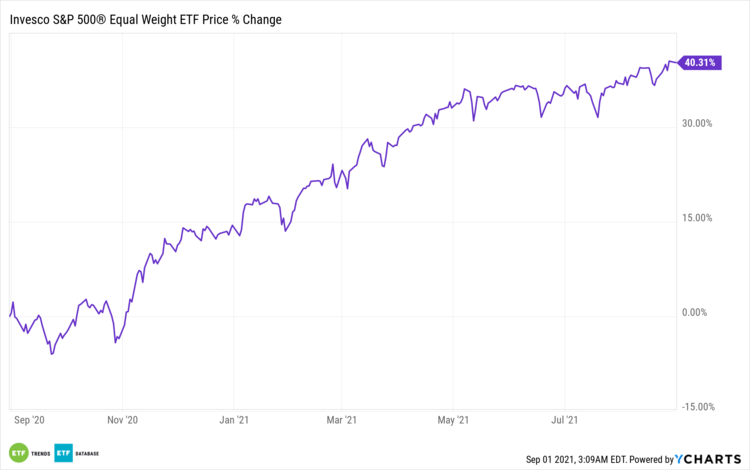
Investors who are hesitant on whether this equal weight approach can truly extract gains from the S&P 500 only have to look at the past year’s performance. The ETF is up 40% within the last 12 months, proving that it can capture upside while still protecting from the downside by reducing concentration risk.

Content continues below advertisement

Invesco SP500 Equal Weight ETF Price Change

For more news, information, and strategy, visit the Portfolio Strategies Channel.

Loading Articles...

Advertisement

Is Your Portfolio Positioned With Enough Global Exposure?

ETF Education Channel

How to Allocate Commodities in Portfolios

Tom LydonApr 26, 2022
2022-04-26

A long-running debate in asset allocation circles is how much of a portfolio an investor should...

Core Strategies Channel

Why ETFs Experience Limit Up/Down Protections

Karrie GordonMay 13, 2022
2022-05-13

In a digital age where information moves in milliseconds and millions of participants can transact...

}
X
