


Decades of global market dominance by U.S. equities have caused investors to wonder if today’s market valuations may not support the underlying fundamentals. If that’s the case, a more lucid picture of future returns could be found in international equities investing.
Thornburg Investment Management’s Matt Burdett, who serves as the firm’s head of equities and portfolio manager, presented the case of why the current market environment is conducive to international equities investing. Burdett joined TMX VettaFi’s Head of Research Todd Rosenbluth to discuss this opportunity in a webinar: Going Global: An Advisor’s Guide To Looking Beyond the US.

Murky Market Future for U.S.?
Burdett expertly outlined the macroeconomic and market-specific backdrop that’s paving the way towards the profitable path to international investing. He explained that market leadership is cyclical. The U.S. has been in pole position for an extended period of time, which could eventually turn in favor for international markets. What’s causing the shift? A disparity between earnings and market capitalization driven by growth-focused U.S. equities could be leading to portfolios too heavily concentrated in U.S. growth. Much of this is due to the popularity of the artificial intelligence (AI) theme.
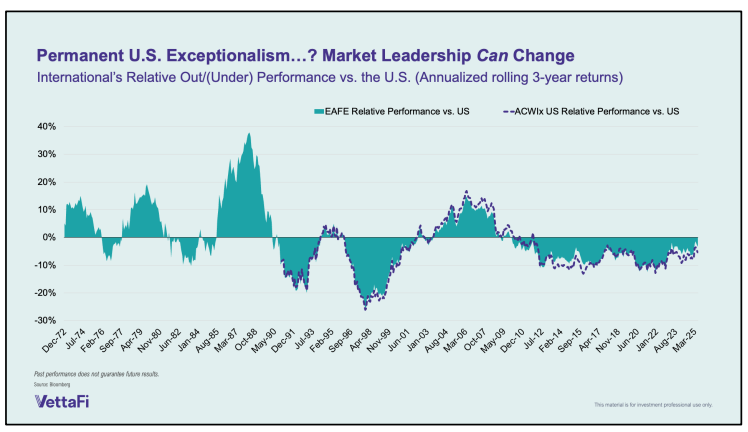
“It’s been a long period of time the U.S. has been leading the markets,” Burdett explained. “This can evolve and you can see outperformance in international just as it has in certain time periods [like the early 2000s].”
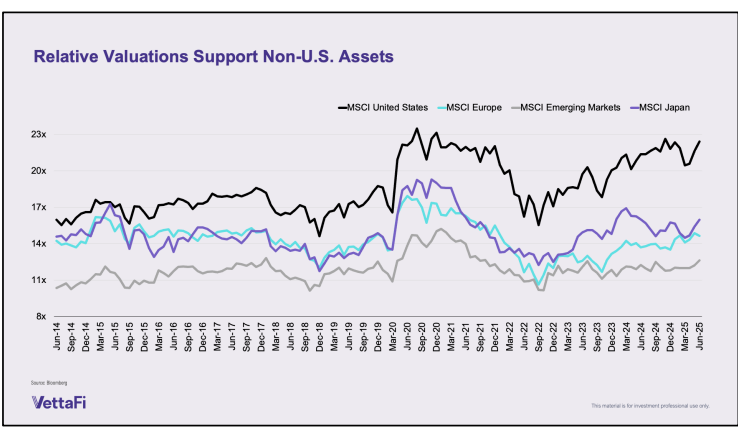
The macroeconomic implications are also tilting in favor of international equities. As Burdett explained, a confluence of tariffs, inflation, interest rate cuts, and a U.S. dollar in decline continue to produce compounding effects that make international equities more attractive relative to their U.S. counterparts.
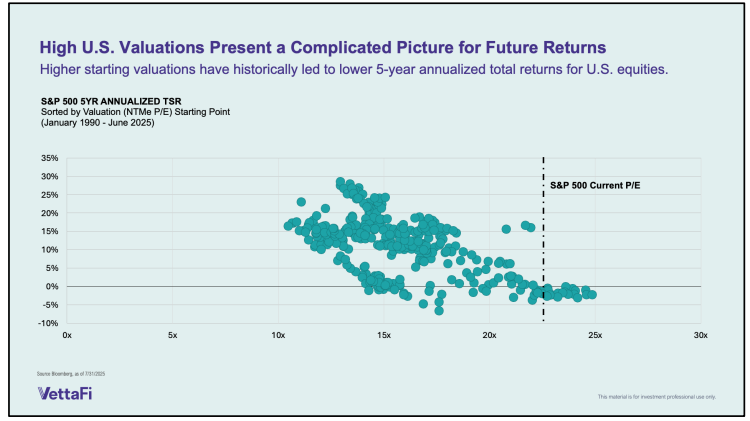
Additionally, earnings growth has been stronger in certain parts of the globe, such as Europe and Japan. This ties back to lofty market valuations in the U.S. that may not match company fundamentals, thereby leading investors to believe that U.S equities outperformance may have reached an apex. From a forward-looking standpoint, this makes the future returns of U.S. equities more murky compared to international equities.
“Starting valuations matter a lot in terms of future returns,” Burdett said.
Will International Strength Continue?
When it comes to international equities exposure, 52% of survey respondents during the webinar noted they already have between a 10%–20% allocation. Moreover, almost 50% are anticipating that international equities will continue outperforming. That said, it’s not too late to consider allocation for those who are still on the fence with international equities exposure.
“What [the survey results] tell me is that people are considering international markets more,” Burdett said. “And understanding that better balance in client portfolios is something to think about.”
One of the paths to investment is ETFs — active management, in particular, presents a compelling option in international investing. It’s an area in which Thornburg thrives.
A Bottom-Up Approach
The crux of Thornburg’s international investing strategy is to seek opportunities using a bottom-up approach. Because the international equities space can be nuanced and complex, a game plan is always in order. With that, Thornburg’s investing strategy is underpinned by three pillars to screen potential opportunities: seeking underappreciated opportunities, a resilient foundation, and the ability to execute. Burdett explained all three pillars in more depth during the webinar. Added to this are holdings based on the compartmentalization of business risk as well as earnings streams into three baskets: basic value, a consistent earner, and an emerging franchise.
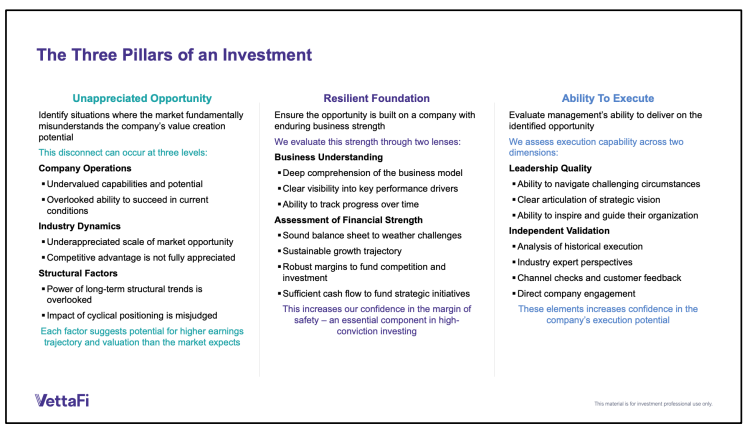
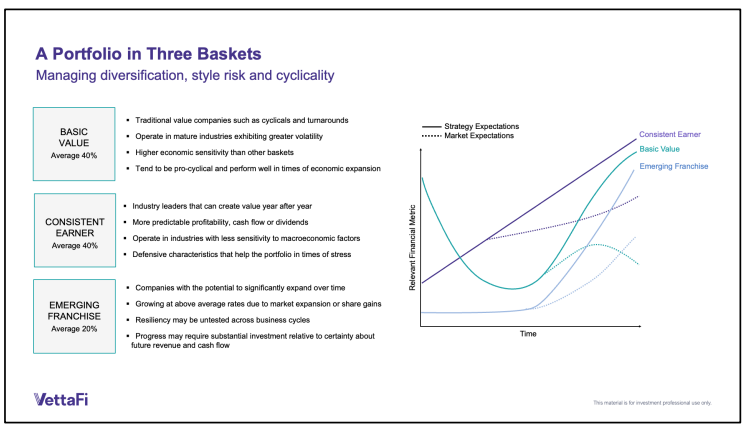
“It’s a process of a three by three,” Burdett explained. “Three pillars of an investment and then three baskets to help us compartmentalize the types of earnings streams that companies have.”
With $52 billion in assets managed and growing, one of the best ways to encapsulate the aforementioned investing approach is via Thornburg’s suite of active ETFs. Moreover, they have a pair of funds that utilize active management when international investing: the Thornburg International Equity ETF (TXUE ) as well as the +*Thornburg International Growth Fund ETF*+ (TXUG ). TXUE presents an ideal option for broad international equities exposure. Meanwhile, those looking to lean into the growth factor should consider TXUG. The actively managed funds leverage the expertise and experience of Thornburg’s investment management team to navigate international markets, which as shown in the webinar, come with their own unique set of idiosyncrasies and risks.
To watch the complete webinar, click here.
Click here to learn more about TXUE and TXUG as well as their full suite of ETFs.
For more news, information, and analysis, visit our Portfolio Strategies Content Hub.

