
ETFdb Logo
  • ETF Database
  • Content Hubs
    • Themes
      • Active ETF
      • Alternatives
      • Artificial Intelligence
      • China Insights
      • Core Strategies
      • Crypto
      • Disruptive Technology
      • Energy Infrastructure
      • ETF Building Blocks
      • ETF Investing
      • ETF Strategist
      • Financial Literacy
      • Fixed Income
      • Free Cash Flow
      • Future ETFs
      • Innovative ETFs
      • Institutional Income Strategies
      • Leveraged & Inverse
      • Market Insights
      • Market Outlooks
      • Modern Alpha
      • Nuclear Energy
      • Portfolio Strategies
      • Sector Investing
      • Tax Efficient Income
      • Thematic Investing
    • Asset Class
      • Equity
        • U.S. Equity
        • Int'l Developed
        • Emerging Market Equities
      • Alternatives
        • Gold/Silver/Critical Materials
        • Cryptocurrency
        • Currency
        • Volatility
      • Fixed Income
        • Investment Grade Corporates
        • US Treasuries & TIPS
        • High Yield Corporates
        • Int'l Fixed Income
    • ETF Ecosystem
    • ETFs in Canada
    • Market Outlook
    • Crypto ETF Hub
  • Tools
    • ETF Screener
    • ETF Country Exposure Tool
    • ETF Database Categories
    • Indexes
    • Scenario Analysis
    • Watchlists
    • Head-To-Head ETF Comparison Tool
    • Mutual Fund To ETF Converter
    • ETF Stock Exposure Tool
    • ETF Issuer Fund Flows
  • Research
    • ETF Education
    • Equity Investing
    • Dividend ETFs
    • Leveraged ETFs
    • Inverse ETFs
    • Index Education
    • Index Insights
    • Top ETF Sectors
    • Top ETF Issuers
    • Top ETF Industries
  • Webcasts
  • Sectors
    • Sector Investing Content Hub
    • XLK
    • XLI
    • XLU
    • XLY
    • XLP
    • XLRE
    • Sector Power Rankings
    • XLE
    • XLC
    • XLF
    • XLV
    • XLB
  • Multimedia
    • ETF 360 Video Series
    • ETF of the Week Podcast
    • Gaining Perspective Podcast
    • ETF Prime Podcast
    • Video
  • Company
    • About VettaFi
  • PRO
    • Pro Content
    • Pro Tools
    • Advanced
    • FAQ
    • Free sign up
    • Login
  1. Smart Beta Content Hub
  2. Meet DBJP, A Safe Currency ETF for Risky Times
Smart Beta Content Hub
Share

Meet DBJP, A Safe Currency ETF for Risky Times

Ben HernandezNov 19, 2020
2020-11-19

When the U.S.-China trade wars were at their zenith, the Japanese yen was a safe haven currency for U.S. and Chinese investors. The COVID-19 pandemic has since changed that, but Japanese equities exposure with a currency hedging component are still possible via the Xtrackers MSCI Japan Hedged Equity ETF (DBJP A+).

DBJP seeks investment results that correspond generally to the performance of the MSCI Japan US Dollar Hedged Index. The fund, using a “passive” or indexing investment approach, seeks investment results that correspond generally to the performance, of the underlying index, which is designed to track the performance of the Japanese equity market while mitigating exposure to fluctuations between the value of the U.S. dollar and the Japanese yen.

DBJP will invest at least 80% of its total assets in component securities (including depositary receipts in respect of such securities) of the underlying index. DBJP’s expense ratio comes in at 0.46%.

The fund has been rebounding nicely since the pandemic sell-offs in March, and if the world’s third largest economy can continue its trajectory, then DBJP stands to benefit in 2021.
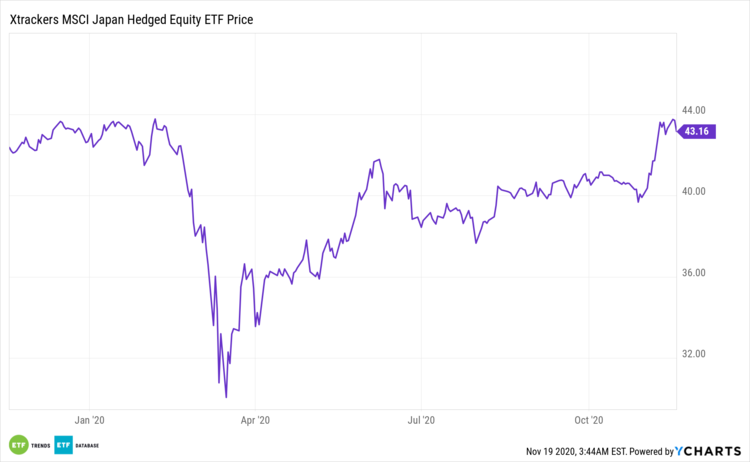
DBJP ETF Year Price

The Yen as a Safe Currency

“Having burnished its traditional image as a global safe haven during the coronavirus pandemic, Japan’s yen is attracting fresh interest as the highest yielder among the three major currencies,” a Reuters article said. “The past few weeks have seen the yen hit multi-month highs as news broke of a Biden presidency and a possible COVID-19 vaccine, which is at odds with its tendency to weaken when investors seek risk and growth prospects.”

“Analysts cite two big reasons driving a wave of money into yen markets. As a net creditor nation in a world of fiscal profligacy, the yen has retained some of its safe-haven credentials,” the article added further. “In addition, as interest rates in Europe and the United States plunge, Japanese government bonds (JGBs) offer comparatively higher returns, in particular, on an inflation-adjusted basis.”

“Investing in the U.S., outside of the equity market, is less attractive than what they can engineer in the JGB market,” said Chris Weston, head of research at Pepperstone in Melbourne.

The article further noted that the “change in the yen’s fortunes was brought about by the U.S. Federal Reserve’s sharp monetary easing, which wiped out returns in dollar-based assets. Japanese investors lost their big appetite for overseas investments as domestic yields became higher than those available abroad.”

“The Fed has changed the dynamics,” Weston said.

For more news and information, visit the Smart Beta Channel.


Content continues below advertisement

Loading Articles...

Advertisement

Is Your Portfolio Positioned With Enough Global Exposure?

ETF Education Channel

How to Allocate Commodities in Portfolios

Tom LydonApr 26, 2022
2022-04-26

A long-running debate in asset allocation circles is how much of a portfolio an investor should...

Core Strategies Channel

Why ETFs Experience Limit Up/Down Protections

Karrie GordonMay 13, 2022
2022-05-13

In a digital age where information moves in milliseconds and millions of participants can transact...

}
X
