ETFdb Logo
  • ETF Database
  • Content Hubs
    • Themes
      • Active ETF
      • Alternatives
      • Artificial Intelligence
      • China Insights
      • Core Strategies
      • Crypto
      • Disruptive Technology
      • Energy Infrastructure
      • ETF Building Blocks
      • ETF Investing
      • ETF Strategist
      • Financial Literacy
      • Fixed Income
      • Free Cash Flow
      • Future ETFs
      • Innovative ETFs
      • Institutional Income Strategies
      • Leveraged & Inverse
      • Market Insights
      • Market Outlooks
      • Modern Alpha
      • Nuclear Energy
      • Portfolio Strategies
      • Sector Investing
      • Tax Efficient Income
      • Thematic Investing
    • Asset Class
      • Equity
        • U.S. Equity
        • Int'l Developed
        • Emerging Market Equities
      • Alternatives
        • Gold/Silver/Critical Materials
        • Cryptocurrency
        • Currency
        • Volatility
      • Fixed Income
        • Investment Grade Corporates
        • US Treasuries & TIPS
        • High Yield Corporates
        • Int'l Fixed Income
    • ETF Ecosystem
    • ETFs in Canada
    • Market Outlook
    • Crypto ETF Hub
  • Tools
    • ETF Screener
    • ETF Country Exposure Tool
    • ETF Database Categories
    • Indexes
    • Scenario Analysis
    • Watchlists
    • Head-To-Head ETF Comparison Tool
    • Mutual Fund To ETF Converter
    • ETF Stock Exposure Tool
    • ETF Issuer Fund Flows
  • Research
    • ETF Education
    • Equity Investing
    • Dividend ETFs
    • Leveraged ETFs
    • Inverse ETFs
    • Index Education
    • Index Insights
    • Top ETF Sectors
    • Top ETF Issuers
    • Top ETF Industries
  • Webcasts
  • Sectors
    • Sector Investing Content Hub
    • XLK
    • XLI
    • XLU
    • XLY
    • XLP
    • XLRE
    • Sector Power Rankings
    • XLE
    • XLC
    • XLF
    • XLV
    • XLB
  • Multimedia
    • ETF 360 Video Series
    • ETF of the Week Podcast
    • Gaining Perspective Podcast
    • ETF Prime Podcast
    • Video
  • Company
    • About VettaFi
  • PRO
    • Pro Content
    • Pro Tools
    • Advanced
    • FAQ
    • Free sign up
    • Login
  1. Thematic Investing Content Hub
  2. A Small Cap Fund with Call Potential? Meet the RYLD ETF
Thematic Investing Content Hub
Share

A Small Cap Fund with Call Potential? Meet the RYLD ETF

Ben HernandezMar 08, 2021
2021-03-08

It’s one thing to get exposure to the small cap rally, but an added benefit is getting exposure to the way these funds have been actually moving. ETF investors can get exposure to both via the Russell 2000 Covered Call ETF (RYLD A).

As inflation fears put investors on edge, small cap exposure can give them the growth component when markets turn around. While history is not an indicator of future performance, it definitely is on the side of small caps.

“Historically, small-cap stocks tend to outperform large-cap stocks during the early stages of a new bull market,” a U.S. News & World Report News report said. “The 2020 March bottom in the S&P 500 marked the beginning of a new bull market. Vaccine rollouts, pent-up consumer demand and unprecedented government stimulus have many analysts anticipating the next several years will be an excellent period for earnings growth and investing upside. There are plenty of excellent buying opportunities among small-cap stocks that have the potential for significant growth in 2021 and beyond. Here are seven of CFRA’s top small-cap stock picks with growth potential.”

RYLD seeks to provide investment results that correspond generally to the price and yield performance, before fees and expenses, of the Cboe Russell 2000 BuyWrite Index. The Global X Russell 2000 Covered Call ETF (RYLD) follows a covered call or buy-write strategy, in which the fund buys exposure to the stocks in the Russell 2000 Index and writes or sells corresponding call options on the same index.

RYLD gives investors:

  • High Income Potential: RYLD seeks to generate income through covered call writing, which historically produces higher yields in periods of volatility.
  • Monthly Distributions: The fund makes distributions on a monthly basis.
  • Efficient Options Execution: The ETF writes call options on the Russell 2000 Index, saving investors the time and potential expense of doing so individually.
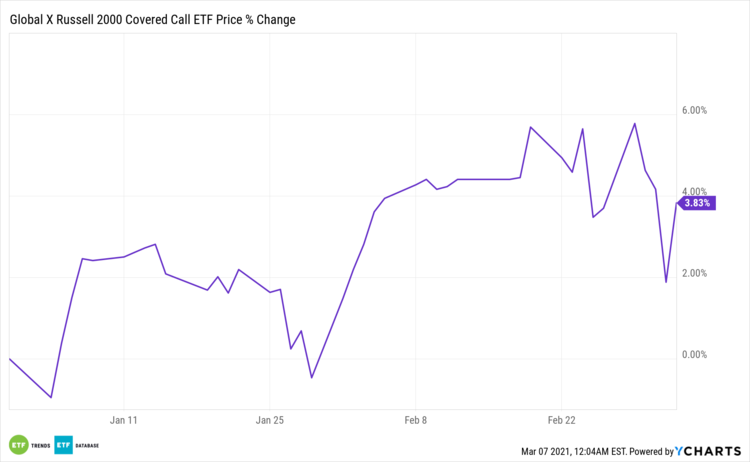
RYLD Price % Change

An Income Generator

As outlined by Investopedia, a buy-write strategy involves “an option trading strategy where an investor buys a security, usually a stock, with options available on it and simultaneously writes (sells) a call option on that security. The purpose is to generate income from option premiums.”

“Because the option position only decreases in value if the price of the underlying security increases, the downside risk of writing the option is minimized,” the article added. “The most common example of this strategy is the use of a covered call on a stock already owned by an investor.”

Content continues below advertisement

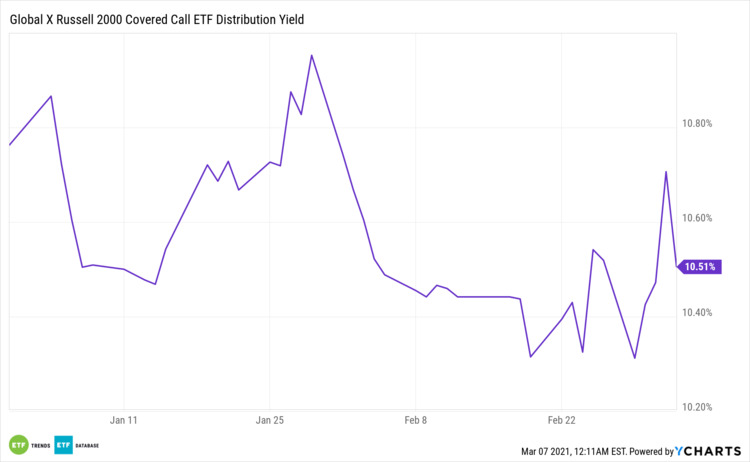
RYLD Distribution Yield

For more news and information, visit the Thematic Investing Channel.

Loading Articles...

Advertisement

Is Your Portfolio Positioned With Enough Global Exposure?

ETF Education Channel

How to Allocate Commodities in Portfolios

Tom LydonApr 26, 2022
2022-04-26

A long-running debate in asset allocation circles is how much of a portfolio an investor should...

Core Strategies Channel

Why ETFs Experience Limit Up/Down Protections

Karrie GordonMay 13, 2022
2022-05-13

In a digital age where information moves in milliseconds and millions of participants can transact...

}
X
