


Investors seeking emerging markets (EM) exposure will typically take a traditional approach that involves funds benchmarked to the MSCI Emerging Markets Index. This is where the National Security Emerging Markets Index ETF (NSI ) takes a differentiated approach to EM with a focus on national security threats.
EM indexes may inadvertently include constituents that are subject to U.S. sanctions, involved in espionage, or linked to human rights abuses. By employing a rigorous National Security Governance (NSG) process built upon the U.S. Intelligence Cycle, the fund filters out companies that pose strategic threats or cybersecurity risks. By tracking the Alerian National Security Emerging Markets Index rather than the MSCI index, NSI screens out bad actors that endanger national security interests.
Key Takeaways:
- By utilizing a rigorous National Security Governance (NSG) process based on the U.S. Intelligence Cycle, NSI filters out “bad actors” involved in espionage or sanctions that are often inadvertently included in traditional emerging markets indexes.
- NSI provides a more efficient, high-conviction alternative to broad funds like EEM. It maintains a significantly higher effective holdings ratio that ensures fund performance is driven by its most meaningful positions rather than a small fraction of a massive basket.
- Unlike “ex-China” funds that use broad country exclusions, NSI targets specific corporate threats. This allows investors to capture high-growth opportunities while mitigating the specific risks of human rights violations and cybersecurity threats.
See More: Space ETF UFO Begins April With Sky-High Stock Performance
NSI Versus EEM
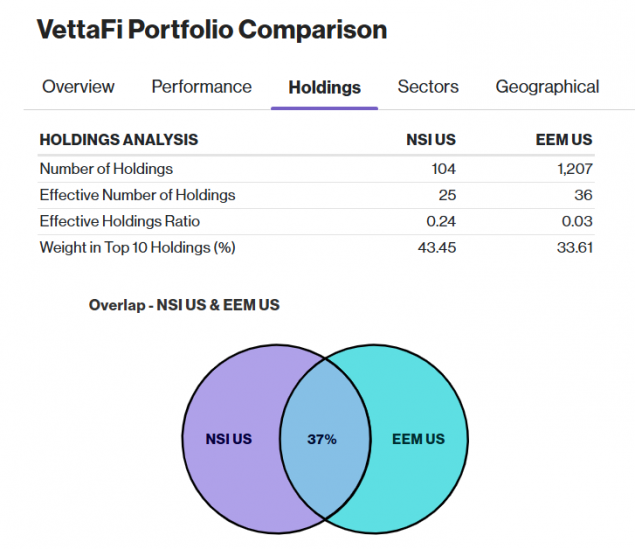
When it comes to getting broad-based EM exposure, a common ETF option is the iShares MSCI Emerging Markets ETF (EEM ). As mentioned, EEM is one of those funds linked to the MSCI Emerging Markets Index, which offers vast exposure to EM equities. Again, this doesn’t address the security threat component. Comparatively, NSI offers a more concentrated, intelligence-driven alternative to the broad focus of EEM. A look at the holdings of each portfolio further highlights the differentiation between the two.
As evidenced by its over 1,200 holdings, EEM casts a wide net for exposure. Conversely, NSI maintains a high-conviction portfolio of just 104 holdings. This greater selectivity is further punctuated by a higher effective holdings ratio (0.24 for NSI vs. 0.03 for EEM). The ratio is calculated by dividing the effective number of holdings by the actual number of holdings. The higher ratio of NSI indicates that its performance is distributed more meaningfully across its basket. Accordingly, each holding bears more significance to the performance of the fund. In contrast, EEM’s 0.03 ratio indicates that despite its over 1,200 holdings, it is significantly more top-heavy. Ultimately, investors are reliant on a tiny fraction of its total holdings to move the performance needle — 36 (the effective number of holdings) are driving the performance of a fund with over 1,200 holdings.
Furthermore, NSI’s top 10 holdings command 43.45% of the fund versus EEM’s 33.61%. With only a 37% overlap, NSI’s index effectively strips away the national security risks embedded in larger, passive EM benchmarks.
High-Growth Performer
When looking for high-growth exposure to EM, some investors may opt to use “ex-China” funds to avoid geopolitical friction. NSI, however, doesn’t just exclude a country, but specific threats. The fund can maintain China exposure as long as the company domiciled in that country clears the governance screens. To be excluded from the index, companies must meet one of nine investments screens that include the following: subject to U.S. government sanctions, strategic threat, cybersecurity threat, espionage threat, or human rights violations.
The fund’s primary objective is to deny capital to foreign companies that endanger U.S. interests while simultaneously mitigating geopolitical volatility. This allows investors to attain exposure to high-growth areas in the expansive EM market while mitigating the risk of potential government sanctions tied to national security threats.
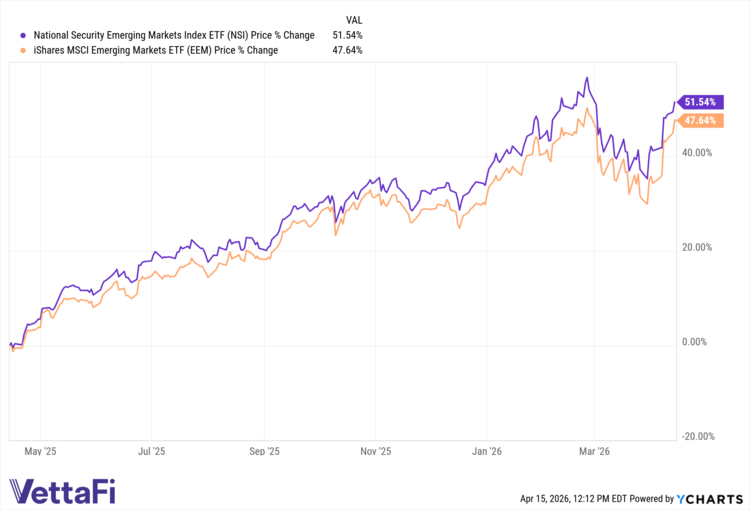
Looking at its trailing 12-month performance, NSI demonstrates that values-based investing can align with outperformance. By outpacing the broader EEM fund the past year, NSI proves that a national security first approach goes beyond a moral choice. The fund is also a high-growth portfolio energizer.
In the end, NSI emerges as a compelling option for investors seeking EM growth without compromising on national security standards.
For more news, information, and analysis, visit The Thematic Investing Content Hub.
VettaFi LLC (“VettaFi”) is the index administrator and calculation agent for NSI, for which it receives a fee. However, NSI is not issued, sponsored, endorsed, or sold by VettaFi, and VettaFi has no obligation or liability in connection with the issuance, administration, marketing, or trading of NSI.

