


Thematic exchange-traded funds (ETFs) saw a resurgence in 2025, bringing growth opportunities in niche subsectors back into the spotlight. That said, some investment trends can be short-lived. Meanwhile, others offer secular trends with enduring investment horizons, such as drone technology. In the early frame of 2026, investors will want to position their portfolios to capture this long-term upside in the REX Drone ETF (DRNZ).
In a webinar called How to Find Pure Play Approaches to Drone Technology, REX Shares COO Scott Acheychek joined TMX VettaFi Head of Research Todd Rosenbluth to discuss this unique opportunity. From its early beginnings to its manifestations as an investment opportunity via an ETF wrapper in DRNZ, webinar attendees had much to take away regarding drone technology.

Why A Drones ETF?
When it comes to thematic ETFs, education is often required to ensure that investors are aware of the fund. Case in point: Almost 50% of attendees noted they’re “not familiar” with the drones industry as a viable investment opportunity. Meanwhile, 44% are somewhat familiar.
In addition to awareness, to even build an ETF product around any investment theme there must be a strong investment case. What Acheychek called a “path to conviction” must be realized before an ETF like DRNZ can come to fruition.
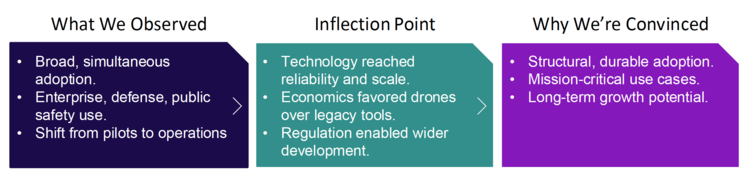
As far as building an investment case goes, Acheychek outlined the early origins of the drones industry beginning with military applications. Then came the early 2000s. That time period marked a big shift in the industry to commercial applications as technology became more advanced and efficient. Today, they’re “smaller, cheaper, and easier to use,” Acheychek noted.
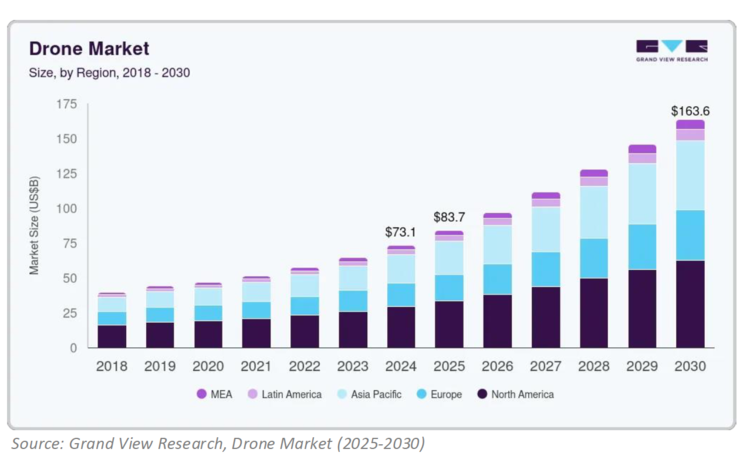
Acheychek went on to further explain that DRNZ was created to capture an industry with long-term growth potential versus one with a “single cycle opportunity.” How big can this market grow? The potential is immense — the global drone market is expected to exceed $163 billion by 2030.
Pure Play Exposure to Drones
So with an investment case in hand, it was time for REX Shares to build the product. REX Shares opted for a rules-based, indexed fund that captured the full spectrum of the drones industry. It chose not to narrow its focus to military applications which commonly use drone technology in modern warfare.
“This should be a pure-play drone ETF — bottom line,” Acheychek said. He noted that REX Shares wanted to encapsulate “the entire drone market” wrapped within the convenience, cost-efficiency, and flexibility of an ETF.
To accomplish all of the aforementioned objectives, REX Shares turned to VettaFi’s indexing team. The DRNZ ETF came to inception just before the end of October. Per its baseline fund description, DRNZ tracks the VettaFi Drone Index. That index provides global exposure by adding constituents that utilize drones and unmanned aerial vehicles (UAVs) in military reconnaissance. Fund holdings include companies focused on commercial delivery, agriculture, infrastructure inspection, and AI-enabled industrial automation.
The index scope uses two buckets:
- Pure play: companies with strictly drone-related revenue (equal to or greater than 50%) comprising 80% of the fund (with an allocation cap of 15% per constituent); and
- Diversified: companies that derive a portion of their revenue (equal to or greater than 20%) from drones or a defense company with dedicated drone research & development (with an allocation cap of 5% per constituent).
DRNZ Holdings of Note
Some of the notable holdings Acheychek outlined in the webinar:
- Draganfly: Canada-based, designs and manufactures advanced unmanned aerial tech;
- AeroVironment: U.S.-based, builds military drones for defense applications;
- EHang Holdings: China-based, focused on passenger drones; and
- Droneshield: Australia-based, focused on protecting airspace and critical infrastructure.
As cited by Rosenbluth, a common theme around these holdings is the global diversification. It’s one of the key aspects of this fund, giving investors exposure to global opportunities as opposed to a smaller geographic slice.
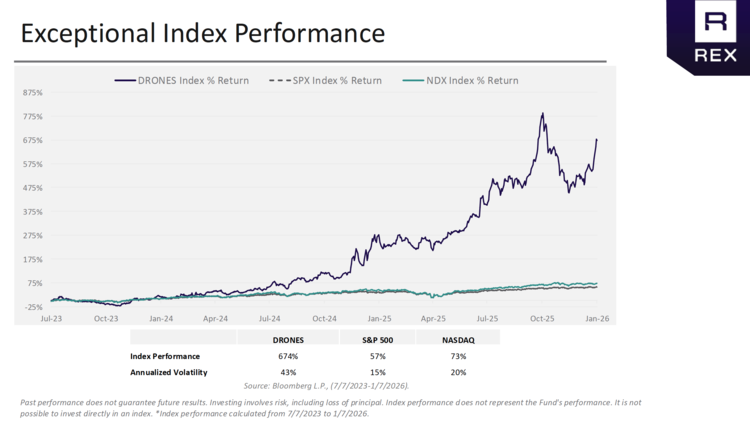
As shown in a chart by Acheychek, DRNZ index is already exhibiting exceptional performance since its inception late last year:
Where Does It Fit in a Portfolio?
Thematic funds typically occupy a satellite allocation in a portfolio that would complement traditional growth exposure. Overall, these funds meld the opportunity for profitability along with topical themes that may pique an investor’s interests. Webinar attendees noted that the average percentage of thematic ETFs in a client portfolio is between 3% to 5%.
“Most advisors carve out a small sleeve,” Acheychek said. He confirmed that DRNZ could be used as a thematic, satellite allocation. DRNZ exposes investors to a wide range of market cap sizes. Thus, tempered exposure is ideal to limit the inherent volatility that can come with small-cap equities.
Overall, DRNZ is able to give investors the opportunity to replace single-stock holdings within the industry for more diversified exposure to the entire sector. Acheychek mentioned that “access” to the industry and a “thoughtful index design” help to make DRNZ a unique product offering in a nascent drones ETF marketplace.
“DRNZ is a disciplined, rules-based access product in a difficult-to-replicate niche,” Acheychek said. That aligns with the REX Shares philosophy of offering unique ETF products to the general investing populace.
Click here for more information on DRNZ.
For more news, information, and analysis, visit The Thematic Investing Content Hub.
vettafi.com is owned by VettaFi LLC (“VettaFi”). VettaFi is the index provider for DRNZ, for which it receives an index licensing fee. However, DRNZ is not issued, sponsored, endorsed, or sold by VettaFi, and VettaFi has no obligation or liability in connection with the issuance, administration, marketing, or trading of DRNZ.

