ETFdb Logo
  • ETF Database
  • Content Hubs
    • Themes
      • Active ETF
      • Alternatives
      • Artificial Intelligence
      • China Insights
      • Core Strategies
      • Crypto
      • Disruptive Technology
      • Energy Infrastructure
      • ETF Building Blocks
      • ETF Investing
      • ETF Strategist
      • Financial Literacy
      • Fixed Income
      • Free Cash Flow
      • Future ETFs
      • Innovative ETFs
      • Institutional Income Strategies
      • Leveraged & Inverse
      • Market Insights
      • Market Outlooks
      • Modern Alpha
      • Nuclear Energy
      • Portfolio Strategies
      • Sector Investing
      • Tax Efficient Income
      • Thematic Investing
    • Asset Class
      • Equity
        • U.S. Equity
        • Int'l Developed
        • Emerging Market Equities
      • Alternatives
        • Gold/Silver/Critical Materials
        • Cryptocurrency
        • Currency
        • Volatility
      • Fixed Income
        • Investment Grade Corporates
        • US Treasuries & TIPS
        • High Yield Corporates
        • Int'l Fixed Income
    • ETF Ecosystem
    • ETFs in Canada
    • Market Outlook
    • Crypto ETF Hub
  • Tools
    • ETF Screener
    • ETF Country Exposure Tool
    • ETF Database Categories
    • Indexes
    • Scenario Analysis
    • Watchlists
    • Head-To-Head ETF Comparison Tool
    • Mutual Fund To ETF Converter
    • ETF Stock Exposure Tool
    • ETF Issuer Fund Flows
  • Research
    • ETF Education
    • Equity Investing
    • Dividend ETFs
    • Leveraged ETFs
    • Inverse ETFs
    • Index Education
    • Index Insights
    • Top ETF Sectors
    • Top ETF Issuers
    • Top ETF Industries
  • Webcasts
  • Sectors
    • Sector Investing Content Hub
    • XLK
    • XLI
    • XLU
    • XLY
    • XLP
    • XLRE
    • Sector Power Rankings
    • XLE
    • XLC
    • XLF
    • XLV
    • XLB
  • Multimedia
    • ETF 360 Video Series
    • ETF of the Week Podcast
    • Gaining Perspective Podcast
    • ETF Prime Podcast
    • Video
  • Company
    • About VettaFi
  • PRO
    • Pro Content
    • Pro Tools
    • Advanced
    • FAQ
    • Free sign up
    • Login
  1. Thematic Investing Content Hub
  2. Grab Multi-Factor Exposure with Just One ETF
Thematic Investing Content Hub
Share

Grab Multi-Factor Exposure with Just One ETF

Ben HernandezJun 07, 2021
2021-06-07

Adjusting a portfolio in order to tilt towards the favored factors in a given market environment doesn’t have to be a trying task with assets like the Global X Adaptive U.S. Factor ETF (AUSF A).

Whether it’s tilting a portfolio towards value, capturing momentum, or stifling volatility, AUSF has ETF investors covered. Furthermore, AUSF comes with a low expense ratio of 0.27%.

AUSF seeks to provide investment results that correspond generally to the price and yield performance of the Adaptive Wealth Strategies U.S. Factor Index. The fund invests at least 80% of its total assets in the securities of the index. Its 80% investment policy is non-fundamental and requires 60 days prior written notice to shareholders before it can be changed.

The index is designed to dynamically allocate across three sub-indices that provide exposure to U.S. equities that exhibit characteristics of one of three primary factors: value, momentum, and low volatility. AUSF provides investors with:

  • Outperformance Potential: AUSF seeks to outperform traditional market capitalization weighted indices by allocating across three factors that have historically demonstrated advantages compared to broad benchmark indices. AUSF is up 48% within the past year.
  • Dynamic Factor Allocation: AUSF either allocates to two factors with a 50%/50% weighting, or all three factors with a weighting of 40%/40%/20%, depending on the trailing returns of each factor.
  • Tax Efficiency: Dynamically allocating across multiple factors within one ETF can result in tax efficiencies compared to buying and selling individual factor ETFs.
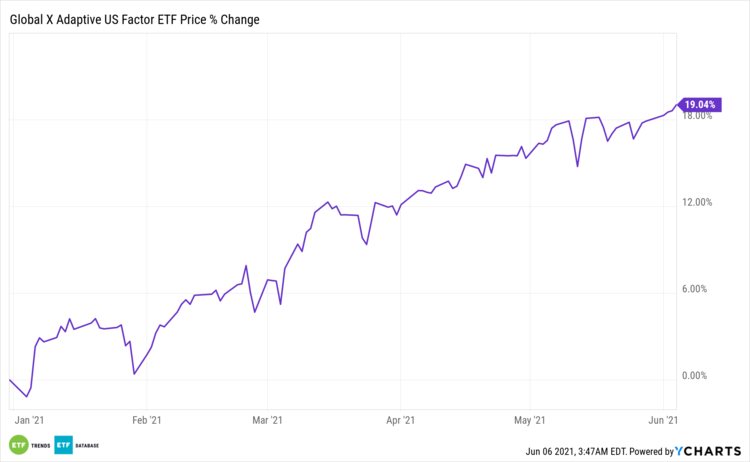
AUSF Performance Figures

An Auspicious Time for a Multi-Factor Strategy

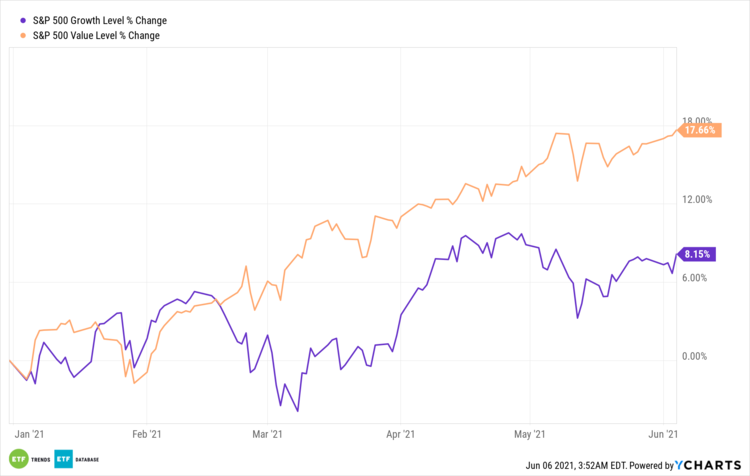
The common narrative thus far this year has been the strength of value versus growth. It could be an auspicious time for a multi-factor strategy as the S&P 500 Value Index is up over the comparable growth index by almost 10%.

“Multi-factor strategies tend to do particularly well in periods of value spread compression,” an Investor’s Corner article said. “They can also do well in periods of value spread expansion, in particular when based on the more robust sector and beta-neutral factor styles, but still do less well than in spread compression periods.”

“It is interesting to notice that investing in the best single raw factor with a perfect foresight timing strategy based on the value spread would have barely outperformed the more diversified multi-factor composites,” the article added.

Content continues below advertisement

S&P 500 Growth vs Value

For more news and information, visit the Thematic Investing Channel.

Loading Articles...

Advertisement

Is Your Portfolio Positioned With Enough Global Exposure?

ETF Education Channel

How to Allocate Commodities in Portfolios

Tom LydonApr 26, 2022
2022-04-26

A long-running debate in asset allocation circles is how much of a portfolio an investor should...

Core Strategies Channel

Why ETFs Experience Limit Up/Down Protections

Karrie GordonMay 13, 2022
2022-05-13

In a digital age where information moves in milliseconds and millions of participants can transact...

}
X
