


Exactly 10 years ago, the Amplify Online Retail ETF (IBUY ) debuted, marking a decade since its inception gave investors concentrated exposure to digital commerce. In 2016, IBUY established the notion that retail was becoming more of a technology story.
Today, the fund is still a compelling option for growth exposure to the structural shift in global consumption habits. Online retail has matured, but the advent of AI shows that the sub-sector is still a rapidly evolving space. It is one that IBUY is poised to capture.
Key Takeaways
- IBUY maintains a more concentrated profile than broad retail funds, with an effective holdings ratio of 0.60. By allocating over 32% of the fund to its top 10 names, it ensures that high-conviction picks like Figs and Carvana significantly drive total returns.
- Unlike competitors heavily dominated by single mega-cap stocks, IBUY utilizes a modified equal-weight strategy. This prevents over-concentration in giants like Amazon, allowing investors to capture a broader range of emerging acorn to oak growth stories across the global digital landscape.
- By focusing on pure-play digital firms rather than stagnant brick-and-mortar retailers, IBUY captures the ongoing technological evolution of the consumer experience.
A Decade of Retail Disruption
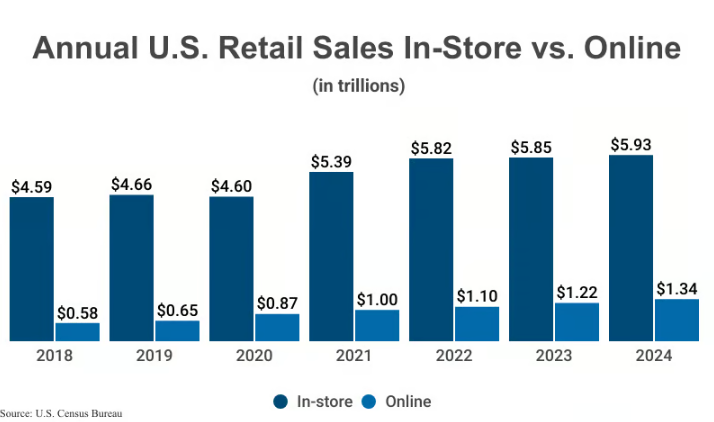
10 years ago, e-commerce was still in its nascent stages. While the 2020 pandemic certainly helped to spur growth, online sales haven’t tapered since. According to data from Capital One, annual U.S. retail sales online have risen since 2018, culminating in Americans spending $1.34 trillion online in 2024.
Over the past 10 years, IBUY has evolved alongside the online retail industry as the retail apocalypse continues to see the closure of physical stores. The fund’s portfolio is no longer about shipping packages, but the complete digitization of the consumer experience. In totality, IBUY encompasses the following :
- Traditional E-Commerce: Global marketplaces and direct-to-consumer brands.
- Online Services: Travel booking, ride-sharing, and digital lodging.
- Online Delivery: Food and grocery delivery platforms that have become household utilities.
A Modified Equal Weight Strategy
Powering IBUY is the EQM Online Retail Index. It’s comprised of a globally diverse basket of publicly-traded companies. These companies derive a sizeable portion of their revenue from online retail. As mentioned, this subset includes traditional online retail, online travel, online marketplace, and omni channel retail.
The fund employs a modified equal-weighting methodology. Unlike market-cap-weighted strategies that can become over-concentrated in online retail giants like Amazon, IBUY takes a more diversified approach. As a result, it gives investors exposure to all market cap sizes as well as global exposure. As such, its portfolio will contain movers and shakers in the online retail industry alongside less recognizable names that could be the next acorn to oak story.
Here are its top five holdings (as of 4/20/26):
- Figs Inc (FIGS) – 5.28% weight: As the fund’s top allocation, Figs has disrupted the healthcare apparel industry with its direct-to-consumer model that prioritizes brand loyalty in tandem with high-margin recurring revenue.
- Liquidity Services Inc (LQDT) – 3.59% weight: Liquidity Services is a vital player in the e-commerce ecosystem, and operates the world’s largest B2B e-commerce marketplace for surplus assets such as GovDeals and Liquidation.com.
- eBay Inc (EBAY) – 3.20% weight: This online retail pioneer remains a cornerstone of the fund, capturing the company’s shift towards enthusiast categories like luxury watches and trading cards.
- Carvana Co (CVNA) – 3.10% weight: This online automotive retailer’s inclusion underscores the shift in consumer comfort toward purchasing high-ticket items like through virtual channels as opposed to brick-and-mortar dealers.
- Expedia Group Inc (EXPE) – 3.08% weight: This online travel retailer’s massive platform continues to capture digital booking for global travel over physical goods.
See More: IBUY Rebalances Ahead of Black Friday
Comparing XRT and ONLN
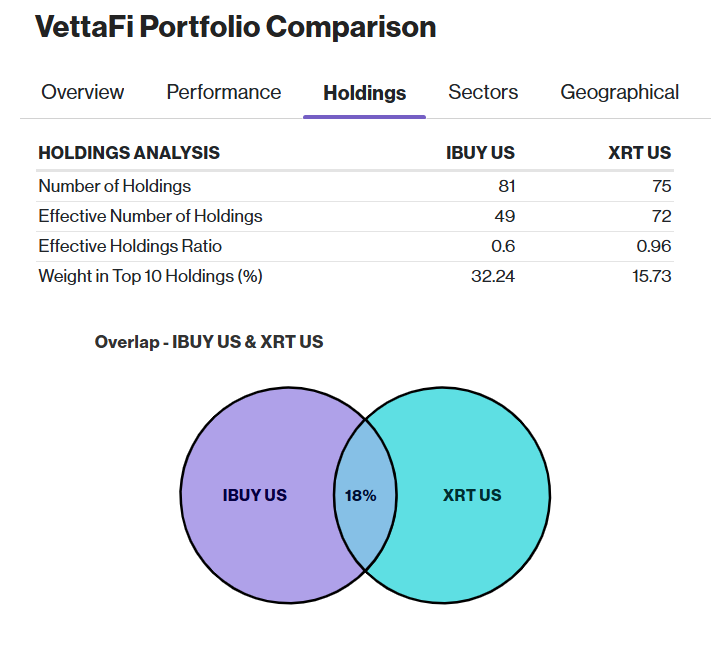
When IBUY is juxtaposed with a broader retail-focused ETF such as the State Street SPDR S&P Retail ETF (XRT ), the divergences in their holdings speak to the differences between the two funds. XRT is also a modified equal weight index. However, it sticks more closely to an even distribution mandate with its 0.96 Ratio effective holdings ratio.
On the other hand, IBUY’s effective holdings ratio is 0.60, making it more concentrated in specific names. The top 10 holdings in IBUY account for 32.2% of the total fund while in XRT, it’s only 15.7%. An example of this concentration disparity is Carvana. XRT holds a 1.67% weighting (as of 4/17/26) versus IBUY’s aforementioned 3.10%. This greater attribution allows upside in Carvana to have a more significant impact on IBUY.
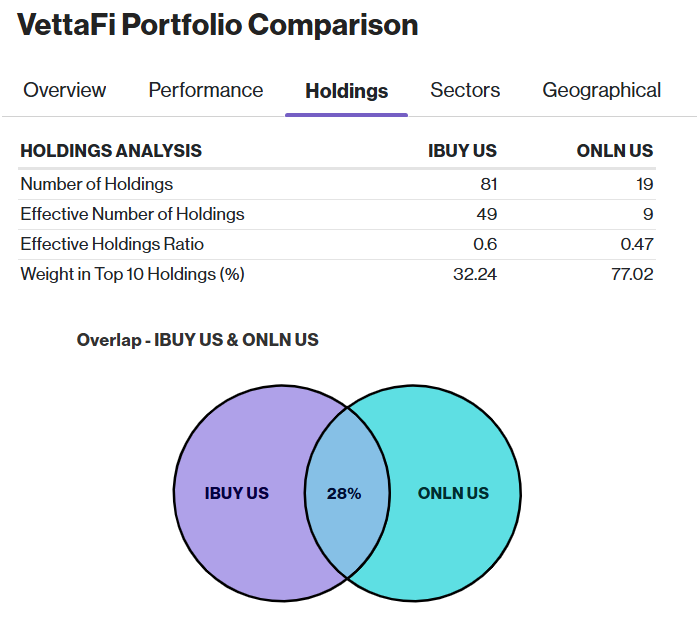
A more direct comparison to IBUY would be the ProShares Online Retail ETF (ONLN ). Despite the same focus on online retail, the holdings once again tell the tale of two different funds. The overlap between the two is only 28%, highlighting the differentiation in their portfolios.
ONLN’s effective holdings ratio is 0.47 while its effective number of holdings is just nine. Furthermore, ONLN’s top 10 holdings comprise 77% of the fund compared to IBUY’s 32.2%. This indicates that a majority of the fund’s performance is driven by select names such as Amazon, which has about a 25% weighting in the fund. Conversely, IBUY’s effective number of holdings is 49, providing more balanced exposure while still maintaining a high-conviction profile compared to XRT.
The Next Era of Retail Growth: AI
As mentioned, the online retail space continues to evolve, and IBUY is uniquely positioned to capture this growth. With the age of AI in full swing, companies within IBUY’s current portfolio are leveraging AI to enhance operational efficiency in areas like inventory management, predictive logistics, and hyper-personalized shopping experiences.
10 years in, e-commerce has become an essential component in the retail industry. However, as mentioned, the space is rapidly evolving with AI permeating various facets of the industry. Given this, IBUY continues to provide investors with a pure-play growth engine that recognizes the future of commerce is increasingly conducted on a computing device.
For more news, information, and analysis, visit The Thematic Investing Content Hub.
vettafi.com owned by VettaFi LLC (“VettaFi”). VettaFi is the index provider for IBUY, for which it receives an index licensing fee. However, IBUY is not issued, sponsored, endorsed, or sold by VettaFi, and VettaFi has no obligation or liability in connection with the issuance, administration, marketing, or trading of IBUY.

