


Cannabis stocks have seen renewed investor interest as federal policy momentum improves. The most important recent development was the placement of FDA-approved marijuana products and state-regulated medical marijuana products from Schedule I to Schedule III under the Controlled Substances Act. Schedule III drugs are considered to have a lower abuse potential than Schedule I or II drugs, although they still remain controlled substances. This does not mean full federal legalization, but could have improved accounting/tax benefits and increased access to capital for cannabis operators. Investors and advisors who want to take advantage of potential regulatory upside may find it easiest to invest through ETFs. Here’s what you need to know.
Regulation Still Drives the Cannabis Trade
Cannabis equities remain highly sensitive to regulatory news. This is partly because federal law still creates unusual constraints around banking, taxes, exchange listings, custody, and institutional access. As a result, cannabis stocks often trade less on traditional fundamentals alone and more on changes in perceived policy. For more background on the regulatory environment, see my colleague Jane Edmondson’s most recent note on the topic.
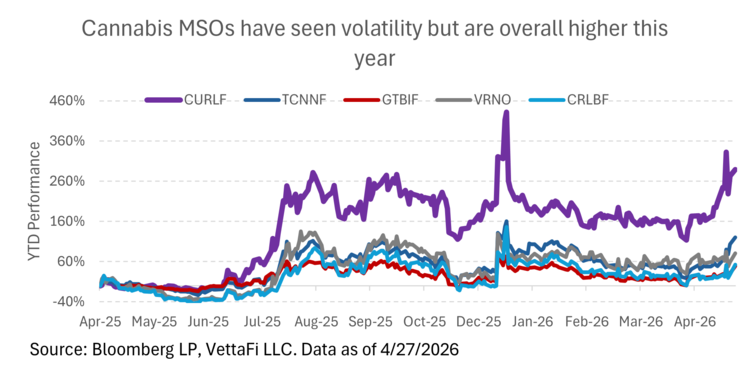
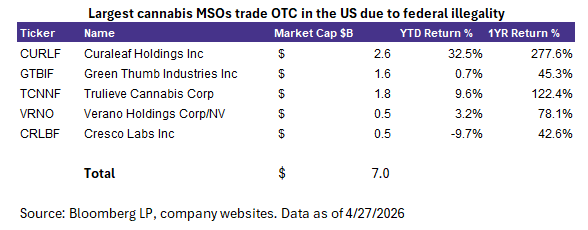
Over the past year, the performance of the five major multi-state operators (MSOs) fluctuated from in the double-digit negative range to up over 100%. But overall performance has been positive. The largest, Curaleaf Holdings Inc (CURLF) has $2.6 billion in market capitalization and has been up 33% year-to-date (over 277% in the past year). Another large MSO, Trulieve Cannabis Corp (TCNNF) has been up around 10% YTD (over 122% in the past year).
U.S. Cannabis Exposure Is Still Difficult to Access Directly
The cannabis industry’s unusual market structure is one reason ETFs have remained relevant. Many of the largest U.S. cannabis companies are MSOs that operate in state-legal cannabis markets. But because marijuana has remained federally restricted, many U.S. MSOs have not been able to list on major U.S. exchanges.
Instead, several U.S. cannabis companies trade over the counter in the U.S. and on Canadian exchanges. Curaleaf, for example, began trading on the Toronto Stock Exchange under the ticker CURA in December 2023, while continuing to trade OTCQX in the U.S. under CURLF. Trading on the TSX allows the company greater liquidity, access to a wider range of investors, and eligibility in equity indexes.
U.S.-listed cannabis ETFs can hold these Canadian-listed stocks, but otherwise have to invest in U.S. cannabis stocks through swaps (see AdvisorShares education on swaps).
The Number of ETFs Has Dwindled, But Some Strong Players Remain
ETF opportunities have grown narrower with more closures than existing ETFs. Recent closures include the AXS Cannabis ETF (THCX), the Global X Cannabis ETF (POTX), and the recently liquidated Cambria Cannabis ETF (TOKE). Currently, three issuers dominate the space: AdvisorShares, Amplify, and Roundhill.
AdvisorShares: MSOS, YOLO, MSOX
AdvisorShares leads with over $1 billion in assets among its ETFs, including MSOS, YOLO, and MSOX. The AdvisorShares Pure US Cannabis ETF MSOS) is broader than MSOS and includes a wider range of cannabis-related holdings, including Canadian companies and other parts of the cannabis ecosystem. These include Village Farms (VFF), High Tide (HITI), and Charlotte’s Web Holdings (CWEB). Notably, YOLO holds 55% of its weight in MSOS.
And AdvisorShares also offers a 2x daily leveraged ETF on its own MSOS — the AdvisorShares MSOS Daily Leveraged ETF (MSOX ). This ETF is intended for sophisticated investors looking to gain magnified exposure to the U.S. cannabis sector.
Amplify: MJ, CNBS
Amplify offers two ETFs in the space. The Amplify Seymour Cannabis ETF (CNBS ) is actively managed by experienced investor and portfolio manager Tim Seymour. Relative to peers like MSOS, this fund offers broader exposure across the U.S. cannabis ecosystem including cannabis/hemp plants, support (e.g., agricultural tech, real estate, commercial services), and ancillary businesses (e.g., consumption devices, investing & finance, tech & media). As of March 2026, the fund has almost 60% of its weight allocated to MSOs.
The Amplify Alternative Harvest ETF (MJ ) is an indexed ETF that tracks the total return performance of the Prime Alternative Harvest Index. It holds over 50% of its weight in the CNBS ETF, and the remaining amount is allocated toward companies within the cannabis ecosystem benefitting from global medicine and recreational cannabis legalization initiatives, including Tilray Brands (TLRY), Cronos Group (CRON), and Canopy Growth Corp (CGC). It does not currently hold swaps (although it holds them indirectly through its exposure to CNBS). This ETF was acquired as part of Amplify’s 2024 acquisition of ETF Managers Group (ETFG) ETF assets.
Roundhill: WEED
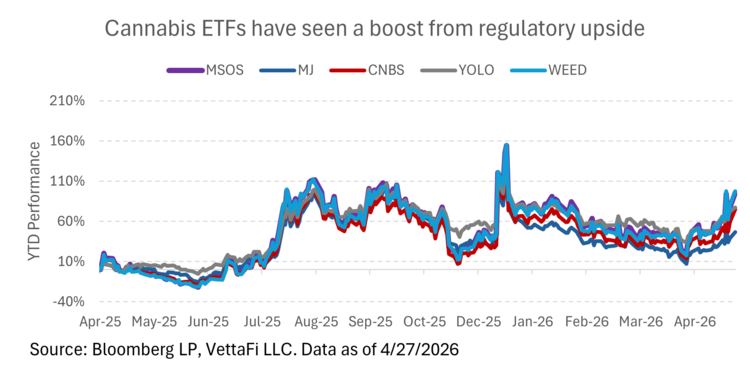
The Roundhill Cannabis ETF (WEED ) is the newest of the group, although it has been around since 2022. Also actively managed, this fund takes a simple and straightforward approach of allocating to the five largest MSOs. WEED has been the best performing out of its peers recently, due to that focus on the U.S. regulatory story. Interestingly, this fund has also waived its fee until at least May 1, 2026. Its post-waiver fee would be 41 basis points, which is significantly lower than most of its peers.
Bottom Line:
Cannabis ETFs remain a narrow but differentiated thematic play on regulatory upside. Rescheduling does not equal federal legalization, but it could improve the operating backdrop for U.S. cannabis companies by reducing tax burdens and potentially broadening investor access over time.
For more news, information, and analysis, visit The Thematic Investing Content Hub.
VettaFi LLC (“VettaFi”) is the index provider for CNBS, for which it receives an index licensing fee. However, CNBS is not issued, sponsored, endorsed, or sold by VettaFi, and VettaFi has no obligation or liability in connection with the issuance, administration, marketing, or trading of CNBS.

