ETFdb Logo
  • ETF Database
  • Content Hubs
    • Themes
      • Active ETF
      • Alternatives
      • Artificial Intelligence
      • China Insights
      • Core Strategies
      • Crypto
      • Disruptive Technology
      • Energy Infrastructure
      • ETF Building Blocks
      • ETF Investing
      • ETF Strategist
      • Financial Literacy
      • Fixed Income
      • Free Cash Flow
      • Future ETFs
      • Innovative ETFs
      • Institutional Income Strategies
      • Leveraged & Inverse
      • Market Insights
      • Market Outlooks
      • Modern Alpha
      • Nuclear Energy
      • Portfolio Strategies
      • Sector Investing
      • Tax Efficient Income
      • Thematic Investing
    • Asset Class
      • Equity
        • U.S. Equity
        • Int'l Developed
        • Emerging Market Equities
      • Alternatives
        • Gold/Silver/Critical Materials
        • Cryptocurrency
        • Currency
        • Volatility
      • Fixed Income
        • Investment Grade Corporates
        • US Treasuries & TIPS
        • High Yield Corporates
        • Int'l Fixed Income
    • ETF Ecosystem
    • ETFs in Canada
    • Market Outlook
    • Crypto ETF Hub
  • Tools
    • ETF Screener
    • ETF Country Exposure Tool
    • ETF Database Categories
    • Indexes
    • Scenario Analysis
    • Watchlists
    • Head-To-Head ETF Comparison Tool
    • Mutual Fund To ETF Converter
    • ETF Stock Exposure Tool
    • ETF Issuer Fund Flows
  • Research
    • ETF Education
    • Equity Investing
    • Dividend ETFs
    • Leveraged ETFs
    • Inverse ETFs
    • Index Education
    • Index Insights
    • Top ETF Sectors
    • Top ETF Issuers
    • Top ETF Industries
  • Webcasts
  • Sectors
    • Sector Investing Content Hub
    • XLK
    • XLI
    • XLU
    • XLY
    • XLP
    • XLRE
    • Sector Power Rankings
    • XLE
    • XLC
    • XLF
    • XLV
    • XLB
  • Multimedia
    • ETF 360 Video Series
    • ETF of the Week Podcast
    • Gaining Perspective Podcast
    • ETF Prime Podcast
    • Video
  • Company
    • About VettaFi
  • PRO
    • Pro Content
    • Pro Tools
    • Advanced
    • FAQ
    • Free sign up
    • Login
  1. Index Insights
  2. Midstream Credit Ratings: Making the (Investment) Grade
Index Insights
Share

Midstream Credit Ratings: Making the (Investment) Grade

Stacey Morris, CFAMar 25, 2019
2019-03-25

Summary 

  • Midstream companies are focused on preserving or attaining investment-grade credit ratings in order to secure lower borrowing costs when building projects.
  • Many midstream companies boast investment-grade credit ratings based on the constituents of our AMNA Index, a broad composite of North American midstream companies.
  • Alerian’s midstream indices are heavily weighted towards names with investment-grade credit ratings.

Midstream credit ratings are a recurring topic in Alerian Insights (2017, 2016, 2015 3-part series) — not because we’re too lazy to think of new topics (OK, that may be a small part of the reason) — but because credit ratings are important for midstream companies as prolific project builders. Often, midstream projects are financed with 50% debt. A better credit rating means cheaper debt and better project returns, hence the desirability of investment-grade credit ratings for midstream companies.

In this piece, we’ll look at credit ratings for the 59 constituents of the Alerian Midstream Energy Index (AMNA), a broad-based composite of North American energy infrastructure companies. We’ll also look at the investment-grade weightings for five of our midstream indices. Before we get into those details, we’ll briefly revisit why credit ratings matter.

What is the value of an investment-grade rating?
For midstream companies, an investment-grade credit rating is not just a feather in the cap or a perceived stamp of approval from a rating agency. Rather, an investment-grade credit rating means saving cash. For example, Andeavor Logistics (ANDX) anticipated more than $25 million in savings for annual interest costs as a result of refinancing its debt in late 2017 after achieving an investment-grade rating. Tallgrass Energy (TGE) and Rockies Express Pipeline LLC received investment-grade credit ratings from Fitch in September, and TGE noted in its October presentation that a potential improvement to its credit rating would reduce its cost of debt. TGE also stated in the presentation that S&P had recently revised its outlook to positive watch. For midstream companies, preserving or attaining an investment-grade credit rating is clearly important.

Making the grade: midstream credit ratings and takeaways.
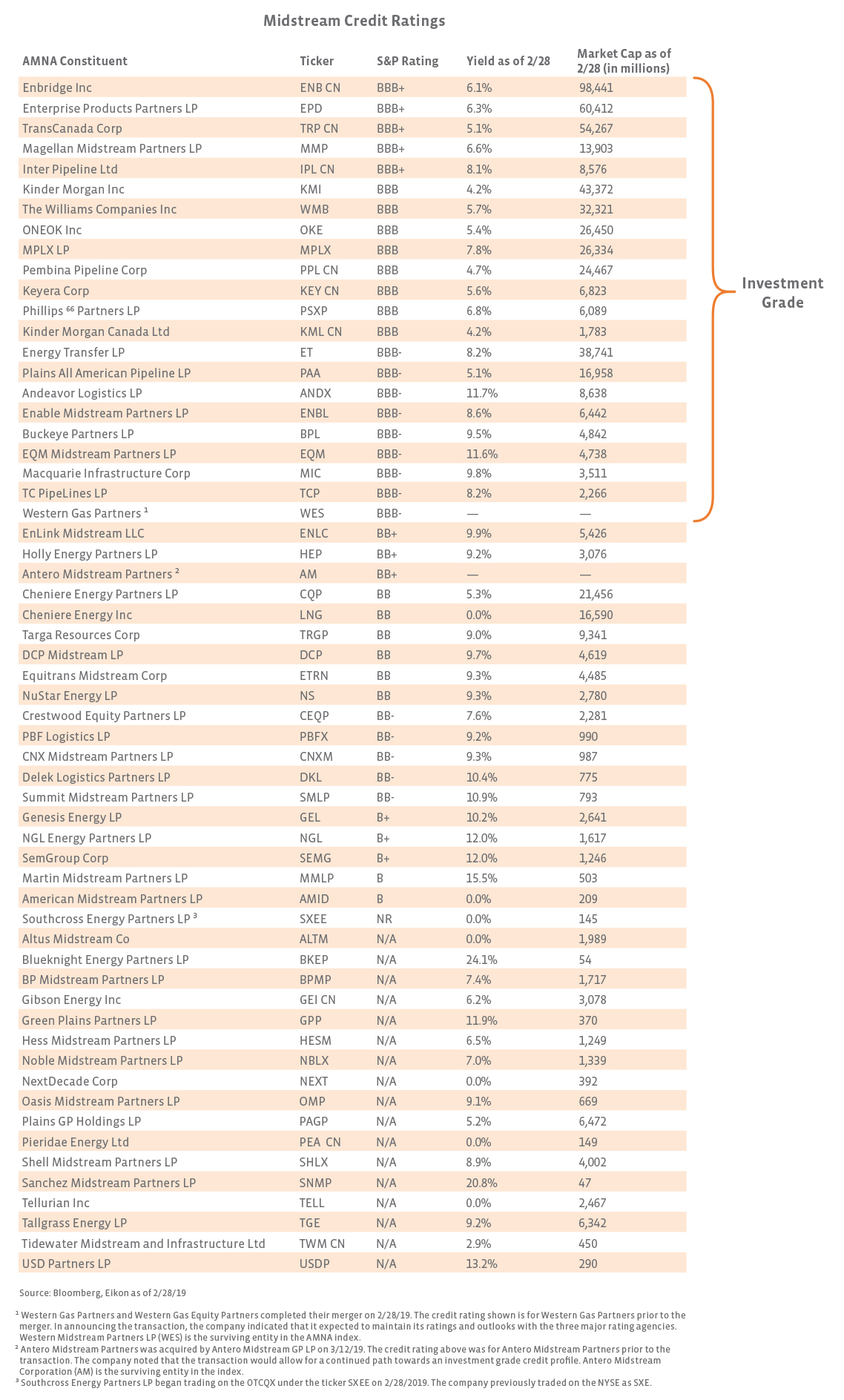
The table below includes S&P credit ratings for the midstream companies included in the AMNA index as well as yield and market capitalization. We focus on S&P ratings because those are used to determine the investment-grade weightings for our indices.

Of the 59 constituents in the AMNA index, 41 names have ratings from S&P. Of those 41 names with ratings, 22 companies have investment-grade ratings (BBB- or better). In other words, of the companies with ratings, more names have investment-grade ratings than below investment-grade ratings. The average market cap for investment-grade rated names is ~$23 billion, but the range is quite wide: from Enbridge (ENB) at $98 billion to TC PipeLines (TCP) with a market cap below $2.3 billion. One would expect investment-grade companies to have lower yields (cheaper equity). The average yield for investment-grade names was 7.1% as of February 28 compared to an average yield of 9.9% for those names with ratings below investment grade and paying a dividend. There is a wide range of yields and market caps among the names without S&P ratings, which include TGE despite its investment-grade rating from Fitch and Plains GP Holdings (PAGP), although Plains All American (PAA) has an investment-grade rating.

This is the image alt text

What is the investment-grade weighting in Alerian indices?
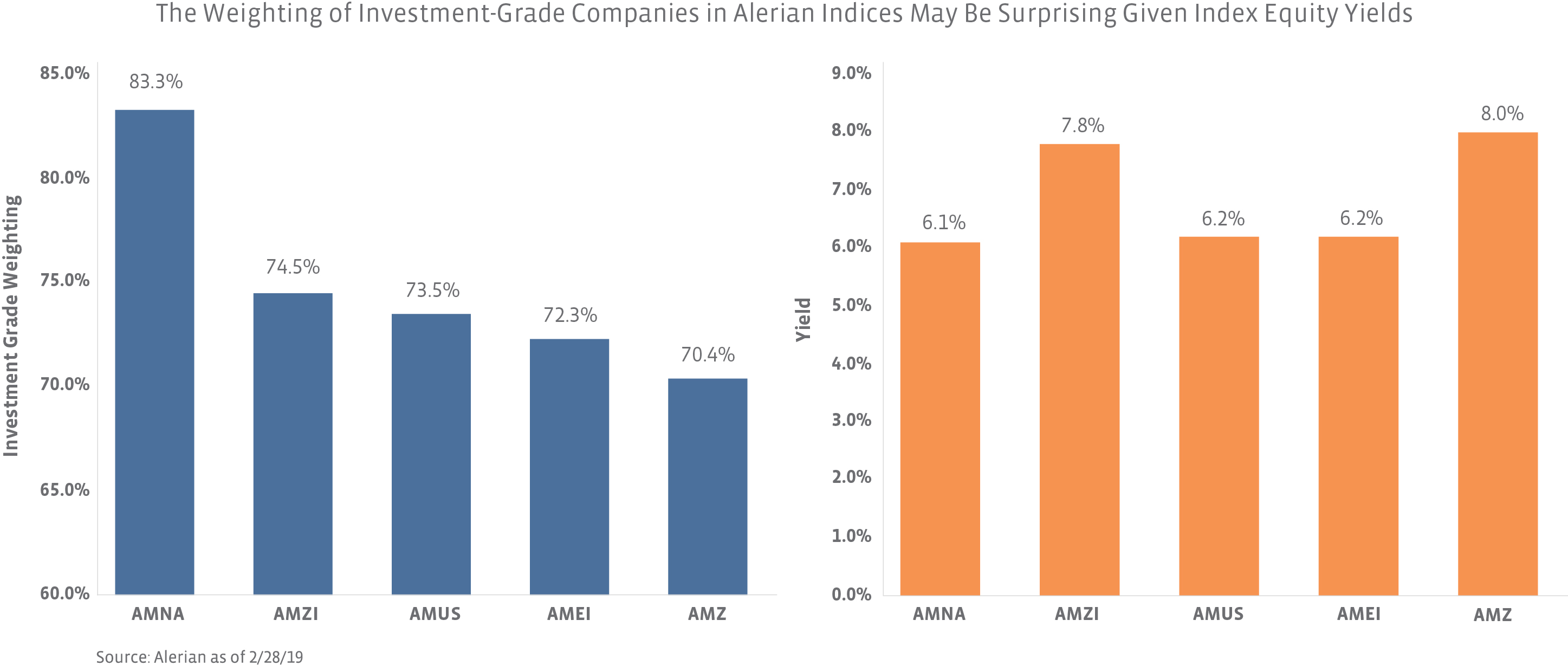
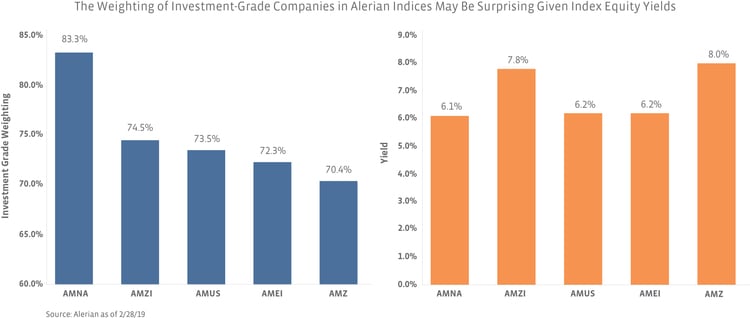
The chart below shows the weighting of constituents with investment-grade credit ratings from S&P in five of our midstream indices. Given midstream equity yields shown in orange below, investors may expect lower credit quality for the sector than is the case. One factor in the heavy weighting of investment-grade companies for midstream is the barbell nature of market capitalizations in this space. The indices below are weighted by float-adjusted market capitalization with a 10% cap. As an example, seven companies of the 59 constituents in the AMNA Index account for almost three-fourths of the investment-grade weighting for the index.

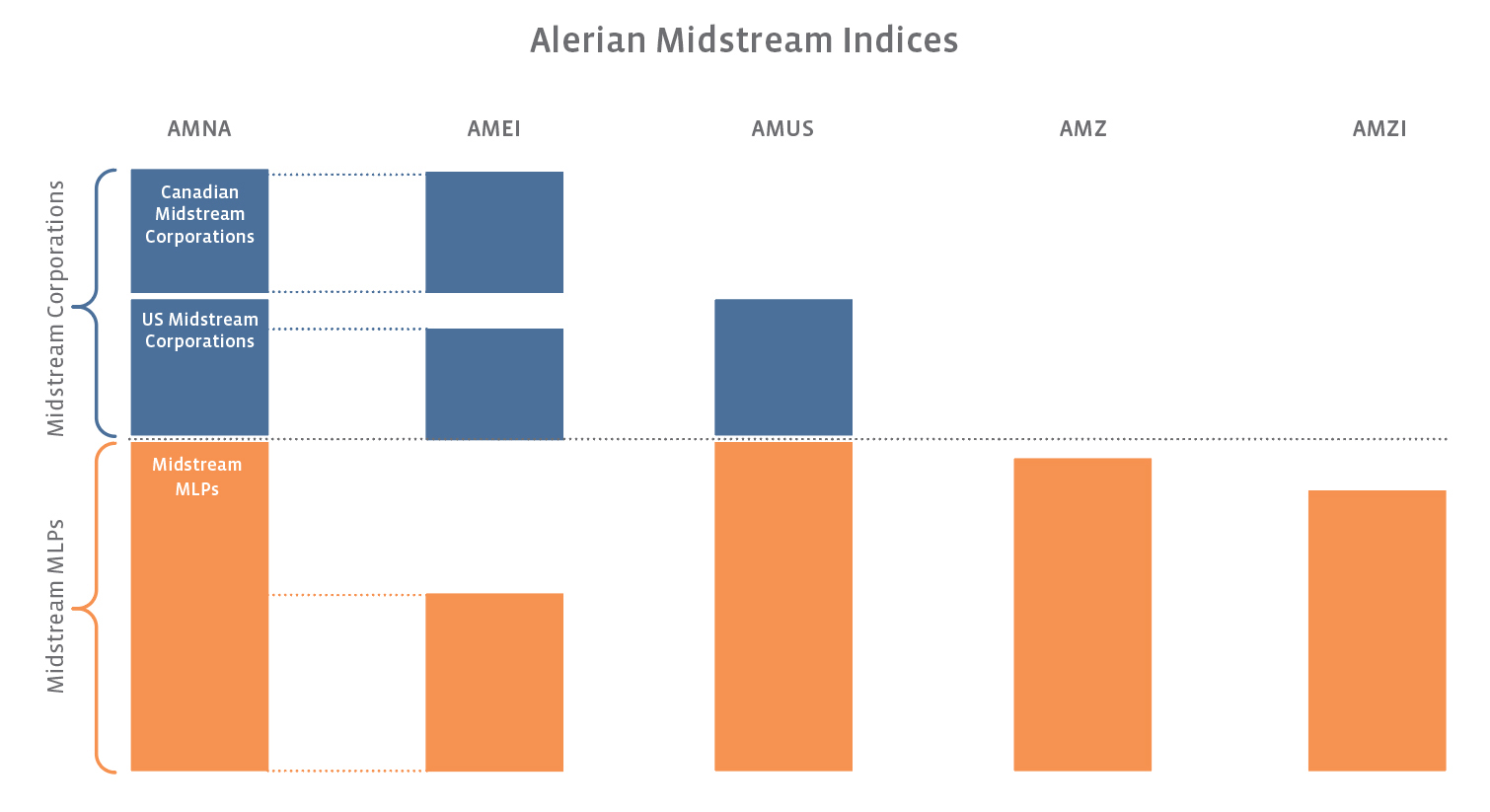
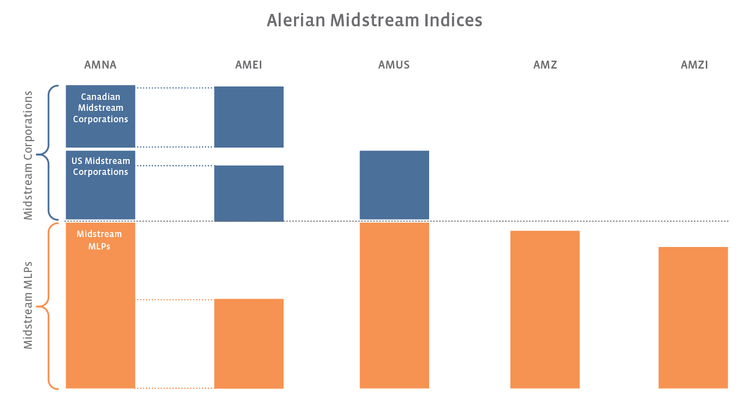
As shown in the chart below, AMNA, our composite midstream index, has the highest weighting of investment-grade companies at 83.3%, followed by the Alerian MLP Infrastructure Index (AMZI), which includes energy infrastructure MLPs. The Alerian US Midstream Energy Index (AMUS) is similar to AMNA but only includes US energy infrastructure companies. Finally, the Alerian Midstream Energy Select Index (AMEI) is the investable version of the AMNA Index. AMEI caps MLPs at 25% and includes a liquidity requirement. The Alerian MLP Index (AMZ) has the lowest investment-grade weighting at 70.4%. The AMZ consists of energy infrastructure MLPs but is broader than the AMZI (the AMZ has twelve more constituents). One may expect that the index with the highest investment-grade weighting (AMNA) has the lowest yield, and the index with the lowest investment-grade weighting (AMZ) has the highest yield. For a helpful infographic distinguishing these five indices, please see the appendix to this piece.

Content continues below advertisement

This is the image alt text

Bottom line
Investment-grade credit ratings are important to midstream companies as a means to lower borrowing costs, which in turn supports better project returns. Midstream’s reliance on debt markets for financing growth projects and the barbell nature of market capitalizations result in a heavy weighting to investment-grade companies across our midstream indices.

Appendix

This is the image alt text


» Popular Pages

  • Tickers
  • Articles

Jun 22

Private Credit Offers Viable Yield Path as Rates Stay Elevated

Jun 22

Franklin Files for Bitcoin-Integrated Dividend ETFs

Jun 22

Managing Exposure to International Equity ETFs Amid UK Political Shifts

Jun 22

Physical AI & Global Reshoring Beyond the Humanoid Hype

Jun 22

Gaming ETF GAMR Adds Arcade Gaming Giant to Portfolio

Jun 22

Weekly Economic Snapshot: A Hawkish Hold in a High-Stakes Market

Jun 22

Calamos Flagship Autocallable ETF Passes $1 Billion in AUM

Jun 22

T. Rowe Price Makes the Midyear Case for Small-Caps

Jun 22

Why SanDisk (SNDK) Is GFLW's Top Holding

Jun 22

The Qs Shift Gears: Nasdaq 100 Rebalances While SpaceX Looms

QQQ

Invesco QQQ Trust Series I

VOO

Vanguard S&P 500 ETF

GLD

SPDR Gold Shares

PPLT

abrdn Physical Platinum...

SIVR

abrdn Physical Silver Shares...

FOTO

Tuttle Capital Pure Play...

SMH

VanEck Semiconductor ETF

DRAM

Roundhill Memory ETF

SCHD

Schwab US Dividend Equity ETF...

IVV

iShares Core S&P 500 ETF

Loading Articles...

Advertisement

Is Your Portfolio Positioned With Enough Global Exposure?

ETF Education Channel

How to Allocate Commodities in Portfolios

Tom LydonApr 26, 2022
2022-04-26

A long-running debate in asset allocation circles is how much of a portfolio an investor should...

Core Strategies Channel

Why ETFs Experience Limit Up/Down Protections

Karrie GordonMay 13, 2022
2022-05-13

In a digital age where information moves in milliseconds and millions of participants can transact...

}
X